Key points
- Germany has reaffirmed its commitment to strengthening energy cooperation with Nigeria.
- German Foreign Minister Johann Wadephul described Nigeria as a strategic and reliable energy supplier to Europe.
- Germany plans to expand collaboration in renewable energy while supporting Nigeria’s gas development.
- German businesses also identified opportunities for increased investment in technology, digitalisation and infrastructure.
Main story
Germany has reaffirmed its commitment to strengthening energy cooperation with Nigeria, describing the country as a strategic and reliable energy supplier to Europe.
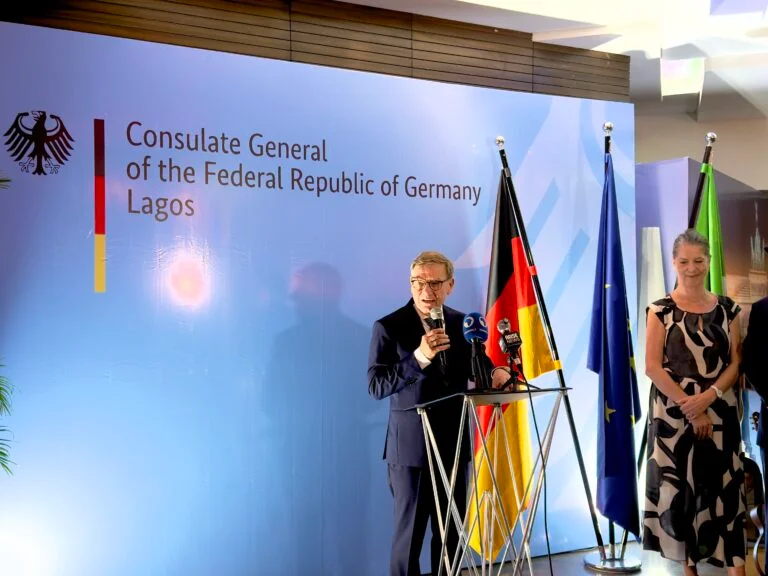
German Foreign Minister Johann Wadephul made the remarks on Tuesday night at a reception hosted by the German Consulate in Lagos during his official visit to Nigeria.
His visit, the third to Africa in 2026, began in Mauritania and will conclude in South Africa. He is scheduled to hold high-level bilateral talks with Nigeria’s Minister of Foreign Affairs, Amb. Bianca Odumegwu-Ojukwu, on Wednesday.
Wadephul said recent geopolitical tensions, particularly around the Strait of Hormuz, had highlighted Nigeria’s growing importance to Europe’s energy security.
According to him, petroleum imports from Nigeria in recent weeks helped offset supply disruptions in Europe.
He added that Nigeria had emerged as one of Europe’s leading jet fuel suppliers during the first half of 2026.
“Only in June, Nigeria covered 25 per cent of Europe’s jet fuel imports. This is a vivid testimony to the importance of our partnership bilaterally and for the whole of Europe,” he said.
The minister said Germany intended to build on the German-Nigerian Energy Partnership established in 2008 by expanding cooperation in renewable energy.
He added that German industries were ready to support Nigeria in reducing its carbon footprint by unlocking its vast natural gas resources while expanding renewable energy capacity.
Beyond energy, Wadephul commended Nigeria’s contribution to regional security through its participation in the Multinational Joint Task Force combating terrorism in the Lake Chad Basin.
He said Germany had supported Nigeria through military training, equipment and funding, including 120 million euros for the regional stabilisation fund for the Lake Chad region.
The minister, accompanied by a German business delegation, described trade and investment as key pillars of the bilateral relationship.
Earlier, Mr Christoph Wolfrum, Director of Economic and European Affairs at the German Foreign Ministry and Head of the Business Delegation, said Nigeria remained a country of significant economic potential.
He said both countries were already cooperating in energy supply, renewable energy and climate protection, while identifying information technology as another promising area for collaboration.
Also speaking, the Chief Executive Officer of Siemens for Sub-Saharan Africa and President of the German-Africa Business Association, Ms Sabine Dall’Omo, said German companies were interested in expanding partnerships with Nigerian firms in digitalisation, cybersecurity and technology.
She said Siemens had adopted a local partnership model for its electricity distribution business in Nigeria to strengthen local capacity and technology transfer.
Dall’Omo also said Nigeria’s removal from the Financial Action Task Force (FATF) grey list had improved investor confidence and could help reduce financing costs over time.
The issues
As Europe seeks to diversify its energy supply, Nigeria is positioning itself as a key supplier of both conventional and cleaner energy resources while attracting investment in renewable energy, technology and infrastructure.
What’s being said
“Only in June, Nigeria covered 25 per cent of Europe’s jet fuel imports. This is a vivid testimony to the importance of our partnership bilaterally and for the whole of Europe.” — Johann Wadephul, German Foreign Minister
What’s next
Nigeria and Germany are expected to deepen bilateral discussions on energy, trade, investment and technology, with renewed focus on renewable energy development, gas utilisation and private sector partnerships.
Bottom line
Germany’s renewed commitment reflects Nigeria’s growing importance in Europe’s energy strategy and signals broader opportunities for cooperation in clean energy, technology and investment.