KEY POINTS
- The Federal Government has denied plans to increase electricity tariffs, describing social media reports of a planned hike as misinformation.
- A 17.7MW hybrid solar mini-grid project with battery storage is expected to serve 22,597 customers across five community clusters in Oyo State.
- The project will cover communities in Akinyele, Ido, Ibadan North, Egbeda and Lagelu local government areas.
- The government says it plans to strengthen the national grid across three energy corridors to improve electricity supply.
MAIN STORY
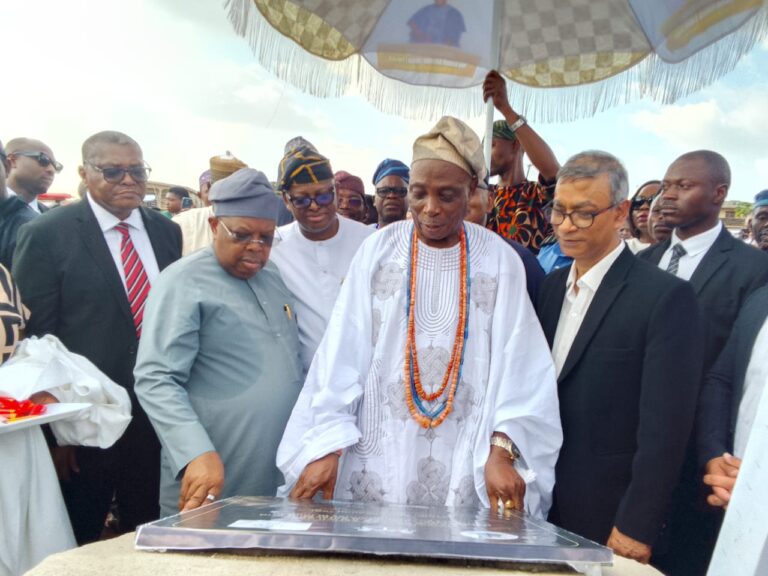
The Federal Government has ruled out plans to increase electricity tariffs, saying its priority is to improve power supply, as it launched a 17.7MW hybrid solar mini-grid project with battery storage for communities in Oyo State.
The Minister of Power, Joseph Tegbe, gave the assurance on Thursday in Ibadan while flagging off the project, dismissing reports circulating on social media that the government intended to raise electricity tariffs.
“I want to say this clearly and without ambiguity: there is no plan to increase electricity tariffs.
“What we are planning is a power sector that works round the clock,” he said.
Tegbe said the government’s commitment to more reliable electricity included developing three energy zones: the Lagos-Ogun corridor, the Abuja-Kaduna-Kano corridor, and the Benin-Enugu-Port Harcourt corridor.
He explained that the Oyo project would improve electricity supply to communities across Akinyele, Ido, Ibadan North, Egbeda and Lagelu local government areas. The interconnected mini-grid is expected to provide power to homes and businesses, reduce dependence on generators and create better conditions for investment and employment.
The project is being developed by Paras Energy and Natural Resources Development Limited, with the Ibadan Electricity Distribution Company (IBEDC) using its existing distribution infrastructure to integrate and deliver the electricity generated.
IBEDC Managing Director and Chief Executive Officer Deolu Ijose said the project would provide electricity to 22,597 customers across five community clusters: Bola, Jiboye, Molade-Adelubi, Ogo-Oluwa and Sooko-Elega.
He said the installation would comprise 17.7 megawatt-peak (MWp) of solar photovoltaic generation capacity supported by battery storage. The arrangement is intended to demonstrate how electricity distribution companies and private developers can collaborate to expand access to power.
Ijose added that the project builds on previous interventions by IBEDC, including the Mokoloki mini-grid in Ogun State and the recently commissioned Oke-Oyi mini-grid in Kwara State. He urged host communities to protect the infrastructure.
Providing details of the installations, the Managing Director and Chief Executive Officer of the Rural Electrification Agency (REA), Abba Abubakar-Aliyu, said Bola in Akinyele Local Government Area would receive 1.8MW of capacity, while Jiboye in Ido would receive 3.5MW.
Molade in Ibadan North would receive 6.9MW, Ogo-Oluwa in Egbeda 3.6MW, and Sooko in Lagelu 1.9MW.
The project forms part of wider efforts to improve electricity access beyond areas adequately served by conventional grid infrastructure. Tegbe said the Federal Government intended to build and strengthen the national grid across the eastern, western and central corridors as part of its ambition to extend round-the-clock electricity supply across Nigeria.
He commended President Bola Tinubu for his leadership under the Renewed Hope Agenda and acknowledged the support of the Olubadan of Ibadanland. He also thanked the REA, Paras Energy, the World Bank, IBEDC and the Oyo State Government for their contributions to the project.
The importance of extending electricity infrastructure to underserved communities was also highlighted by the Olubadan of Ibadanland, Oba Rashidi Ladoja, who praised the minister for including rural communities in power reform initiatives.
Ladoja urged the Oyo State Government to accelerate work on its ongoing hybrid power project and complete it before 2027 so residents could begin benefiting from more reliable electricity.
Representing Governor Seyi Makinde, the state Commissioner for Energy and Mineral Resources, Prof. Dahud Shangodoyin, said the state government would continue to pursue practical electricity interventions across Oyo State.
He said the state’s Hybrid Independent Power Project, designed to supply the state secretariat and other strategic public facilities, had a capacity of 11MW. The first 5MW phase was commissioned in 2024.
“Our wide agenda includes solar power for public facilities, rural electrification, mini-grids, as well as private sector-led generation and distribution.
“Therefore, no single technology can meet every need,” Makinde said.
The governor also urged the developer and implementing institutions to maintain clear construction and commissioning plans and comply with applicable licences and technical standards.
THE ISSUES
The tariff clarification comes as the government seeks to improve electricity supply through grid expansion and decentralised power projects. However, the launch of additional generation capacity does not, by itself, establish how consistently electricity will be delivered to customers or what they will pay for the service.
For the beneficiary communities, the project’s impact will depend on the successful integration of solar generation, battery storage and distribution infrastructure, as well as the reliability of operations after commissioning.
The initiative also illustrates the role of partnerships between public agencies, distribution companies, private developers and development institutions in extending electricity access to underserved areas.
WHAT’S BEING SAID
“I want to say this clearly and without ambiguity: there is no plan to increase electricity tariffs.” – Joseph Tegbe, Minister of Power
“What we are planning is a power sector that works round the clock.” – Joseph Tegbe, Minister of Power
“Our wide agenda includes solar power for public facilities, rural electrification, mini-grids, as well as private sector-led generation and distribution.” – Seyi Makinde, Oyo State Governor
WHAT’S NEXT
The project will need to move through implementation and commissioning before its expected benefits can be assessed in practice. The developer and implementing institutions have also been urged to comply with technical standards, while host communities have been asked to protect the infrastructure.
The Federal Government’s wider plans include strengthening the national grid across the three identified energy corridors, while the Oyo State Government is expected to continue work on its 11MW hybrid power project serving public facilities.
BOTTOM LINE
The Federal Government has denied plans to raise electricity tariffs while promoting a 17.7MW hybrid solar mini-grid project expected to serve 22,597 customers in Oyo State. The project’s significance will ultimately depend on whether the new infrastructure delivers reliable electricity to households and businesses across the five beneficiary clusters.