






…Weight-based shipping fees and FX pressures drive production push as Nigeria installs 803 MW despite cost barriers
Chinese manufacturers of solar inverters, batteries and panels are actively scouting Nigerian partners to establish local production facilities, responding to an import cost structure that industry players say is throttling what could be explosive market growth.
At the recently concluded Powerlec International Solar, Storage, Renewables, EV, Power and Electrical Exhibition at Landmark Event Centre Lagos, Chinese manufacturers went beyond displaying products – they were actively seeking investment partnerships to build local manufacturing capacity.
The push comes as Nigeria’s solar market faces a paradox: booming adoption alongside crushing import economics. While the country installed an estimated 803 megawatts of solar capacity in 2025, making it Africa’s second-largest solar market behind South Africa, the cost structure behind that growth tells a more complicated story.
“The companies that import for us charge us $13–15 per kilogram,” said Adewale Dauda, CEO of Holaf Solutions & Energy. “A kilo is like three sachets of pure water. You think about that, and it tells you how shipping economics works.”
Because shipping is priced by weight, importers prioritize lighter equipment to preserve margins. Once shipping, customs duties, port charges, agent fees, and foreign exchange costs are bundled together, effective import costs can reach around ₦1.5 million for a small batch of equipment – forcing sellers to price systems at ₦2.2–2.5 million just to cover costs.
“The report shows the scale of adoption,” Dauda said, referring to recent Global Solar Council data, “but what it does not show is the structure of costs behind it, and how that influences what gets sold and who can afford it.”
Why Manufacturers Are Looking at Nigeria Now
Molobe Obinna of 74Teletronics, an expert installer, said the manufacturing push wasn’t surprising given market realities. “Nigeria is heavily dependent on imports, which mainly come from China, but the increase on duty paid on solar products has shot up market prices, which is why they are now seeking partners to build production factories here in Nigeria to sustain and drive up the current adoption rate.”
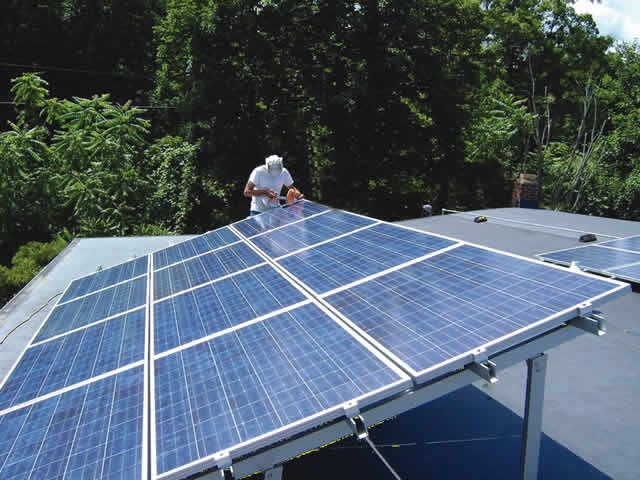
The economics driving household adoption are compelling. Across Lagos and beyond, rooftops are filling with solar panels as households and businesses tire of paying for unreliable power twice – once to the grid, and again for fuel to run backup generators.
A Lagos family in Ajah that adopted solar in September 2024 described their shift as pure economics. They had spent years buying fuel for petrol generators, sometimes more than ₦45,000 every three days when petrol approached ₦900 per litre.
“We went more than seven months without buying petrol,” a family member said. “That was the first time in years we did not need petrol at all.”
The shift changed daily life. Windows stayed open, noise diminished, and energy planning became less stressful. “Solar is less a lifestyle statement and more a budgeting decision,” the family member added.
That calculation is now happening across millions of Nigerian households, creating a market that attracted manufacturers to Powerlec looking for more than sales – they’re seeking production partners.
The Real Estate Market Signals Depth of Demand
The solar trend is creating tangible expectations in Nigeria’s property market, reinforcing why manufacturers see local production as viable.
Kayode Adeniyi of Boa Group said developers are witnessing the shift directly. “After the removal of fuel subsidies, about 75 percent of homes in urban cities are now going for solar energy,” he said. “Clients actively request solar for reliability. As developers, we integrate it in our estates, especially for external lighting, staircases, lobbies, and other common areas.”
Adeniyi added that while solar isn’t yet standard inside all private units, homes that factor in backup power from the outset tend to sell faster. “Solar is no longer just an add-on. It has become a key factor in how properties are evaluated in the market.”
Asked about replicating South Africa’s solar financing model, Adeniyi noted challenges. “Funds are not easily accessible, and servicing loans can cost up to 36 percent annually. Until financing options improve, adoption in lower-income housing remains constrained, even though awareness and demand are high across all property segments.”
Quality and Technology Driving Market Maturity
Installers note that technological improvements have contributed to solar’s rise and are making the market more attractive for serious manufacturers.
“Earlier panels and batteries were often oversold or undersized,” said Osunniyi Obafemi, an installer and importer. “People heard solar did not work because systems were misrepresented.”
He pointed to newer technologies – lithium-ion batteries, hybrid inverters, and smart monitoring – as real improvements. “Customers can now see in real time what their system produces and consumes. That builds trust.”
Yet the market remains crowded with products of varying quality. Obafemi emphasized the importance of trusted sources and proper testing, noting that panels advertised at 300 watts sometimes deliver far less.
Local Manufacturing Seen as Key to Scale
Installers and developers alike see local manufacturing as essential to unlocking the market’s full potential.
Adedayo Philip Ayegusi of Firstiephil Enterprise said installations are rising, but access remains closely tied to income. “Most solar components are imported, so the system price moves with the dollar. Financing options exist, but they are limited and often expensive.”
While some solar components are now made in Nigeria, most panels and batteries still arrive from China or other markets. The interest from Chinese manufacturers in establishing local facilities could represent a shift – if partnerships materialize and if the economics work beyond the exhibition floor.
Market Challenges Persist
Even households that invest in solar face ongoing challenges. Voltage spikes from electricity distribution networks have damaged solar converters, forcing many users to add voltage regulators to protect equipment.
“This is ironic,” said one such Lagos family. “The grid you are trying to escape can still hurt your setup.”
Maintenance, including sourcing genuine battery components, remains a challenge in parts of the market, with many users turning to trusted installers to avoid counterfeit parts.
What This Means
A report released in early 2026 by the Global Solar Council showed that across the continent, installed solar capacity jumped to around 4.5 gigawatts in 2025, a 54 percent increase from the previous year, and could exceed 33 gigawatts by 2029 if current trends continue.
For Nigeria, the question is whether foreign manufacturing interest translates into actual production facilities that can lower costs and expand access beyond the households that can afford ₦2.5 million systems.
“Every day at Alaba Market, there are solar panels and equipment stocked and sold in large quantities,” Dauda said. “You wonder who’s buying them, then you realize it is everywhere.”
The momentum is unmistakable, driven by private economics, cost pressures, and unreliable grid power. Whether Chinese partnerships can turn that momentum into truly mass-market adoption depends on factors beyond exhibition halls—policy frameworks, financing structures, and whether the economics of local production can compete with the entrenched import model.
Across Lagos, generator noise hasn’t disappeared entirely. But in a growing number of homes, it’s no longer the default fallback. It’s the backup to the backup, and in some cases, it’s barely used at all.