





KEY POINTS
• Dozens of delegates walked out as Benjamin Netanyahu addressed the UN General Assembly.
• Netanyahu attacked New York Mayor Zohran Mamdani, Iran and Israel’s European critics.

• Britain, France and Türkiye were among Israel’s allies and partners criticised in the speech.
• Palestinian President Mahmoud Abbas addressed the assembly by video after being denied a US visa.
MAIN STORY
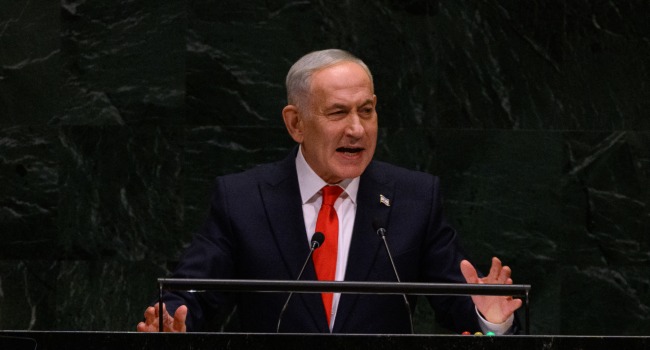
Israeli Prime Minister Benjamin Netanyahu used his address to the 81st United Nations General Assembly on Thursday to defend Israel’s military actions and attack critics, including New York Mayor Zohran Mamdani, Iran and several European allies.
The speech triggered a walkout by dozens of delegates, with some envoys booing and jeering as Netanyahu took the podium. His own delegation applauded during the address, while the session’s presiding officer called for order.
Netanyahu responded to the departing delegates by describing those who remained as “moral cowards” and telling them to leave as well.
The Israeli prime minister also targeted Mamdani, accusing the New York mayor of antisemitism and saying Jews in the city no longer felt safe since his election.
Mamdani had previously said he would seek to enforce an International Criminal Court arrest warrant against Netanyahu if he had the authority to do so, but later acknowledged that he did not have that power.
In response to Netanyahu’s speech, Mamdani accused the Israeli prime minister of repeating what he described as false claims about Israel’s conduct in Gaza and referred to the ICC warrant alleging war crimes and crimes against humanity.
The ICC issued arrest warrants for Netanyahu and former Israeli Defence Minister Yoav Gallant in 2024 over alleged war crimes and crimes against humanity linked to Israel’s military campaign in Gaza. Israel rejects the allegations.
Netanyahu also criticised Britain and France, whose governments have become increasingly critical of Israel’s conduct and have imposed limited sanctions on Israeli exports from the occupied West Bank.
He attacked the two countries over accusations of colonialism against Israel, pointing to their own colonial histories.
Iran was another major focus of the speech. Netanyahu described its government as a “murderous dictatorship” and said Israeli and US military action had prevented Tehran from developing nuclear weapons.
He also suggested that the fall of Iran’s leadership was approaching, although Iran’s government remains in control of the country and the conflict continues to affect regional security and energy routes.
Netanyahu further criticised Turkish President Recep Tayyip Erdoğan, accusing Türkiye of supporting Hamas and describing Erdoğan as a “tyrant”.
Burhanettin Duran, communications director for the Turkish presidency, rejected Netanyahu’s comments as baseless accusations that were incompatible with UN principles.
During the speech, Netanyahu also displayed a pager similar to those used in the 2024 attacks targeting Hezbollah operatives in Lebanon. The devices had reportedly been modified with explosives before being distributed to members of the Iran backed group.
Outside the UN headquarters, protesters demonstrated against Netanyahu’s visit, with some carrying banners calling for an end to the war in Gaza. At least 30 people were reportedly arrested, including actors and politicians.
Palestinian President Mahmoud Abbas did not attend the New York gathering in person after the Trump administration denied visas to members of his delegation. He instead addressed the assembly through a recorded video message, rejecting the reasons given for the visa restrictions.
Netanyahu’s appearance in New York comes as Israel prepares for elections scheduled for October 27. He was due to make only a brief visit to the city before returning to Israel and was not scheduled to meet senior US officials during the trip.
THE ISSUES
- The walkout during Netanyahu’s address highlighted the sharp international divisions surrounding Israel’s military actions and the continuing criticism of its conduct in Gaza.
- Netanyahu’s decision to target critics including Mamdani, Britain, France and Türkiye broadened the speech beyond Iran and Israel’s military campaigns to include disputes with governments and political figures that have criticised his administration.
- The dispute over the ICC warrant remains a major point of contention, with the court alleging war crimes and crimes against humanity while Netanyahu and the Israeli government reject the allegations.
- Abbas’s absence from the UN gathering added another diplomatic dispute, with the Palestinian leadership challenging the US decision to deny visas to his delegation.
WHAT’S BEING SAID
“If there are any other moral cowards who haven’t left this hall, please do so now,”
Benjamin Netanyahu, Prime Minister of Israel
“They accuse Israel, tiny Israel, of colonialism — some colonialism. And who’s accusing us? Among them are people in Britain and in France. For God’s sakes, they invented the term,”
Benjamin Netanyahu, Prime Minister of Israel
“Netanyahu used his speech to repeat baseless lies meant to sanitize his genocide of Palestinians,”
Zohran Mamdani, Mayor of New York
WHAT’S NEXT
Netanyahu is expected to return to Israel after his brief New York visit as the October 27 election campaign continues. The international dispute over Israel’s military actions, the ICC proceedings and the country’s relations with critics and allies is expected to remain part of the wider diplomatic debate.
BOTTOM LINE
Netanyahu’s UN address was marked by a major delegate walkout and sharp exchanges with critics over Israel’s military actions and foreign policy. His attacks extended from Iran to Western allies, Türkiye and New York’s mayor, underscoring the divisions surrounding Israel at the UN.