




Key points
- Burkina Faso’s transitional leader, Capt. Ibrahim Traoré, has proposed tighter controls on Islamic education and called for what he described as a “moderate” Islam.
- He said the government would repatriate students studying Sharia abroad and sanction clerics promoting extremist ideologies.
- The proposals have drawn mixed reactions, with some supporting the security rationale and others warning of possible religious tensions.
- Analysts have urged the government to balance scientific development with continued support for religious scholarship.
Main story
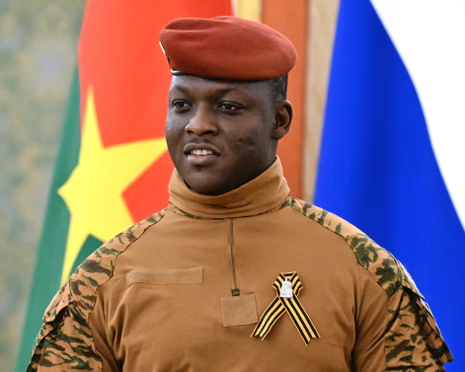
Burkina Faso’s transitional leader, Capt. Ibrahim Traoré, has sparked debate across West Africa after proposing stricter controls on Islamic education and calling for what he described as a “moderate” Islam as part of efforts to tackle violent extremism.
Traoré made the remarks during a meeting with the Forces Vives of the Yaadga region in northern Burkina Faso last Thursday, according to the Senegalese online newspaper Dakaractu.
He announced plans to repatriate Burkinabè students studying Islamic law in Saudi Arabia and other Arab countries and warned that those who refused to return could lose their citizenship.
According to Traoré, the government would also sanction clerics found promoting extremist ideologies.
“Extremists, you must pull yourselves together; the fight has begun. We will suspend them from preaching if they speak at random,” he said.
He alleged that foreign actors were exploiting religion to destabilise Burkina Faso and said the government would financially support imams who promote peaceful religious teachings.
Traoré argued that the country needed to prioritise technical and scientific education over overseas religious studies.
According to Dakaractu, he said more than 800 Burkinabè students were studying Sharia abroad instead of acquiring skills needed for national development.
The announcement follows recent government regulations requiring students seeking education abroad to obtain approval from the Ministry of Higher Education to ensure their programmes align with national priorities.
It also comes after other measures affecting religious activities, including new regulations on public prayers and the introduction of a national Day of Customs and Traditions.
The proposals have generated mixed reactions.
Some observers view the measures as part of the military government’s strategy to counter violent extremism, while others fear they could alienate sections of Burkina Faso’s Muslim population.
Public affairs analyst and Associate Professor at the University of Namibia, Dr Babayo Sule, said Traoré’s emphasis on science and technology was understandable but cautioned against abandoning religious education.
He argued that countries such as Saudi Arabia continue to invest heavily in science and technology while maintaining religious scholarship.
According to him, Burkina Faso should adopt a balanced approach by allowing religious education to continue while investing more public resources in training scientists, engineers and technology professionals.
Sule warned that eliminating religious scholarship could create unintended social consequences in a religiously diverse society.
Meanwhile, some analysts quoted by French broadcaster RFI suggested Traoré’s actions formed part of a broader effort to consolidate political authority by distancing himself from former allies, while others believe tensions between the government and religious leaders could persist.
The debate comes as Burkina Faso continues to confront a prolonged insurgency by armed groups linked to al-Qaeda and the Islamic State.
The issues
Burkina Faso faces the challenge of balancing national security objectives with religious freedoms as it seeks new strategies to combat extremism while maintaining social cohesion.
What’s being said
“Extremists, you must pull yourselves together; the fight has begun. We will suspend them from preaching if they speak at random.” — Capt. Ibrahim Traoré, Burkina Faso’s transitional leader
What’s next
The government is expected to move ahead with tighter oversight of foreign religious education and religious preaching, while the proposals are likely to attract continued scrutiny from religious leaders, civil society and regional observers.
Bottom line
Traoré’s proposals reflect Burkina Faso’s determination to confront extremism, but their long-term success may depend on balancing security concerns with religious inclusion and public trust.