




Written By Chidorum Nwakanma
The news that emerged over the weekend of was more than just another government announcement; it was a strong signal of a deliberate, strategic economic vision in operation in Abia State.
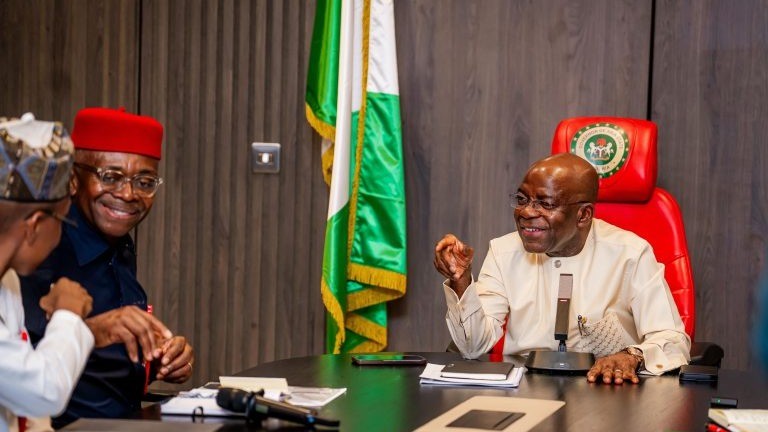
Governor Alex Otti’s decision to formalise a $200 million partnership with Presco Plc for palm oil production, following a significant deal with the Radisson Hotel Group, exemplifies a consistent approach to rebuilding the state’s economy from the ground up. This isn’t merely about attracting investment; it’s about restoring a legacy and building a sustainable future.
A Twin-Engine Strategy for Growth
The two public-private partnerships (PPPs) are the pillars of this new approach:
- The Presco Plc Palm Oil Project involves a $200 million investment to develop a 14,000-hectare oil palm plantation across sites in Ozuitem, Abam, and Ulonna. The project intends to generate over 5,000 jobs and contribute billions of naira annually to Abia’s GDP.
- The Radisson Hotel Group Partnership: A collaboration to reconstruct, rebrand, and operate the iconic Enyimba Hotel in Aba as a 5-star “Enyimba Radisson Hotel.” This is a significant project aimed at boosting tourism, business travel, and conferencing in the commercial centre.
What gives these announcements immediate credibility is the calibre of the partners. Radisson is a global leader in hospitality with a solid understanding of the Nigerian market. Presco Plc is a fully integrated agro-industrial giant listed on the Nigerian Stock Exchange—a serious player with a long-term perspective. We admired their expansion into Ghana as they became international. As such, they stand in stark contrast to what some might call “audio projects.” These are partnerships in which the private sector has as much, if not more, to lose from failure as the government itself.
Restoring the ‘Okpara Legacy’ and Spurring Industrialisation
The Presco deal, in particular, holds significant historical importance. It exemplifies a deliberate continuation of the agricultural revolution led by the late Premier of the Eastern Region, Dr Michael Okpara. His farm settlement schemes transformed the region into a national centre for palm oil production. By focusing on the same historic settlements, the Otti administration is not merely clearing land for a plantation; it is removing decades of overgrowth caused by neglect to reconnect with a proven path to prosperity.
My friend Frederick Apeji contextualises this sum of money.
He notes that “$200 million is a massive amount in the context of Abia State today. The state raised a total internally generated revenue (IGR) of N134.8 billion in the past six years (2019, 2020, 2021, 2022, 2023 and 2024).
“At an exchange rate of $1/N1,300, the $ 200 million in question is N260 trillion, more than 1,900 times Abia State’s IGR collected over six years! “
This partnership is a catalyst for deep economic transformation:
1. Massive Economic Stimulus: The $200 million injection is a direct foreign investment that will generate a multiplier effect. It aims to elevate Abia beyond its dependence on federal allocations by establishing a strong, internally generated revenue base through agriculture, taxes, and value chains.
2. Large-Scale Employment: The creation of over 5,000 direct and indirect jobs across the agricultural value chain is a game-changer. As Governor Otti aptly noted, “That’s what interests me – jobs for my people.” This initiative is a direct investment in tackling unemployment and reducing rural-urban drift.
3. Strategic Industrialisation: By establishing a reliable, large-scale supply of crude palm oil, the project will naturally attract downstream industries—such as food processing, cosmetics, and biofuel companies—forming a self-sustaining agro-industrial cluster. This aligns perfectly with the state’s objective of becoming one of Nigeria’s top three industrial plantation clusters by 2032.
The Ultimate Goal: Building Human Capital
The true genius of this twin-pronged strategy—agriculture and hospitality—lies in its potential to create a virtuous cycle of human capital development.
Economically, human capital—the skills, health, and knowledge of its people—is a crucial driver of growth. The Presco project enhances skills and productivity in the agricultural sector, while the Enyimba Radisson Hotel develops expertise in the service and tourism industries. A more skilled and efficient workforce attracts further investment.
Socially, the economic growth generated by these projects will provide the government with the tax revenue needed to invest in better schools, hospitals, and social programmes. In turn, social development fosters a more capable, healthy, and stable workforce, which drives further economic growth.
Essentially, Governor Otti is not merely announcing projects; he is showcasing a first-class economist’s understanding of how to develop a modern economy.
By attracting reputable, long-term partners such as Presco Plc and the Radisson Group, he is establishing a foundation for a future where Abia State is not just a participant in Nigeria’s economy but a driving force within it. The deals are important for the investment and jobs they generate today, and they are genuinely transformative for the sustainable growth cycle they promise for tomorrow.
Chidorum Nwakanma is an experienced business leader, author, and specialist in integrated marketing communication.