







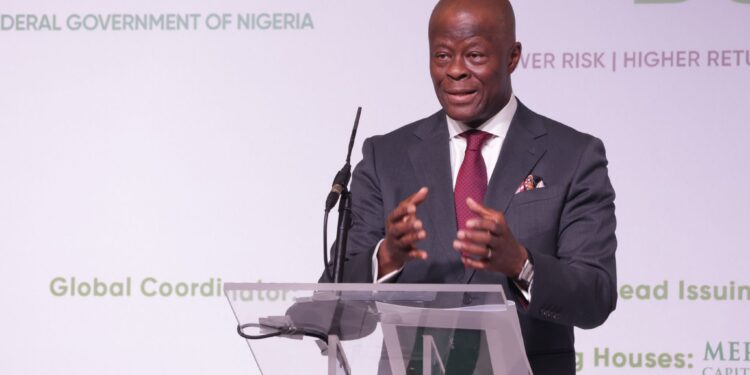
Nigeria must urgently recalibrate its fiscal strategy by reducing reliance on borrowing and expanding its domestic revenue capacity, according to the Minister of Finance and Coordinating Minister of the Economy, Wale Edun.
Speaking at the Nigerian Revenue Service (NRS) management retreat in Abuja, Edun cautioned that global financial conditions have grown increasingly adverse for developing economies, rendering debt-funded growth both expensive and structurally risky.
Global Financial Pressures Worsening for Developing Nations

Edun observed that multilateral financial cooperation has weakened in recent years, with countries increasingly prioritising domestic economic protection over international support commitments. He warned that developing economies now face a deteriorating external balance — paying significantly more in debt servicing obligations than they receive in development assistance or investment inflows.
Citing 2024 data, Edun revealed that developing countries collectively disbursed approximately $163 billion in debt service payments. In contrast, they received only $42 billion in official development assistance and $97 billion in foreign direct investment. The figures illustrate a reversal of net capital flows, placing additional strain on fiscal sustainability frameworks in emerging markets.
Revenue Mobilisation as a Fiscal Anchor
Against this backdrop, Edun emphasised that Nigeria’s fiscal stability must rest primarily on internally generated revenue rather than continuous borrowing.
“The foundation of sustainable public finance must be our own fiscal effort,” he stated, stressing that savings required for long-term investment can only be built on a dependable revenue base.
He linked Nigeria’s expanding debt profile to external shocks such as the COVID-19 pandemic, geopolitical conflicts, and global trade disruptions — factors that have compelled many developing nations to increase borrowing while facing higher interest costs. The result, he explained, is shrinking fiscal space, making it more difficult to fund essential services including infrastructure, education, and healthcare.
Sustainable Revenue for Development Goals
Edun argued that transitioning toward sustainable revenue streams is critical to supporting inclusive growth and social protection. He maintained that stable revenues would enable Nigeria to invest meaningfully in infrastructure development, strengthen social services, and protect vulnerable populations. However, his remarks come at a time when members of the National Assembly have acknowledged that additional borrowing may remain unavoidable in the near term.
At a public hearing on the 2026 Appropriation Bill, Senate Committee on Appropriations Chairman Olamilekan Adeola stated that Nigeria’s large fiscal deficit and unpredictable revenue inflows make continued borrowing a practical necessity. According to Adeola, the real issue lies not in borrowing itself but in how funds are structured, managed, and deployed.
Tax Reform as Core Strategy
Edun described ongoing tax reforms as a central pillar of the administration’s shift away from debt dependency. He explained that the reforms aim to improve equity, efficiency, and fairness in Nigeria’s tax framework while expanding fiscal space for capital and social expenditure. Nevertheless, he cautioned that legislative changes alone would not deliver meaningful results without robust implementation and compliance enforcement.
“No fiscal reform succeeds in an environment of weak compliance,” he noted, adding that enforcement must be balanced with public trust-building measures.
Edun stressed that taxpayer confidence plays a decisive role in revenue performance. Citizens must perceive fairness in tax administration and see tangible public benefits from their contributions.
Role of the Nigerian Revenue Service
The Finance Minister positioned the Nigerian Revenue Service at the centre of the country’s fiscal transformation agenda, describing it as instrumental to converting policy objectives into measurable outcomes. He explained that reform success should be evaluated through indicators such as higher and more predictable revenue collections, reduced fiscal vulnerability, and improved public service delivery.
Edun further highlighted the interplay between macroeconomic variables and revenue generation. Economic growth broadens the tax base; exchange rate movements affect customs duties; and inflation influences compliance behaviour and the real value of collections. He warned against maintaining a revenue system that fluctuates excessively with oil price cycles, arguing instead for a more resilient and diversified fiscal architecture.
Leadership Transition at the NRS
Earlier in the retreat, Executive Chairman of the Nigerian Revenue Service, Zacch Adedeji, described the establishment of the NRS as a defining institutional shift. He said the transition marks a departure from legacy structures and demands a new standard of leadership discipline, accountability, and operational execution.
Adedeji urged senior managers to critically reassess entrenched assumptions and management practices, warning that outdated approaches could undermine reform momentum. According to him, the credibility of Nigeria’s revenue system — and broader economic confidence — now depends on the NRS’s ability to deliver transparent, disciplined, and results-driven performance.