








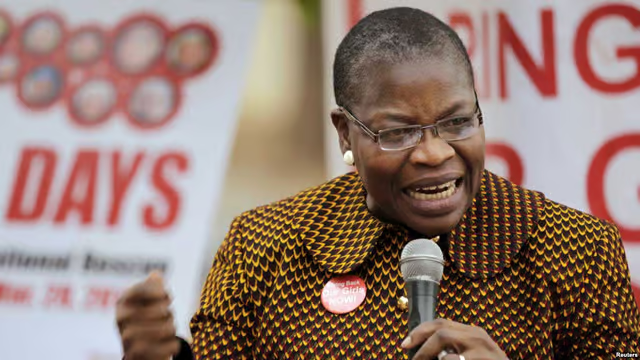
Former Minister of Education and founder of the School of Politics, Policy and Governance (SPPG), Dr Obiageli Ezekwesili, has sharply criticised the Lagos State Government over the demolition of homes in the Makoko waterfront community, accusing authorities of engaging in what she described as “class cleansing” and an unlawful seizure of land.
In an open memorandum addressed to President Bola Tinubu and Lagos State Governor Babajide Sanwo-Olu, dated 19 January, Ezekwesili condemned the demolitions as unconstitutional, unjust and a violation of the fundamental rights of affected residents. She characterised the exercise as “state-sanctioned oppression of the poor” and questioned whether economic deprivation had become a basis for stripping citizens of their rights.
“Makoko residents are not squatters on Nigerian soil. They are citizens of Nigeria, they are mobilised by the same political class during elections. They work, raise families, and their children—now abruptly forced out of school—are among the most brilliant Nigerians I have encountered,” she wrote.
Ezekwesili accused the Lagos State Government of reneging on prior assurances given to community leaders that demolitions would be restricted to structures located within 30 to 50 metres of high-tension power lines. She alleged that the exercise had since exceeded those limits, extending deep into residential areas.
“Despite the legally acceptable distance falling within the agreed 30–50 metre range, demolitions reportedly continued far beyond this threshold,” she said, citing human rights monitors who claimed affected buildings were located between 277 and 522 metres from the power lines.
Describing the action as a “fundamental breach of trust and legality,” Ezekwesili likened the demolitions to a land grab and referenced reports that at least four people lost their lives during the exercise. She compared the incident to the biblical account of Naboth and King Ahab, suggesting an abuse of state power against the vulnerable.
“What has happened in Makoko is not about safety or urban renewal,” she stated. “It is about individuals wielding state authority to carry out a vicious class cleansing.”
She warned that the demolitions had triggered a humanitarian crisis, with thousands of residents displaced and left without shelter. According to her, many families are now sleeping in the open, exposed to harsh weather, disease, violence and hunger, while children have been forced out of school and livelihoods abruptly destroyed.
Ezekwesili called for an immediate suspension of all demolitions, full disclosure of the legal framework governing power-line setbacks, and the provision of emergency shelter, healthcare and compensation for displaced families. She also demanded a transparent, community-driven process for long-term resettlement and accountability for the use of force against civilians.
Arguing that the actions violated constitutional guarantees of dignity, fair hearing and social justice, she said the state could not justify homelessness as an administrative outcome. “A government cannot create homelessness and then plead administrative delay. Leaving citizens without shelter after state action violates everything the Nigerian Constitution stands for,” she said.
The former minister urged both federal and state authorities to pursue inclusive urban development strategies rather than forced evictions, stressing that sustainable mega-cities are built through in-situ upgrading, secure land tenure, access to sanitation, education and livelihood support.
In a stern warning to political leaders, Ezekwesili said, “A nation that fails to govern well and then criminalises poverty while celebrating wealth has completely lost its moral compass. Begin with the grieving children of Makoko and their families. The urgency is undeniable.”





, Dr Obiageli Ezekwesili, has sharply ...)