








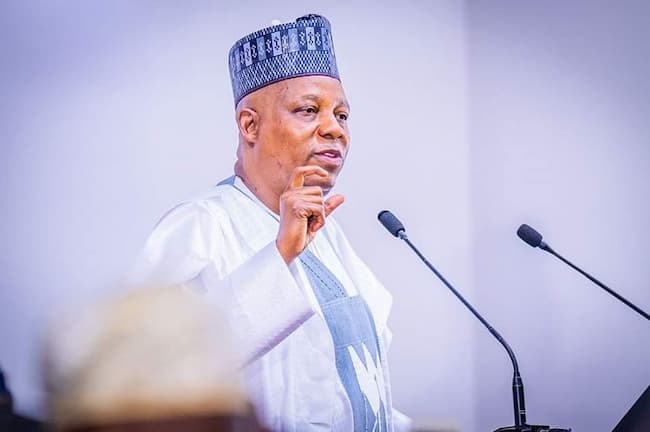
Vice-President Kashim Shettima has called on Nigerian automotive manufacturers to ramp up production of Compressed Natural Gas (CNG) and electric vehicles (EVs) to meet growing demand for clean mobility, even as the limited number of CNG refuelling stations continues to constrain adoption. Speaking in Abuja during the 25th Abuja International Motor Fair, themed “Driving Nigeria’s Automotive Future: Innovation, Sustainability, and Growth,” Shettima, represented by Minister of Innovation, Science and Technology Kingsley Udeh, described the automotive industry as “the engine of the Renewed Hope Agenda.”
He emphasised that the government’s strategy for mobility is anchored on three pillars: Gas, Green, and Growth, highlighting Nigeria’s abundant gas reserves as a pathway to affordable mass transit. Shettima said the deployment of CNG for public transportation is crucial to cushioning the effects of economic reforms while providing lasting, affordable relief for millions of Nigerians. He urged manufacturers to prepare for rising demand for CNG-powered vehicles, CNG kits, and electric vehicles, stressing that local production, battery assembly, and youth training are vital for Nigeria to secure a place in the global EV supply chain.
Shettima noted that the government has made N20 billion available through Credit Corp to support purchases of locally assembled vehicles, describing affordable financing as key to stimulating demand, expanding production, and creating jobs. He reiterated the administration’s ambition to position Nigeria as the West African hub for CNG and electric mobility under the Nigeria First Policy.
Despite policy support and investments, infrastructure gaps remain a challenge. Nigeria currently has fewer than 50 operational CNG refuelling stations, limiting mass adoption. Farouk Ahmed, CEO of the Nigerian Midstream and Downstream Petroleum Regulatory Authority, highlighted the urgent need for hundreds of additional stations to facilitate the transition of public transport fleets from petrol to CNG.
Senator John Enoh, Minister of State for Industry, reaffirmed the government’s commitment to the automotive sector through stable policies and targeted incentives, while Joseph Osanipin, Director-General of the National Automotive Design and Development Council (NADDC), emphasised the council’s work to revive the industry via the National Automotive Industry Development Plan. With about 30 active vehicle assemblers and nearly $1 billion in investments, Nigeria’s automotive sector shows strong long-term potential despite infrastructure and financing challenges.
Ifeanyichukwu Agwu, Managing Director of BKG Exhibition Limited and co-organiser of the motor fair, called for a functional national vehicle-financing scheme, stressing that affordable access to mobility is critical for economic growth. The 25th Abuja International Motor Fair continues to showcase innovations, new-energy vehicles, and local manufacturing capacity, reflecting the sector’s vital role in Nigeria’s industrialisation and sustainable development.


 and electric vehicles (EVs) to meet growing demand for clean mobility, even as the limited number of CNG refuelling stations continues to constrain adoption. Speaking in Abuja during the 25th Abuja International Motor Fair, themed “Driving Nigeria’s Automotive Future: Innovation, Sustainability, and Growth,” Shettima, represented by Minister of Innovation, Science and Technology Kingsley Udeh, described the automotive industry as “the engine of the Renewed Hope Agenda.”)