





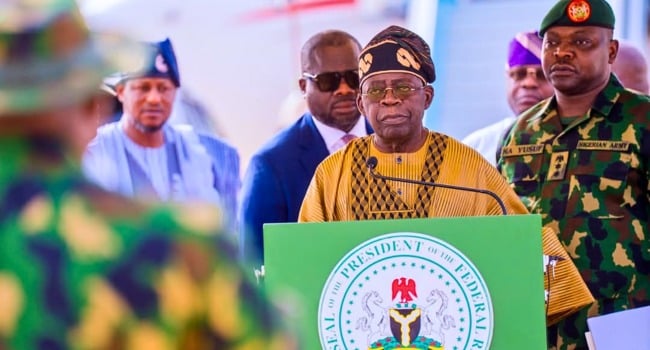
President Bola Tinubu has reaffirmed the Federal Government’s commitment to resolving the long-standing Ogoni crisis as part of broader efforts to revitalise oil production in the Niger Delta.
The President made this known on Wednesday during the formal commissioning of the Otakikpo Crude Oil Export Terminal in Rivers State, where he emphasised that despite the global transition towards cleaner energy, oil and gas will continue to play a dominant role in the world’s energy mix for decades to come.
Represented by the Minister of State for Petroleum Resources (Oil), Senator Heineken Lokpobiri, President Tinubu cited new projections by the International Energy Agency (IEA) indicating that the world must invest at least $540 billion annually in upstream oil and gas projects over the next 25 years to avoid an energy crisis.
“The revelation underscores the continued relevance of Nigeria’s oil reserves and validates our ongoing engagements with host communities, particularly the Ogoni people, to restart production in dormant oilfields,” the President said.
He dismissed global pressures for Africa to abandon its hydrocarbon resources, noting that energy transition should be based on equity and national interest.
“For years, we were told to abandon our oil and gas in exchange for handouts,” he said. “But the game has changed. Oil and gas remain central to global energy security, and Nigeria must position itself strategically.”
Tinubu explained that the government is already in advanced talks with Ogoni leaders to ensure lasting peace and unlock the region’s oil potential. “Once the Ogoni issue is resolved, the Otakikpo terminal will serve as the main evacuation point for crude from Ogoniland. This project is both timely and strategic for Nigeria’s production growth,” he noted.
Developed by Green Energy International Limited at a cost exceeding $400 million, the Otakikpo terminal is located in Ikuru Town, Andoni Local Government Area of Rivers State. Tinubu described the facility as the first indigenous-built crude export terminal in over 50 years—marking a “new chapter” in Nigeria’s upstream sector.
“This commissioning is not just symbolic; it is a practical demonstration of indigenous capacity and the power of Nigerian enterprise,” the President stated. “The facility will address one of the industry’s biggest challenges—crude evacuation—and serve multiple operators in the region, aligning with our executive orders aimed at improving the business environment.”
Lokpobiri added that Nigeria has met all obligations required to host the newly established African Energy Bank, a regional financial institution designed to improve access to funding for oil and gas projects across the continent. “Africa’s major challenge is access to finance. This bank will mobilise local capital, including pension funds, to drive strategic energy investments,” he said.
Commending Green Energy International for reinvesting profits in local development, Tinubu praised the firm for setting a benchmark for indigenous operators. “While many diverted funds into personal luxury, Green Energy chose to create tangible value that strengthens both the industry and the economy,” he remarked.
He warned marginal field operators to meet their minimum work obligations or risk losing their licences, stressing that “the oil and gas sector remains critical to solving Nigeria’s economic challenges.”
Providing further technical details, Gbenga Komolafe, Chief Executive Officer of the Nigerian Upstream Petroleum Regulatory Commission (NUPRC), described the Otakikpo Terminal as a “historic milestone.” The facility, he said, is capable of exporting up to 750,000 barrels of crude oil per day, with potential expansion to three million barrels daily.
“This is the first shore-based export terminal developed entirely by a Nigerian company in more than half a century,” Komolafe stated. “It signals a new era for our petroleum industry by expanding evacuation capacity, reducing dependence on ageing international facilities, and empowering indigenous producers.”
He added that the project would enhance Nigeria’s crude evacuation efficiency, reduce transportation costs, and strengthen the competitiveness of local oil producers.
“The Otakikpo Terminal marks a turning point in Nigeria’s oil and gas narrative. It demonstrates that indigenous companies can deliver world-class infrastructure, drive economic growth, and advance national energy security.” Komolafe concluded.