



Key points
- Brent crude climbed above $80 per barrel as renewed US-Iran hostilities intensified fears of oil supply disruption.
- President Donald Trump says the US will reinstate a blockade targeting Iranian shipping and seek 20% of cargo value to cover security costs in the Strait of Hormuz.
Higher crude prices could boost Nigeria’s oil revenue and dollar inflows but also expose motorists to fresh petrol price increases.
Main Story
Global oil prices have surged above $80 per barrel as escalating US-Iran hostilities and President Donald Trump’s renewed blockade plan deepen fears of a major disruption to energy flows through the Strait of Hormuz.
Brent crude futures rose about 4% to their highest level in more than three weeks, while US benchmark West Texas Intermediate (WTI) climbed 4.13% to $74.36 per barrel.
The market rally followed fresh US strikes on Iran and retaliatory attacks targeting American allies in the Middle East, further reducing expectations of a quick de-escalation.
But a new announcement from Trump has added another layer of uncertainty to global energy markets.
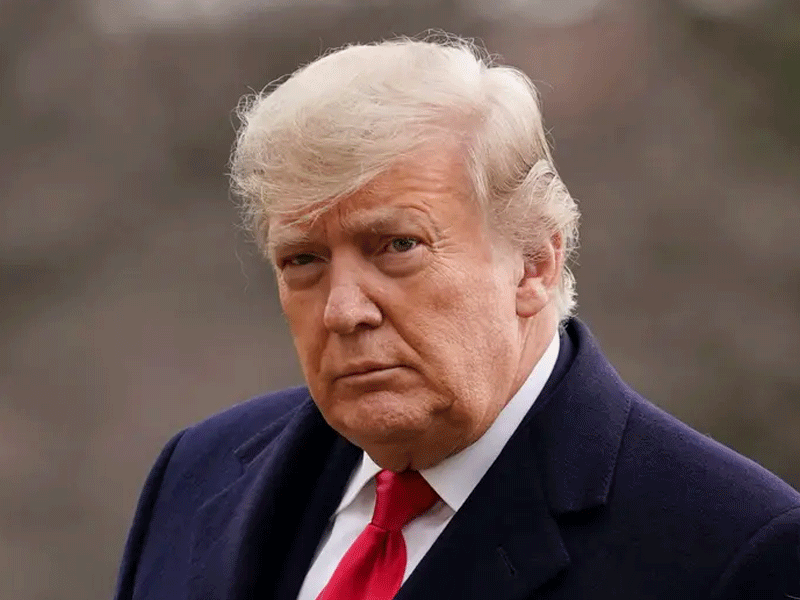
The US President said Washington would reinstate its blockade targeting Iranian shipping and become the “guardian” of the Strait of Hormuz.
Trump also proposed that the US be reimbursed at a rate of 20% on cargo shipped through the strategic waterway to cover the cost of providing maritime security.
For Nigeria, the oil rally presents an economic paradox: more crude revenue for the government, but potentially higher fuel costs for households and businesses.
The Issues
The Strait of Hormuz is one of the world’s most important energy transit routes, making any prolonged disruption a major risk to global oil and gas supplies.
Tanker movements through the corridor have already fallen sharply as shipowners reassess security risks.
Only six vessels were reportedly tracked through the passage on Sunday, while concerns over attacks have discouraged some oil and liquefied natural gas tankers from attempting the route.
The growing shipping uncertainty could tighten global oil supplies and add a geopolitical risk premium to crude prices.
Trump’s proposed 20% cargo charge creates an additional concern.
Beyond military risks, shipping companies could face higher transit costs if the proposed US reimbursement arrangement is implemented.
For energy markets, that could increase freight and insurance costs and ultimately feed into global commodity prices.
Nigeria’s $80 oil opportunity — and petrol risk
Higher oil prices could strengthen Nigeria’s fiscal position.
As Africa’s major crude producer, Nigeria stands to earn more from each barrel exported if prices remain above the assumptions underpinning government revenue projections.
Stronger oil receipts could also improve foreign exchange inflows and offer some support to the naira.
The timing is particularly significant as Nigeria’s crude production has recently improved from previous lows.
However, Nigerian consumers could face the opposite effect.
The downstream petroleum market is increasingly exposed to international crude prices and foreign exchange movements following deregulation.
Higher crude prices raise refinery feedstock costs and can translate into more expensive petrol, diesel and aviation fuel.
The risk has become even more significant after Dangote Petroleum Refinery shifted major petroleum product sales to dollar-denominated transactions.
A combination of higher crude prices and naira depreciation could therefore create renewed upward pressure on domestic pump prices.
What’s Being Said
Trump said the United States would take a more direct role in securing the Strait of Hormuz.
“We’ll become the guardian of the Strait,” Trump said, adding that the US expected to be reimbursed for the cost and risks involved in securing the waterway.
“We’re going to get paid for guarding it. A lot of money, but we just want to be reimbursed for doing all of this, for putting our people in danger,” he added.
In a separate statement, Trump said the US would be reimbursed “at the rate of 20% on all cargo shipped” for the costs of providing security in the volatile region.
Iran’s Islamic Revolutionary Guard Corps has maintained that the Strait of Hormuz is closed.
The US disputes the claim and insists the waterway remains open to maritime traffic.
More Insights
The escalating conflict is also beginning to reshape the global LNG market.
Asia-Pacific LNG demand is projected to fall for a second consecutive year as tighter supply and higher spot prices force buyers to reduce purchases and explore alternative fuels.
Regional LNG demand is forecast to decline to 257 million tonnes in 2026 from 268 million tonnes in 2025 and a peak of 278 million tonnes in 2024.
The decline highlights how disruption around Hormuz could extend beyond crude oil markets.
Higher LNG prices could particularly affect energy-importing economies in Asia, where buyers are already adjusting purchasing strategies.
Analysts have also warned that an expansion of the conflict into neighbouring countries or critical energy infrastructure could further tighten global supplies.
What You Should Know
The Strait of Hormuz connects the Persian Gulf with the Gulf of Oman and international shipping routes.
Its strategic importance comes from the enormous volume of crude oil, petroleum products and LNG transported through the narrow passage.
Because of this, military tensions involving Iran can quickly influence global energy prices even before physical supply is significantly disrupted.
Markets typically add a geopolitical risk premium to crude prices when traders believe future supply could be threatened.
For Nigeria, higher oil prices can improve export earnings but also raise domestic energy costs under a deregulated petroleum pricing system.
What’s Next
Oil traders will closely monitor tanker traffic through Hormuz, further US and Iranian military actions and ongoing diplomatic efforts involving Qatar, Pakistan and Oman.
Attention will also turn to how the US intends to implement Trump’s proposed 20% cargo reimbursement arrangement and how major shipping and energy companies respond.
In Nigeria, the focus will be on whether higher Brent prices translate into stronger government oil revenue or trigger another round of petrol price increases.
Bottom Line
Oil above $80 is good news for Nigeria’s export earnings, but the same rally could quickly become a problem at the petrol pump.
With the Strait of Hormuz caught between renewed military confrontation, declining tanker traffic and Trump’s proposed 20% cargo charge, global energy markets are pricing in a new wave of uncertainty.
For Nigeria, the question is whether higher crude revenue will outweigh the inflationary cost of another fuel price shock.