









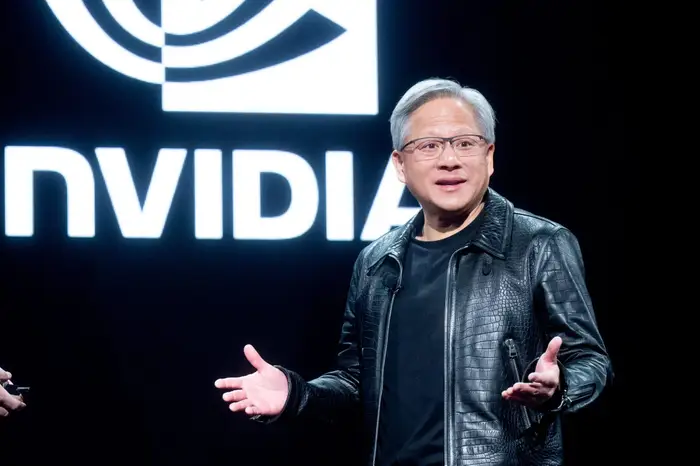
At the Consumer Electronics Show (CES) in Las Vegas, Nvidia CEO Jensen Huang announced that the company’s next-generation Vera Rubin AI platform is now in “full production.” Designed to succeed the Blackwell architecture, the Rubin platform is engineered for “agentic AI” and advanced reasoning models.
Huang revealed that the new chips deliver five times the AI computing performance of their predecessors for chatbot and inference applications, and can improve the efficiency of generating AI “tokens” by up to 10 times.
The Rubin platform is an integrated system comprising six distinct chips: the Vera CPU, the Rubin GPU, NVLink 6 switches, the ConnectX-9 SuperNIC, the BlueField-4 DPU, and Spectrum-6 Ethernet switches. This “extreme co-design” approach allows the system to move data at a staggering 260 terabytes per second.
The Vera CPU itself features 88 custom “Olympus” cores and utilizes “Spatial Multithreading” to physically partition resources for better efficiency, while the Rubin GPU boasts 336 billion transistors and is paired with HBM4 memory providing 22 TB/s of bandwidth.
A major highlight of the keynote was the introduction of Alpamayo, a family of open-source AI models and tools aimed at autonomous vehicle (AV) development. Alpamayo 1 is the industry’s first “chain-of-thought” reasoning model for AVs, allowing self-driving systems to “think through” rare and complex “long-tail” scenarios.
Nvidia is open-sourcing not just the models but also the 1,700-hour Physical AI Open Dataset to build industry trust. The first passenger car to feature this technology will be the all-new Mercedes-Benz CLA, expected to launch in the U.S. in early 2026.
The announcement follows Nvidia’s strategic $20 billion “reverse acqui-hire” of talent and technology from the startup Groq in late 2025. By absorbing Groq’s core engineering team and licensing its low-latency “Language Processing Unit” (LPU) technology, Nvidia aims to neutralize threats in the inference market where rivals like Google and AMD are gaining ground.
Huang confirmed that early adopters of the Vera Rubin systems will include Microsoft, Amazon, Google, and Oracle, with shipments expected to begin in the second half of 2026.








 in Las Vegas, Nvidia CEO Jensen Huang announced that the company’s next-generation Vera Rubin AI platform is now in "full production." Designed to succeed the Blackwell architecture, the Rubin platform is engineered for "agentic AI" and advanced reasoning models.)