




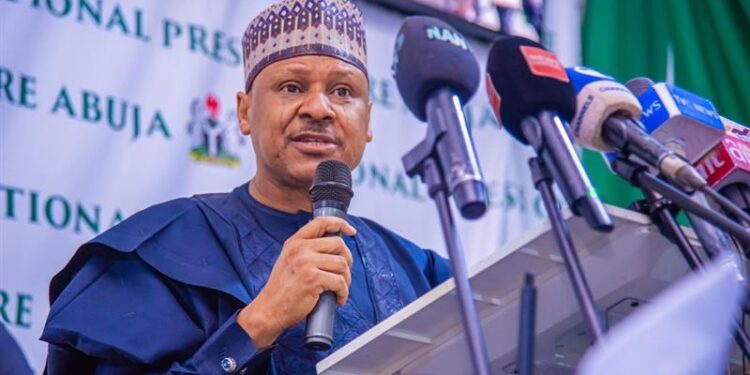
The Minister of Information and National Orientation, Mohammed Idris, has characterized the 2026 Federal Government budget as a strategic roadmap designed to solidify the progress of President Bola Tinubu’s reform agenda.
Titled the “Budget of Consolidation, Renewed Resilience and Shared Prosperity,” the N58.18 trillion appropriation bill was presented to the National Assembly in late December 2025 and aims to translate macroeconomic stability into tangible improvements for Nigerian households.
The fiscal plan prioritizes four critical pillars: security, infrastructure, education, and health. Defence and security received the single largest sectoral allocation of N5.41 trillion, which the administration views as the bedrock for economic growth and investor confidence.
Infrastructure followed with N3.56 trillion, while human capital development was emphasized through N3.52 trillion for education and N2.48 trillion for healthcare. These sectors are intended to work in tandem to drive productivity and long-term national resilience. A key feature of the 2026 budget is a decisive shift toward fiscal discipline. President Tinubu has mandated the end of “overlapping budgets,” a practice that previously led to abandoned projects and perpetual rollovers.
By March 31, 2026, the government aims to close all capital liabilities from previous years, transitioning to a single, transparent revenue and expenditure cycle by April. This move is intended to eliminate ambiguity in governance and ensure that every naira spent is tied to measurable results.
The budget framework is built on conservative economic assumptions, including a crude oil benchmark of $64.85 per barrel, daily production of 1.84 million barrels, and an exchange rate of N1,400 to the US dollar. Of the total N58.18 trillion expenditure, N26.08 trillion is earmarked for capital projects, while recurrent non-debt expenditure stands at N15.25 trillion. Debt servicing remains a significant component, projected at N15.52 trillion, reflecting the government’s commitment to maintaining its international financial standing.
Beyond the numbers, the 2026 budget funds several social and economic initiatives, such as the Nigerian Education Loan Fund (NELFUND) and the Presidential Compressed Natural Gas (CNG) initiative to lower transportation costs. On the infrastructure front, the budget provides for the continued development of the Coastal Highway, the Sokoto–Badagry Expressway, and the Ajaokuta–Kaduna–Kano Gas Pipeline. Minister Idris emphasized that these projects are not merely accounting lines but the foundation for a sustainable digital and industrial economy.