







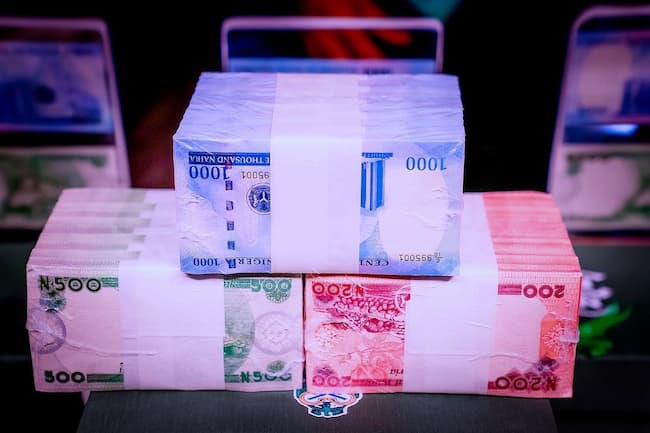
The Nigerian naira closed weaker against the U.S. dollar at the official foreign exchange window on Thursday, depreciating by ₦1.38 amid increased demand for foreign currency, particularly for international transactions.
According to the Central Bank of Nigeria’s daily foreign exchange data from the Nigerian Foreign Exchange Market (NFEM), the local currency settled at ₦1,422.07 per dollar, reflecting persistent pressure from market participants seeking dollar liquidity.
The marginal depreciation was largely driven by heightened demand for U.S. dollars by corporates and other authorised dealers, as liquidity conditions at the central bank window remained tight. During the trading session, the naira exchanged hands within a narrow band, fluctuating between ₦1,421.00 and ₦1,423.00 per dollar.
In contrast, the parallel market showed relative stability, with the exchange rate hovering around ₦1,476 per dollar, underscoring the divergence between the regulated official market and the informal segment.
Meanwhile, official data indicated a modest improvement in Nigeria’s external reserves. Gross reserves increased by $16.14 million compared to the previous trading day, bringing the country’s total reserve stock to $45.99 trillion, reflecting continued inflows and cautious reserve management.
Beyond the domestic currency market, global commodities recorded mixed performances. Crude oil prices declined on Thursday, reversing gains from earlier sessions as investors reassessed global supply and demand dynamics. The retreat followed signals of easing geopolitical tensions after U.S. President Donald Trump softened earlier rhetoric concerning Greenland and Iran.
Brent crude fell by 1.63 per cent, or $1.06, to trade around $64.02 per barrel, while U.S. West Texas Intermediate (WTI) crude declined by 1.80 per cent to approximately $59.41 per barrel.
Gold, however, moved higher as investors sought safety amid lingering geopolitical risks and a weaker U.S. dollar. Expectations of potential interest rate cuts by the U.S. Federal Reserve later in the year also supported the precious metal.
Spot gold prices rose by 0.94 per cent to $4,881.95 per ounce, while U.S. gold futures advanced by 1.16 per cent to $4,893.44 per ounce.
Looking ahead, analysts suggest that gold prices could face headwinds if geopolitical tensions continue to ease and risk appetite strengthens globally. Oil prices, on the other hand, may find modest support as markets monitor production levels and macroeconomic indicators.