









By Emmanuella Opara | October 17th 2026
KEY POINTS
- The International Monetary and Financial Committee has warned of growing geopolitical, trade and financial risks to the global economy.
- The committee called for stronger fiscal policies, sustainable debt management and protection for vulnerable populations.
- It urged countries to improve debt restructuring, strengthen financial stability and support a well-funded IMF.
- The committee’s next meeting is scheduled for April 2027 in Washington, D.C.
MAIN STORY
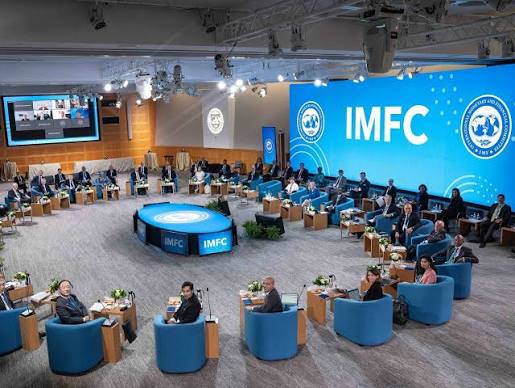
The International Monetary and Financial Committee (IMFC) has called for stronger fiscal management, sustainable debt policies and increased international cooperation to protect the global economy from mounting geopolitical and financial risks.
In a statement issued after its 54th meeting in Bangkok, Thailand, on Saturday, the committee reaffirmed its commitment to global economic stability and broad-based, private sector-led growth.
The meeting was chaired by Saudi Arabia’s Minister of Finance, Mohammed Aljadaan.
The IMFC said the global economy had weathered recent shocks better than expected but warned that continued resilience could not be taken for granted amid escalating conflicts, trade disruptions and emerging financial vulnerabilities.
It noted that wars and conflicts continued to cause severe humanitarian consequences and economic losses, with the poorest and most vulnerable countries bearing a disproportionate share of the impact.
The committee also identified supply chain disruptions, trade tensions and rising commodity prices as threats to economic stability. It warned that further escalation could affect critical trade routes and worsen energy and food insecurity.
It said rapid advances in artificial intelligence were boosting investment and trade, with the potential to improve productivity. However, uncertainties surrounding the economic and financial implications of the technologies could create additional vulnerabilities.
Other risks identified included rising sovereign bond yields in major economies, high public debt and increasing refinancing needs. The committee warned that uneven economic outcomes could deepen existing inequalities and leave low-income countries and fragile states further behind.
To address these challenges, the IMFC called for sound macroeconomic policies, credible medium-term fiscal frameworks and faster efforts to strengthen public finances and ensure debt sustainability.
It said governments needed to rebuild financial buffers while protecting vulnerable populations and maintaining priority investments that could support productivity and economic growth.
The committee also reaffirmed the importance of central bank independence, price stability and monetary policy decisions based on economic data and communicated clearly to the public.
On financial stability, it urged countries to adhere to international standards, monitor emerging risks and strengthen safeguards for digital finance and cybersecurity.
The IMFC welcomed the Bangkok Blueprint, which seeks to improve digital finance safeguards, strengthen cyber resilience and advance international efforts to combat digital fraud.
On international trade, the committee pledged to address excessive global imbalances and trade tensions, avoid distortive policies and strengthen supply chains through country-specific reforms and multilateral cooperation.
It also stressed the importance of secure and resilient energy flows and respect for freedom of navigation in maintaining global economic stability. The committee reaffirmed its April 2021 exchange rate commitments.
The IMFC pledged continued support for countries implementing reforms and addressing debt vulnerabilities, particularly low-income and vulnerable middle-income countries, fragile and conflict-affected states, and small developing states.
It called for improvements in sovereign debt restructuring processes, including under the Common Framework, to make them more predictable, timely, orderly and coordinated.
The committee urged all stakeholders, including private creditors, to improve debt transparency. It also encouraged faster implementation of the International Monetary Fund (IMF) and World Bank Group’s three-pillar approach.
“We encourage increasing support to countries with sustainable debt but facing short-term financing challenges,” it said.
The IMFC welcomed recent policy reviews aimed at strengthening the IMF’s surveillance, debt analysis, lending and capacity development functions. It called for their prompt, effective and even-handed implementation.
The committee also reaffirmed its commitment to a strong, quota-based and adequately resourced IMF at the centre of the Global Financial Safety Net.
It urged member countries to finalise domestic approvals for the quota increase under the 16th General Review of Quotas without further delay.
The IMFC further welcomed efforts to modernise the Fund’s operations, strengthen enterprise risk management and improve staff representation, particularly for women and underrepresented regions, while maintaining merit-based selection processes.
THE ISSUES
The committee’s statement highlights the challenge of sustaining global economic growth amid rising public debt, geopolitical tensions, trade uncertainty and financial risks.
Its concerns also reflect the uneven impact of global economic shocks, particularly on low-income countries and fragile states with limited capacity to absorb rising costs and financing pressures.
The call for stronger debt restructuring processes and improved transparency highlights the need for coordinated action among governments, multilateral institutions and private creditors.
WHAT’S BEING SAID
“We encourage increasing support to countries with sustainable debt but facing short-term financing challenges,” the International Monetary and Financial Committee said.
WHAT’S NEXT
The IMFC’s next meeting is scheduled for April 2027 in Washington, D.C.
The committee also welcomed the one-year extension of Aljadaan’s tenure as chair and thanked the Thai authorities and people for hosting the 2026 Annual Meetings in Bangkok.
BOTTOM LINE
The IMFC is urging governments to strengthen public finances, manage debt risks and deepen international cooperation as geopolitical tensions, trade disruptions and financial vulnerabilities threaten global economic stability. It has also called for greater support for vulnerable economies and a stronger IMF to help countries navigate economic shocks.


 has called for stronger fiscal management, sustainable debt policies...............)