






The Federal Government has reaffirmed its commitment to ensuring food and nutrition security nationwide amid growing concerns over rising food prices, hunger, and malnutrition across the country.
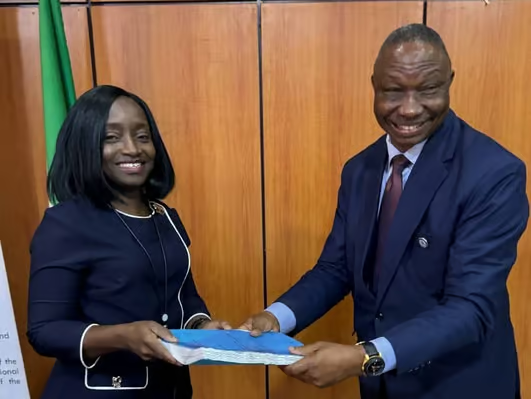
The Permanent Secretary, Federal Ministry of Budget and Economic Planning (FMBEP), Dr Deborah Odoh, restated the government’s resolve while delivering opening remarks at the Steering Committee Meeting for the Review of the National Policy on Food and Nutrition and its Implementation Plan (2016–2025). She described the ongoing policy review as a critical milestone in Nigeria’s collective effort to strengthen food and nutrition security.
Dr Odoh recalled that the President had, early last year, declared a state of emergency on food security, citing escalating food costs, widespread hunger, and rising levels of acute malnutrition. According to available data, an estimated 1.8 million children, particularly in the North-East and North-West, are currently affected by severe acute malnutrition.
She explained that the Steering Committee, inaugurated on March 5, 2025, was constituted to provide strategic leadership for the policy review and ensure alignment with emerging national realities, global best practices, and the Renewed Hope Agenda of the current administration.
According to her, the review process has been highly consultative, involving extensive engagement with stakeholders to produce a 10-year policy blueprint (2026–2035) that will guide food and nutrition security interventions at both national and sub-national levels.
Dr Odoh noted that the revised policy is expected to promote healthy and affordable diets, address all forms of malnutrition, and significantly improve the nutritional status of vulnerable populations, including women, children, adolescents, and the elderly.
She added that the meeting was convened to deliberate on the draft revised policy ahead of its presentation to the National Council on Nutrition, scheduled for January 28, 2026.
In her remarks, the Director of Nutrition, Mrs Clementina Okoro, said the revised policy would serve as a cornerstone for achieving Nigeria’s national targets on malnutrition reduction and for addressing food and nutrition challenges over the next decade.
She commended the collective efforts of federal and state ministries, development partners, consultants, civil society organisations, the private sector, and academia, as well as partners such as the Global Alliance for Improved Nutrition (GAIN), for their sustained support throughout the review process.
Also speaking, the Special Assistant to the President on Public Health and Food and Nutrition, Mrs Uju Rochas Anwuka, emphasised that food and nutrition security remains critical to economic recovery, workforce productivity, and national stability.
She noted that while the existing National Policy on Food and Nutrition has guided multisectoral action across health, agriculture, social protection, and water and sanitation sectors, evolving challenges—including population growth, climate change, and ongoing food system transformations—made a comprehensive review imperative.
The meeting brought together key nutrition stakeholders from across sectors to examine the draft policy and offer recommendations aimed at ensuring that the revised framework is comprehensive, implementable, and capable of delivering measurable impact across the country.