







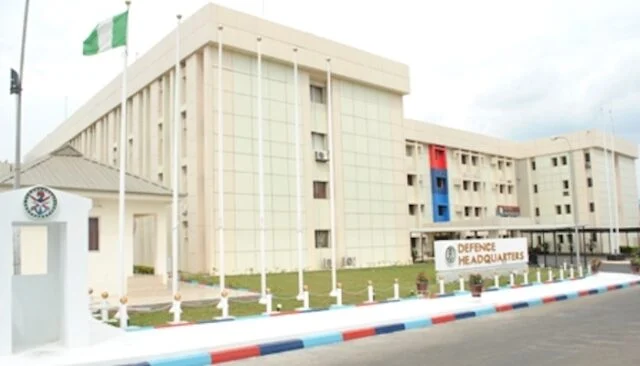
The Defence Headquarters (DHQ) has said it is working with other Federal Government agencies to trace and curb the use of drones by terrorists, amid growing concerns over the deployment of sophisticated unmanned aerial devices in recent attacks.
The Director of Defence Media Operations, Maj.-Gen. Michael Onoja, disclosed this on Friday in Abuja while briefing journalists on recent military operations across the country. He said investigations into the source and supply chain of the drones had reached an advanced stage.
In recent months, terrorist groups operating mainly in the North-East have increasingly deployed drones in attacks on civilians and security personnel, raising alarm over the evolving tactics of insurgents and the apparent access to advanced technology.
Addressing the issue, Onoja said the Armed Forces, in collaboration with relevant government agencies, were taking concrete steps to identify how the drones were being procured and to prevent their use by non-state actors.
“We have reached an advanced stage in taking measures, in conjunction with other Federal Government agencies, to trace where these drones are coming from. I believe that in the next couple of days or months, concrete action will emerge on what we intend to do,” he said.
He added that agencies with the technical capacity to counter drone usage had already been engaged, assuring that decisive action would be taken in the near future.
“The agencies that have the capacity to prevent the use of drones have been contacted, and we believe that action will be taken very soon,” Onoja said.
On allegations circulating on social media that soldiers manning checkpoints in Bauchi State were being compelled to make weekly financial remittances to their commanders, the DHQ spokesperson described the claims as unsubstantiated.
He said the Nigerian military remained a transparent institution, adding that investigations would be carried out if credible details were provided. “If the allegations are found to be true, necessary action will be taken,” he said.
Onoja also linked the return of Nigerian refugees from Cameroon to improved security conditions in previously affected communities, describing it as evidence of the success of ongoing military operations.
“The military, in conjunction with the Federal Government, has tried all within its capacity to ensure the necessary security in those areas,” he said, noting that the voluntary return of refugees was a key indicator of operational gains.
Providing updates on counter-insurgency operations in the North-East under the Joint Task Force, Operation Hadin Kai, Onoja said troops sustained operational momentum by denying Boko Haram, Islamic State West Africa Province (ISWAP) and Jama’atu Ahlis Sunna Lidda’awati wal-Jihad (JAS) fighters freedom of action.
He said ground troops, working alongside the Air Component, hybrid forces and local security groups, carried out aggressive operations across the theatre, neutralising terrorists, arresting informants and logistics suppliers, recovering weapons and dismantling terror networks.
“During the month, troops conducted operations in Gwoza, Damboa, Mobbar, Askira Uba and Konduga Local Government Areas of Borno State. Similar operations were carried out in Michika and Damaturu LGAs of Adamawa and Yobe states, respectively,” he said.
According to him, scores of terrorists were neutralised during the operations, 17 suspects were arrested, and 12 kidnapped victims were rescued, while recovered weapons and suspects are currently in military custody for further action.
In Plateau State, Onoja said troops under Operation Enduring Peace responded swiftly to distress calls, conducting offensive operations across Plateau and parts of Kaduna State.
He said several extremists were neutralised during firefights, 86 suspected criminals were arrested, and 24 kidnapped victims were rescued, while arms and ammunition were also recovered.







 has said it is working with other Federal Government agencies to trace and curb the use of drones ...)