





Key points
- Bilateral trade between Nigeria and the Philippines increased from $47 million in 2023 to $300 million in 2025, representing a 700 per cent growth.
- Plans are underway to establish a Nigeria-Philippines Business Council to strengthen trade and investment relations.
- More than 9,000 Nigerian students are currently pursuing higher education in the Philippines, highlighting growing people-to-people ties.
Main story
The Republic of the Philippines has announced a significant expansion in its economic relations with Nigeria, revealing that bilateral trade between the two countries has grown by 700 per cent over the past three years.
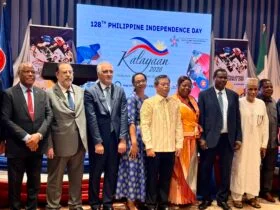
The Philippines Ambassador to Nigeria, Mersole J. Mellejor, disclosed this during the celebration of the country’s 128th Independence Anniversary hosted by the Philippine Embassy in Abuja on Wednesday.
According to the envoy, trade volume between both nations increased from $47 million in 2023 to approximately $300 million in 2025, reflecting a steady upward trajectory in commercial engagement.
Mellejor described the development as evidence of the growing potential of Nigeria-Philippines relations and expressed optimism that trade volumes would continue to rise through stronger partnerships and institutional cooperation.
“The level of bilateral trade is modest by today’s standards, but it has shown remarkable potential, having expanded consistently over the last three years. That is about a 700 per cent increase, and we remain focused on encouraging partnerships between Philippine and Nigerian companies,” he said.
To further strengthen economic cooperation, the ambassador disclosed that discussions were ongoing to establish a Nigeria-Philippines Business Council that would provide a structured platform for businesses in both countries to explore investment opportunities and enhance commercial engagements.
According to him, the proposed council will help organise business interactions and enable stakeholders to leverage the comparative advantages of both economies.
Beyond trade, Mellejor highlighted the growing educational relationship between the two countries, revealing that more than 9,000 Nigerian students are currently enrolled in higher institutions across the Philippines.
He described educational exchanges as one of the strongest pillars of bilateral relations and noted that cultural interactions between both countries continue to deepen.
The envoy pointed to the growing popularity of Afrobeats music in the Philippines and the increasing acceptance of Filipino television programmes among Nigerian audiences as evidence of expanding cultural connections.
Also speaking at the event, the Chief of Protocol at Nigeria’s Ministry of Foreign Affairs, Babagana Wakili, reaffirmed Nigeria’s commitment to strengthening diplomatic and economic cooperation with the Philippines.
Wakili commended members of the Filipino community residing in Nigeria for their contributions to national development, particularly in the health, education and technology sectors.
He noted that Nigerian authorities highly value the professionalism, expertise and services rendered by Filipino nationals working across various industries in the country.
The senior diplomat further identified trade and investment, agriculture, energy, labour mobility and capacity building as priority areas for future collaboration between the two nations.
The issues
Nigeria and the Philippines have maintained diplomatic relations for decades, but economic engagement between both countries has traditionally remained below its full potential.
As global trade patterns evolve and emerging economies seek new markets and partnerships, both countries are increasingly exploring opportunities in education, investment, technology, agriculture and human capital development.
The growing number of Nigerian students in the Philippines and the increasing trade volume underscore the expanding nature of bilateral relations.
Analysts believe stronger institutional frameworks and business partnerships could further unlock economic opportunities between both nations.
What’s being said
The Philippines government says:
Bilateral trade has grown by approximately 700 per cent within three years.
Economic relations between both countries continue to strengthen.
A Nigeria-Philippines Business Council is being planned to boost trade and investment.
Educational exchanges remain a major pillar of bilateral cooperation.
Cultural interactions between Nigerians and Filipinos are expanding.
The Nigerian government, through the Ministry of Foreign Affairs, has also reaffirmed its commitment to deepening cooperation in key sectors including agriculture, energy, investment, labour mobility and capacity development.
What’s next
Stakeholders from both countries are expected to continue discussions on establishing the Nigeria-Philippines Business Council.
Efforts to expand trade, investment and educational exchanges are also likely to intensify as both governments seek to leverage growing diplomatic goodwill.
Business leaders will be watching closely to see how the proposed council translates into concrete investment opportunities and increased commercial activity between the two countries.
Bottom line
The remarkable growth in Nigeria-Philippines trade highlights the strengthening relationship between Africa’s largest economy and one of Southeast Asia’s emerging economic players. With plans for a business council, expanding educational ties and increasing cultural exchanges, both countries appear poised to elevate their partnership beyond diplomacy into a more robust economic and developmental collaboration.