






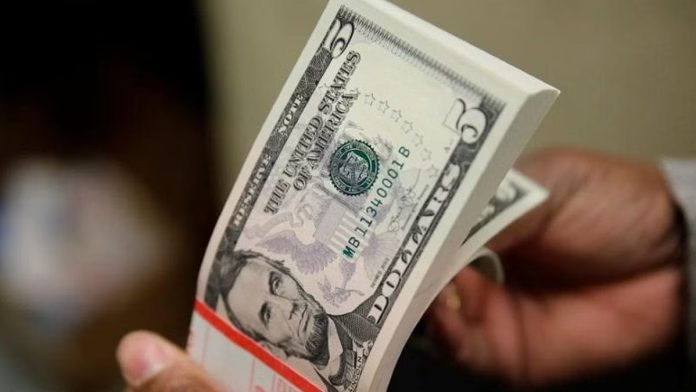
The U.S. dollar weakened across major currency pairs after the U.S. Supreme Court invalidated former President Donald Trump’s use of emergency powers to impose sweeping trade tariffs, triggering renewed volatility in global foreign exchange markets.
The ruling halted what had been a steady rebound for the greenback, pushing investors to reassess trade policy risks and monetary outlooks simultaneously.
The euro advanced toward the $1.18 threshold, recovering from a one-month low, as market participants reacted swiftly to the judicial decision. The dollar fell to 1.1807 against the euro, declined to 1.3515 against the British pound, and slipped to 154.71 against the Japanese yen after touching an earlier 10-day high of 155.64.
Currency analysts note that technical support levels are being closely watched, with projections placing support around 1.22 against the euro, 1.43 against the pound, and near 150.00 against the yen.
The court’s decision effectively nullified Trump’s emergency tariff framework. In response, Trump criticized the ruling and indicated plans to implement fresh trade measures under alternative statutory provisions.
He confirmed that new tariffs will be introduced under Section 122 of the Trade Act of 1974, proposing an additional 10 percent levy on top of existing tariff rates. Trump further disclosed that a new Section 301 investigation will be initiated, potentially paving the way for more permanent trade restrictions.
“We have alternatives. Great alternatives,” Trump stated, signaling his intention to maintain a hardline trade stance.
The former president also argued that foreign governments benefiting from the ruling would not celebrate for long, suggesting retaliatory or substitute trade actions are imminent.
Beyond tariff developments, traders were also digesting macroeconomic data from Europe. Eurozone Purchasing Managers’ Index (PMI) figures came in stronger than expected, showing private-sector activity expanding at its fastest rate since November. Manufacturing recorded its strongest growth since August 2025, while services activity also posted gains.
The improved data added upward momentum to the euro, reinforcing the currency’s rebound.
However, despite the immediate recovery, the euro remains on track to register a weekly loss of approximately 0.7 percent against the dollar. The decline reflects lingering strength in the greenback earlier in the week following the release of Federal Reserve meeting minutes.
Those minutes revealed a divided Federal Open Market Committee (FOMC), with policymakers split on the trajectory of interest rates. The debate has intensified speculation regarding the timing and scale of potential rate cuts under the next Federal Reserve Chair.
Meanwhile, European Central Bank President Christine Lagarde reaffirmed her commitment to complete her term during remarks to The Wall Street Journal, dismissing speculation of an early exit. Her comments provided institutional continuity for eurozone monetary policy.
For forex markets, the combination of legal intervention in trade policy, central bank divergence, and robust European economic data has created a complex macro backdrop.
Traders now await clarity on how alternative U.S. tariff strategies will be structured — and whether they will withstand judicial scrutiny.