








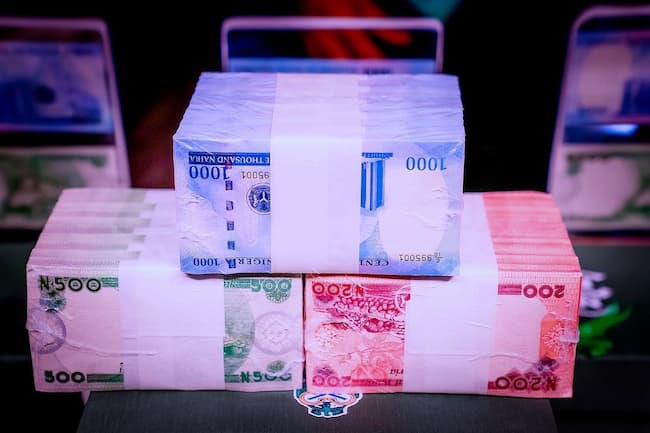
The naira depreciated across both the official and parallel foreign exchange markets on Monday, reversing part of the gains recorded in the previous week as increased demand for foreign currency outpaced available supply.
The local currency had strengthened by more than ₦5 per dollar at the official window last week, buoyed by Central Bank of Nigeria (CBN) interventions and improved foreign exchange inflows. Reduced demand pressures and increased participation from exporters, non-bank corporates, and other sources also supported the earlier appreciation.
However, fresh demand linked to international transactions and FX settlements led to renewed pressure at the start of the week.
According to data published by the CBN, the naira weakened by 0.16 percent at the official market, closing at ₦1,420.28 per dollar. Trading during the session fluctuated within a narrow band of ₦1,419.50 to ₦1,421.00 per dollar, reflecting persistent demand-supply imbalance.
The depreciation trend was mirrored in the parallel market, where the naira lost 1.08 percent to close at ₦1,480 per dollar, highlighting weakened sentiment across both the regulated and informal FX segments.
Meanwhile, Nigeria’s external reserves recorded a modest uptick, increasing by $40.71 million from the previous day to stand at $45.90 trillion, offering some buffer amid ongoing oil price volatility.
In global commodity markets, oil prices stabilized as geopolitical tensions in the Middle East eased. The subsiding civil unrest in Iran reduced fears of potential supply disruptions from one of the world’s major oil producers, while investors shifted attention to broader geopolitical developments, including tensions involving Greenland.
Brent crude edged up slightly by 0.05 percent to trade around $64.16 per barrel, while U.S. West Texas Intermediate (WTI) rose 0.15 percent to approximately $59.43 per barrel.
In contrast, gold prices surged to record levels as investors sought safe-haven assets following renewed trade tensions. U.S. President Donald Trump’s warning of additional tariffs on certain European countries amid the Greenland dispute heightened risk aversion in global markets.
Spot gold jumped by 1.82 percent to $4,678.58 per ounce, while U.S. gold futures climbed 1.87 percent to $4,681.49 per ounce.
Analysts expect markets to remain cautious in the near term, with safe-haven demand continuing to support precious metals, while oil prices are likely to remain range-bound amid mixed macroeconomic signals and lingering geopolitical risks.