






The Nigerian Senate has raised concerns over the Federal Government’s multiple budget implementations within the 2025 fiscal year, describing the practice as unacceptable to Nigerians.
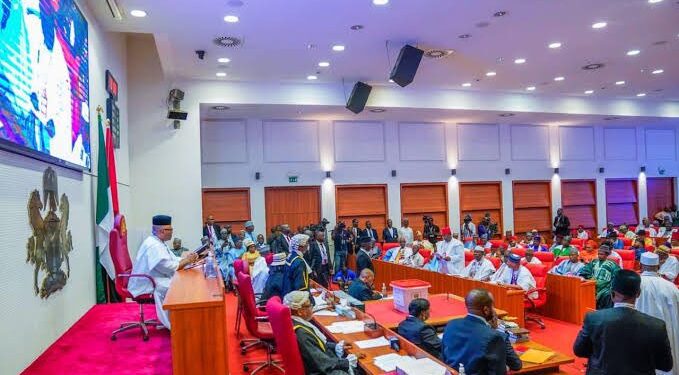
Senators from the Committee on Finance highlighted the issue during a session with the federal government’s economic management team on the 2026-2028 Medium Term Expenditure Framework (MTEF) and Fiscal Strategy Paper (FSP). Sen. Danjuma Goje said the cycle of multiple budget rollovers must end, urging normalisation from next year. Sen. Oyewumi Olalere stressed the need for realistic budget proposals to prevent non-implementation from spilling into subsequent years.
Senators Victor Umeh and Ireti Kingibe questioned why the federal government had not addressed gaps in revenue targets despite borrowings approved by the National Assembly. Minister of Finance and Coordinating Minister of the Economy, Mr Wale Edun, explained that while the 2024 budget revenue targets had been met, the 2025 projections had not. Out of the projected N40 trillion for 2025, only N10 trillion was realised, leaving a shortfall of N30 trillion and forcing the rollover of 70 percent of capital projects to 2026.
Chairman of the Committee, Sen. Sani Musa, assured that budget projections and implementation would return to normal in 2026. He said a three-man ad hoc committee would work with the minister and Accountant-General of the Federation to ensure local contractors for 2024 projects are paid before December 31.
Musa urged the Chairman of the Federal Inland Revenue Service (FIRS), Dr Zacch Adedeji, to achieve the targeted N35 trillion revenue for 2026. Adedeji noted that FIRS collected N20.2 trillion in 2024 and N25.2 trillion in 2025, with previous collections used to cover shortfalls from past budgets.
The Minister of Budget and Economic Planning, Sen. Atiku Bagudu, and the Minister of State for Petroleum, Sen. Heineken Lokpobiri, defended the parameters set for the 2026-2028 MTEF and FSP, which include 1.84 million barrels of oil production per day, a $64.85 oil price benchmark, and an exchange rate of N1,512 to the dollar.