






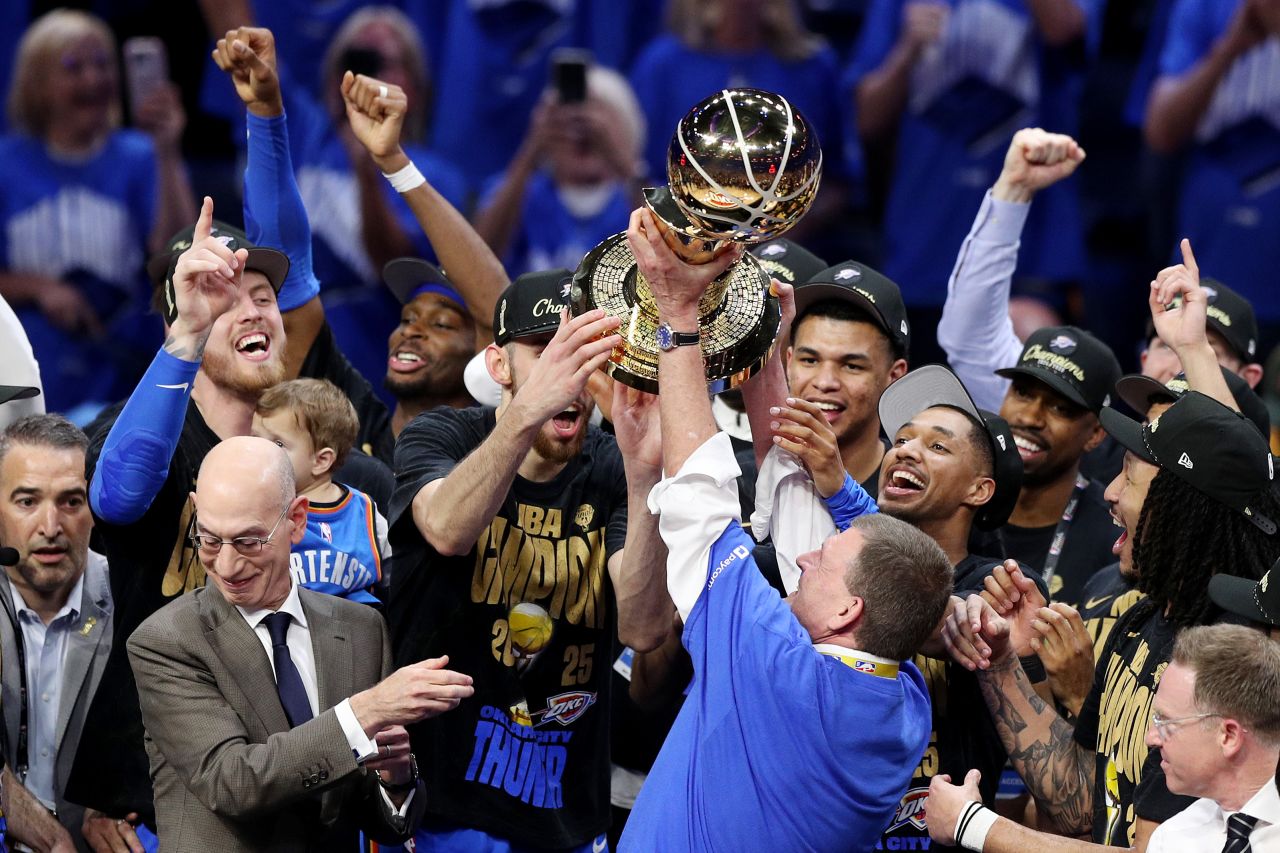
In a groundbreaking moment for the franchise, the Oklahoma City Thunder secured their maiden NBA championship on Sunday night with a decisive 103-91 Game 7 win over the Indiana Pacers, capping a season defined by dominance, resilience, and an extraordinary turnaround in performance.
This victory marks a landmark achievement for the franchise, which relocated to Oklahoma City 17 years ago. After years of rebuilding and near-misses, the Thunder finally reached the summit of professional basketball, rewriting the narrative of one of the league’s most patient and strategic teams.
The Thunder’s 2024-25 campaign was nothing short of historic. After posting win totals of just 22 and 24 games during the 2020-21 and 2021-22 seasons, Oklahoma City surged to the top of the Western Conference for the second consecutive year. This season, they registered 68 wins—ranking among the top seven single-season records in NBA history—and shattered the all-time record for point differential in a regular season, a mark that had stood for over 50 years.
Including the playoffs, Oklahoma City notched 84 victories, tying the 1996-97 Chicago Bulls for the third most wins in a single season. Only the 2016-17 Golden State Warriors (88 wins) and the 2015-16 Bulls (87 wins) achieved more.
However, the Game 7 finale also carried a somber tone due to a devastating injury to Pacers star Tyrese Haliburton. The standout guard suffered a right Achilles injury less than five minutes into the first quarter while driving to the basket, ending his game and potentially altering Indiana’s title hopes. Despite the setback, the Pacers entered halftime leading 48-47.
The Thunder responded in emphatic fashion. Led by league MVP Shai Gilgeous-Alexander, Oklahoma City unleashed a third-quarter blitz, outscoring the Pacers 34-20 to take a commanding lead into the final quarter. Gilgeous-Alexander once again delivered in clutch fashion, finishing with 29 points and 12 assists in a performance that earned him NBA Finals MVP honors.
The Pacers refused to go down without a fight, cutting a 22-point deficit to 10 in the final minutes after a timely three-pointer from Andrew Nembhard. But unlike previous games where Indiana pulled off stunning comebacks, the Thunder maintained their composure and closed the door on any late drama.
“It still feels surreal,” Gilgeous-Alexander said postgame. “We’ve put in the hours, we’ve pushed through the disbelief, and we always believed in ourselves. This team earned this championship.”
The triumph reflects the vision and long-term strategy of General Manager Sam Presti, who has helmed the team since its final season in Seattle back in 2007-08. Under Presti’s stewardship, the Thunder have amassed the second-most regular-season wins since 2008—only behind the Boston Celtics—and sit fifth in postseason victories during that span.
Before this season, however, the franchise had struggled to clinch the ultimate prize, falling short in the 2012 NBA Finals against the Miami Heat and making deep but unsuccessful runs in 2014 and 2016. On the same day that former franchise cornerstone Kevin Durant was traded to the Houston Rockets, Oklahoma City finally broke through and claimed the crown.
The seeds of this title run were sown in 2019 when Presti initiated a transformative rebuild by trading Russell Westbrook and Paul George. In return for George, the Thunder acquired a promising young guard named Shai Gilgeous-Alexander from the LA Clippers—a move that has now defined the franchise’s new era.
Weeks after those trades, Presti published an open letter in The Oklahoman, stating: “In saying goodbye to the past, we have begun to chart our future. The next great Thunder team is out there somewhere.”
That future arrived quicker than anticipated. Alongside Gilgeous-Alexander, the Thunder unearthed defensive stalwart Luguentz Dort in 2019 and later added key foundational pieces in Chet Holmgren (No. 2 overall pick, 2022) and Jalen Williams (No. 12 overall, 2022). Holmgren, despite being hampered by injuries throughout the season, recorded five blocks in Game 7—the highest in a Finals Game 7 since the NBA began tracking the stat in 1973-74.
“Records come and go, but winning as a team, that’s forever,” said Holmgren. “This is something we’ll all remember, something that will live on.”
Williams, who had struggled in earlier rounds, had a breakout series in the Finals. His 40-point effort in Game 5 showcased his potential as a future superstar and a key component in the Thunder’s long-term plans.
With both Williams and Holmgren expected to sign contract extensions this offseason—alongside a potential supermax deal for Gilgeous-Alexander—the Thunder’s core looks set for sustained success. Remarkably, only two players on Oklahoma City’s roster are older than 27, making them the second-youngest team to ever win an NBA title, following only the 1976-77 Portland Trail Blazers.
“They act like champions. They train like champions. They celebrate each other’s success,” said head coach Mark Daigneault. “This team is unique—and now they’re champions.”
The Thunder’s victory also continues a trend of competitive balance in the league. Oklahoma City became the ninth franchise to win an NBA title during Adam Silver’s 12-year tenure as commissioner. By contrast, only eight franchises won during David Stern’s 30-year term.
For Gilgeous-Alexander, this season will be remembered as one of the greatest individual campaigns in NBA history. The 25-year-old joined elite company by claiming the scoring title, the regular-season MVP, the Finals MVP, and the championship—becoming the first player since Stephen Curry in 2015 to accomplish the feat.
Back then, Curry led the rise of a youthful Warriors dynasty. Whether the Thunder are poised for a similar reign remains to be seen. But history shows that every dynasty begins with a single title—and Oklahoma City finally has its first.