










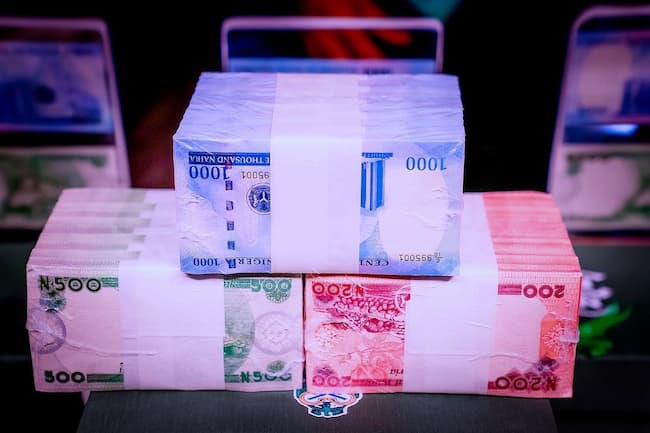
The Nigerian naira gained value across different foreign exchange markets as the Central Bank of Nigeria (CBN) continued to inject US dollars into the economy.
This steady supply of foreign currency has helped stabilize the naira against major currencies like the US dollar, British pound, and Euro. The improved liquidity has also strengthened investor confidence in Nigeria’s financial market.

International oil companies, exporters, corporate entities, and individual inflows contributed significantly to the dollar supply, increasing foreign exchange availability. Data from the FMDQ platform showed that the exchange rate appreciated by 0.15%, closing at N1,501.42 per US dollar on Tuesday. This gain was due to higher supply outpacing demand.
Both official and black-market exchange rates improved, thanks to strong FX inflows. Last Friday, the CBN intervened by selling $39.85 million at rates between N1,495.00/$1 and N1,515.00/$1 to authorized banks. This brought the total FX sales for the week to $106.65 million, according to investment analysts. Additionally, continued dollar supply to Bureau de Change (BDC) operators helped keep the naira stable in the parallel market.
Market analysts observed that the naira appreciated by 0.24% in the parallel market, closing at N1,497.11 per US dollar. The decline in speculative activities and reduced demand pressure contributed to this improvement. However, some experts warn that this momentum might slow down as Nigeria’s foreign reserves continue to decline.
The country’s external reserves have fallen below $39 billion, as the CBN uses available funds to stabilize the naira. Analysts argue that relying on short-term solutions for long-term economic challenges is not sustainable.
Meanwhile, global oil prices dropped by more than 2%, reaching a two-month low due to weak economic data from the US and Germany. Additional concerns over former US President Donald Trump’s tariff policies further weighed on the market. Brent crude fell by $1.61 (2.25%) to $73.17 per barrel, while US West Texas Intermediate (WTI) declined by $1.60 (2.3%) to $69.10 per barrel.
Gold prices also retreated as investors took profits following a record high. Despite ongoing concerns over trade wars, spot gold slipped 0.6% to $2,934.99 per ounce, after peaking at $2,956.15.












 continued to inject....)