






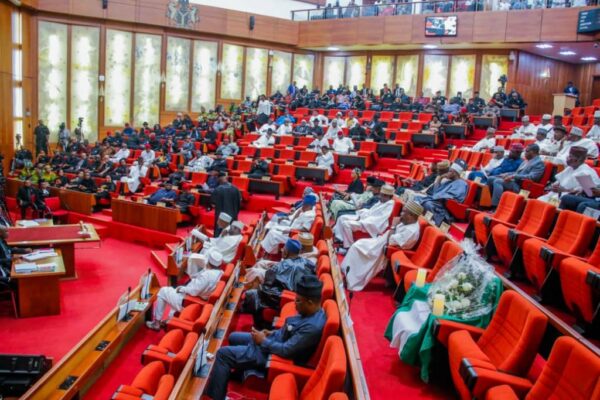
The Nigerian Senate has advanced a bill seeking to impose a 10-year travel document ban on Nigerians convicted or deported from foreign countries, in a move aimed at deterring criminal activities abroad and restoring global confidence in the nation’s passport.
The proposal, sponsored by Senator Bello Sani Abubakar (APC, Niger North), scaled its second reading on Tuesday. The bill seeks to amend the Passport (Miscellaneous Provisions) Act, Cap P343, Laws of the Federation of Nigeria, 2004.
Presenting the bill, Senator Mohammed Onawo said the amendment was necessary to protect Nigeria’s image internationally.
“If a Nigerian is convicted abroad, his passport should be withdrawn for 10 years. This will serve as a deterrent and a signal that Nigeria will not condone criminal conduct that tarnishes her reputation,” he said.
Onawo lamented that crimes committed by Nigerians overseas had led to harsher visa regimes and discrimination against law-abiding citizens.
“The green passport has lost respect globally. Its sovereign pride has been severely diminished — that is a national emergency,” he warned.
Senators expressed strong support for the bill. Senator Babangida Hussaini (Jigawa North-West) urged greater vigilance to prevent foreigners from fraudulently obtaining Nigerian passports, while Senate President Godswill Akpabio described the bill as “a bold corrective step,” recalling cases where criminals in Dubai carried Nigerian passports but were later discovered to be non-Nigerians.
The bill has been referred to the Senate Committee on Interior for further legislative action and a public hearing. If enacted, Nigeria would join a small group of countries that penalise citizens domestically for crimes committed abroad.
Meanwhile, the Senate confirmed that the Nigerian National Petroleum Company Limited (NNPCL) had responded to 19 audit queries amounting to ₦210 trillion, covering its financial records between 2017 and 2023. Chairman of the Senate Committee on Public Accounts, Senator Aliyu Wadada (Nasarawa West), said the responses were under review.
“NNPCL requested an extension during our recess to compile its data and respond comprehensively. They have now replied to all 19 queries, and we are examining the submissions,” Wadada told journalists.
In another development, President Bola Tinubu has declined assent to two recently passed bills — the Nigerian Institute of Transport Technology Establishment Bill, 2025 and the National Library Trust Fund (Amendment) Bill, 2025 — citing provisions that he said could undermine fiscal discipline and conflict with existing laws.
In separate letters read by Senate President Akpabio, Tinubu said the Transport Technology Bill introduced unauthorised levies on trade and allowed borrowing and investment powers that could create unregulated revenue streams outside the national budget. He described such provisions as “fiscally dangerous” and inconsistent with the principles of good governance.
On the National Library Bill, the President raised concerns about potential overlaps with existing laws and excessive fiscal obligations on the federal government.
In another correspondence to the House of Representatives, Tinubu sought legislative approval to secure a $2.35 billion external loan. The request includes $1.23 billion to fund the 2025 budget deficit, $1.12 billion to refinance maturing Eurobonds, and a debut $500 million Sovereign Sukuk to diversify Nigeria’s investor base and finance infrastructure projects.
The President explained that the loan, to be raised through Eurobond issuance, syndicated borrowing, or multilateral facilities, was crucial to bridging revenue shortfalls and maintaining macroeconomic stability.
Meanwhile, Speaker of the House of Representatives, Dr Tajudeen Abbas, has announced that the House will vote on 87 proposals as part of the ongoing constitutional amendment process, focusing on devolution of powers, judicial reform, local government autonomy, and socio-economic rights.
Abbas, who resumed plenary on Tuesday after the legislative recess, reaffirmed the House’s commitment to electoral reforms ahead of the 2027 general elections.
“Our goal is to make elections less contentious and more inclusive, to ensure that electoral disputes are resolved swiftly, and that violence is minimised,” he said.
The Speaker also emphasised the need for legislative action on state policing, renewable energy, and the implementation of the Start-up Act to drive economic growth and improve citizens’ welfare.