Aviator Casino is the perfect place to let your hair down and have fun! It does not matter if you’re looking for a night out with friends or want to try your luck at winning big. Aviator Casino has something for everyone.
With over 400 slot machines and 30 table games, plenty of opportunities exist to win big. Plus, with live music every weekend and special events throughout the year, you can always find something exciting. From blackjack tournaments to poker nights! No matter what fun you’re looking for, aviator casino has it all! Discover a world of fun today at aviator casino – where the possibilities are endless!
Expansion and Growth of Aviator Casinos
Aviator Casinos have been growing and advancing over the past few decades. The company has unlocked several new casinos, including Las Vegas, Atlantic City, and Macau. Aviator Casinos has also been investing heavily in its current properties. It includes remodeling existing casinos to make them more appealing to consumers. It can also involve adding new conveniences such as restaurants, bars, and entertainment venues. The firm also invests in technology to enhance consumer knowledge and improve efficiency. The casino is considering expanding online. They plan to create a platform where customers can play their favorite games from home.
The Latest Developments in Technology at Aviator Casino Sites
Aviator Casino sites continually evolve and present new technologies to enhance gaming adventure. One of the most delinquent developments is the opening of virtual reality (VR) technology. It allows players to engage in a realistic 3D environment. This technology has been utilized in many games. It includes slots, blackjack, roulette, and poker.
Some of these casino sites have also started offering live agent games. Hence, it allowed players to interact with authentic dealers in real-time. It adds a layer of authenticity to the gaming knowledge and makes it feel more like playing at a real casino.
Other developments include utilizing artificial intelligence (AI). It makes the gaming experiences more active and engaging. AI can create more capable opponents that can adjust their techniques based on your play.
Finally, many Aviator Casino sites now offer cryptocurrency payments. It serves as an alternative payment method for deposits and withdrawals. It allows players to make secure transactions. All without worrying about exchange rates or other fees. associated with traditional payment methods.
Responsible Gambling Policies of Aviator Casino Sites
Aviator sites prioritize the safety of their players by implementing responsible gambling policies. These policies include features like deposit limits and self-exclusion options. This is to protect players from potential risks. They also provide access to resources like Gam Care and Gamblers Anonymous for support. The casino encourages players to recognize signs of problem gambling.
They also provide information how to take breaks when necessary. They provide links to organizations that offer assistance to those facing gambling issues. Aviator sites are dedicated to promoting responsible gaming. It also ensures a secure and enjoyable online gaming experience for their customers.
Week 49 Pool Result 2023 | Pool Result and Fixtures This Week
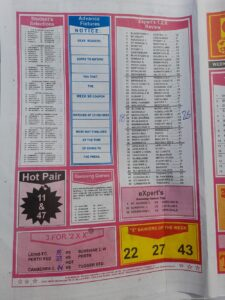
Week 49 Pool Result 2023: Now you can find the pool result, week 49 pool fixtures 2023, pool result, poolresult, pool result today, pool result today saturday, this week pool result, pool result for this week, pool result, uk pool result, aussie pool result, football pools results and fixtures, pools panel results today, live score pool result and fixtures, pool fixtures, pools panel results and pool result this week 49.
Week 49 Pool Result – Football pool coupon result for this week are published on this website immediately after Full-Time confirmation of live scores, we publish the outcome of the Pool Panel at Half-Time once a match Results is to be decided by the Football Pools Panel Association.
Week 49 Pool Result – We publish Half-Time and Full Time Results, first of its kind in Africa.
Week 51 Pool Fixture for Saturday 24 June 2023 – Aussie 2023 Season
Week 51 Pool Result 2023
Now you can find Week 51 Pool Fixtures 2023: pool result, pool fixtures, uk pool fixture, pool fixtures for this week, this week pool fixtures, football pools results and fixtures, pool fixtures this week, coupon fixtures, aussie pool fixtures, uk pool fixtures, advance pool fixtures, special advance fixtures, live score fixtures, pool panel results, pool result today, pool results, pool fixture of Week 51 from FortuneSoccer.com
The Nigerian National Petroleum Company (NNPCL) has confirmed that it will cut imports of premium motor spirit, commonly known as gasoline, once the Dangote refinery begins producing refined petroleum products in late July or early August.
NNPCL is currently the sole gasoline importer in Nigeria, a role the company has held for several years. Other oil marketers stopped importing gasoline because the US dollar was not available at the official rate.
NNPCL also owned a 20% interest in the Dangote Refinery. The 650,000 bbl/d crude oil processing refinery was completed on May 22, 2023 by former President Muhammadu Buhari, who said the facility was a milestone. Also, Aliko Dangote, Founder and President of Dangote Group, said at the opening ceremony that the plant will eliminate the flow of toxic low-grade petroleum products to Nigeria, and that the refinery will meet 100 percent of Nigeria’s fuel demand. It added that it will supply
Dangote also said the refinery will start supplying refined products to the Nigerian market from late July or early August this year.
When our correspondent contacted him to ask what would happen to the NNPCL fuel import program once the Dangote refinery began selling its products in August, National Oil Company spokesman Galbadine Muhammad said: , replied that it would change.
“NNPC Limited imports products from outside Nigeria when needed, but we do not intend to do so. would have wanted to provide a “Given the situation surrounding refineries, we cannot allow country closures, so we have to buy and sell wherever we can. If Dangote products are available, shouldn’t we buy from Dangote?” ?
“There is absolutely no reason. That is why we are interested in the Dangote Refinery. We are co-owners, shouldn’t we do business with our partners rather than do it with other people?”
Muhammad explained that the NNPCL would be supplying crude oil to the Dangote Refinery based on business agreement between both parties, and that this would be in accordance with the international price of crude.
“NNPC owns 20 per cent of that asset and we have an agreement with Dangote that we will supply the refinery with crude. So as soon as Dangote begins to request for crude to pay for it, NNPC is prepared to supply the crude as a business transaction.
“We have been selling crude to different parts of the world for decades, and it is not whether we will sell it to Dangote, for why won’t we sell to Dangote when we are selling to other refineries and countries?”
NNPCL Group Chief Executive Officer, Mele Kyari, recently stated that the supply of 300,000 barrels of crude oil per day by the national oil firm to the Dangote Refinery would start once the facility commenced operations.
Marketers demand pricing template
Meanwhile, oil marketers said the cost of refined petroleum products to be produced by the Dangote Refinery would not be known at the moment until the refinery released its pricing template.
They expressed hope that the refinery would improve the petroleum products’ supply situation in Nigeria, but noted that the cost of white products would only be determined by the pricing template of the facility.
The Secretary, Independent Petroleum Marketers Association of Nigeria, Abuja-Suleja, Mohammed Shuaibu, said, “By the time it starts producing, we would see how implementation is going to be and his template. You can’t say much about a refinery until it’s launched. So let’s see what the production looks like and what it looks like from a pricing template perspective. ”
Also on the subject, Billy Gillis-Harry, president of the Nigerian Petroleum Products Retail Store Owners Association, said the new refinery pricing proposal would give operators an indication of how much refined petroleum products from the mill will cost. said it would.
African Development Bank Group President Akinwumi A. Adesina has welcomed his reappointment by United Nations Secretary-General António Guterres to the Scaling Up Nutrition (SUN) Movement Lead Group, a distinguished team of 22 global leaders dedicated to eradicating global malnutrition in all its forms by 2030.
The announcement, made on 1 June, reflects the commitment of these nutrition champions to address malnutrition, a significant international problem.
Secretary-General Guterres commended the members of the SUN Movement’s Lead Group for their dedication: “These global leaders are championing country-led efforts to scale up nutrition and to deliver for girls, boys and their families a world free from malnutrition by 2030… I believe that the approach of the SUN Movement to tackle malnutrition through a country-owned, multisectoral and multi-stakeholder approach is more crucial than ever before.”
Adesina said he was “greatly honored” by his appointment. “I look forward to helping to deliver on this agenda,” he said.
The African Development Bank is actively engaged in addressing child undernutrition and stunting, which affects 216 million children in Africa. Poor nutrition—linked to nearly half of all child fatalities in Africa—also imposes an economic toll that costs the continent 11% of its gross domestic product.
Adesina advocates for parallel investment in Africa’s “grey matter infrastructure” alongside physical infrastructure. The term “grey matter” refers to the brain’s region involved in cognitive function and other critical operations.
The Bank’s Multi-Sectoral Nutrition Action Plan 2018–2025, a catalyst for nutrition-focused investments across various sectors, aims to reduce stunting in Africa by 40% by 2025. To date, the Bank has reallocated $2.8 billion of its investment portfolio to nutrition-smart initiatives.
The Bank has also partnered with the African Union Commission to launch the African Leaders for Nutrition (ALN) initiative, a forum for current and former leaders, finance ministers, and first ladies to promote nutrition in Africa. ALN’s Presidential Dialogue Group, involving Big Win Philanthropy and the governments of Ethiopia, Democratic Republic of Congo, Malawi, Niger, and Tanzania among others, is working to tackle stunting in the worst-affected African countries.
Bank nutrition initiatives form part of the Bank’s broader Feed Africa strategy, key to transforming Africa into a net food exporter.
In January 2023, the Bank and the Senegalese government co-hosted the Dakar 2 Africa Food Summit which has since mobilized over $70 billion to enhance food and agriculture production in Africa. Additionally, 41 African countries presented “Country Food and Agriculture Delivery Compacts” outlining a nutrition-sensitive roadmap to bolster food security.
The African Development Bank is a signatory of the Abidjan II Agreement, committing to collaborate with the African Union Commission, the Foundation for African Agricultural Research, and the Centres for Global International Agricultural Research. This partnership strives to enhance Africa’s resilience to food crises by fortifying agricultural research and innovation systems at national, sub-regional, and continental levels.
First appointed to the SUN Movement Lead Group in 2016, Adesina joins other esteemed members including Ambassador Josefa Leonel Correia Sacko, African Union Commission Commissioner for Agriculture, Rural Development, Blue Economy and Sustainable Environment; Harjit S. Sajjan, Minister of International Development and Minister responsible for the Pacific Economic Development Agency of Canada; and Pierre Cooke Jr., the Prime Minister of Barbados’ Youth Parliament and Technical Advisor, Healthy Caribbean Coalition.
Showmax’s original Nigerian animated series, Jay Jay The Chosen One has ranked as the most-watched animated series in Nigeria, Ghana and across some countries in East Africa.
The 13-part episode Jay Jay: The Chosen One has emerged as the most viewed kids’ content on Showmax in these countries, leading international animation titles including Sonic The Hedgehog 2, Paw Patrol: The Movie, Minions, Kung Fu Panda and Despicable Me.
Based on the reimagined childhood of football legend, Augustine “Jay Jay” Okocha, the series follows the adventures of Austin, an 11-year-old Nigerian schoolboy who dreams of representing his school at a prestigious football tournament and discovers his extraordinary abilities to communicate with animals and uses his “magic football” to protect them from poachers.
Through Jay Jay’s adventures, the series aims to raise awareness about the importance of wildlife conservation and the need to protect our natural resources. It also highlights the power of kindness, courage, and teamwork in making a positive impact on the world around us.
Join Austin and his friends as they embark on thrilling adventures, meet fascinating animal characters, and learn valuable lessons exclusively on Showmax.
Nigeria’s crude oil production is below 1 million barrels per day, according to a report by the Organization of Petroleum Exporting Countries (OPEC).
OPEC’s monthly oil market report for May showed OPEC’s crude oil production came in at 999,000 barrels per day in May, below the target of 1.73 million barrels per day. Production fell to 999,000 barrels per day from 1.3 million and 1.2 million barrels per day in February and March, respectively, the report said.
But Mele Kyari, chief executive of the Nigerian National Oil Company Group, said in an interview with Reuters last Saturday that Nigeria’s production was 1.56 million barrels per day.
Oil theft and illegal refining have caused Nigeria to struggle to reach OPEC’s 1.742 million barrels per day production target, forcing the cartels to further cut production for the remainder of 2023. similar news
Ayodere Oni, an energy law expert at Bloomfield, said Nigeria’s low output is having a negative impact on the budget.
“Firstly, our budget doesn’t make sense in terms of expected income and funding. We will have to borrow more and the government will not be able to do some things.”
Oil and gas expert Dr. Austin Nuweze said lower production would lead to lower revenues, urging the country to look for alternatives to balance the situation.
“Sales will fall as we have to meet demand. , the country’s reputation will suffer and customers will find another buyer,” he said. An independent researcher and development expert, Dr. Dauda Galba, also believed that lower crude oil production meant a loss of national revenues.
Week 50 Pool Fixtures 2023 | Live Scores Pool Fixtures and Results
Week 50 Pool Result 2023
Now you can find Week 50 Pool Fixtures 2023: pool result, pool fixtures, uk pool fixture, pool fixtures for this week, this week pool fixtures, football pools results and fixtures, pool fixtures this week, coupon fixtures, aussie pool fixtures, uk pool fixtures, advance pool fixtures, special advance fixtures, live score fixtures, pool panel results, pool result today, pool results, pool fixture of Week 50 from FortuneSoccer.com
Trendupp Africa – organisers of Nigeria’s first and widely acclaimed award for Influencers and Content Creators – is proud to unveil the comprehensive list of nominees for the third edition of her awards initiative, Trendupp Awards.
Founded & recognized as Nigeria’s first ever award to laud creativity and celebrate the audacity of content creators and influencers in the country, the award honours individuals and brands across various fields and platforms for their excellent use of social media.
Having received over 200,000 nominations from the general public, across sixteen categories between April 18 – May 11 2023, six nominees have now emerged per category representing the best and brightest talents in the Nigerian digital landscape. The winners will be announced during this year’s anticipated awards ceremony on Sunday July 9, 2023.
Commenting on the quality of Nigerian creators who made the list this year – Iyin Aboyeji, one of the Audacious Trendupp Awards Judging Council and Founder, Future Africa, stated “I take pride in what the Trendupp Awards platform symbolizes — a platform aimed at supporting these creative minds for their audacious contributions to the online community through diverse niche, innovative content, disruptive collaborations.
Alongside my fellow jury members, I look forward to the selection of the eventual category winners based on the three key criterias – Creativity, Consistency & Engagement.”
See below, the full list of the Trendupp Awards 2023 nominees:
Force of Instagram: Taaooma, Sheggz, Enioluwa, Priscy, Bimbo Ademoye, Tomike.
Force of Virality: Portable, Carter Efe, PapayaEx, The Honest Bunch, Lege Miamii, DJ Obi; (ENDOWED BY McVitie’s).
Force of Wellness: Aproko Doctor, Kemen Fitness, Diary of a Naija Girl, Pastor Bolaji, Noisy Naija Paediatrician, TheOlushola.
Force of Twitter: Daniel Regha, Alex HouseOf308, Ben Hundeyin, B.O.D Republic, Mbah, Rutie_xx.
Force of Lifestyle Content: Diiadem, KokoByKhloe, Akin Faminu, ThisThingCalledFashion, Neo Akpofure, Beauty Tukura.
Force of Collaboration: 1xBet, Pepsi Nigeria, Tecno, ChipperCash, Flying Fish, Goldberg.
Force of Social Good: Tunde Onakoya, SavvyRinu, Seyi Oluyole, OsitaPopcorn, Tosin Olaseinde, Otto Orondaam.
Force of Tech Content: VictorPraizeTech, ValorReviews, KnewKeed, Ola of Lagos, Kagan, Ogeh Ezeonu.
Force of YouTube: BrainJotter, Fisayo Fosudo, Broda Shaggi, Tayo Aina, SisiYemmieTV, SamSpedy.
Force of Comedy Skits: NasBoi, Mr Funny (Sabinus), Taaooma, SirBaloComedy, SydneyTalker, Gilmooree.
Force of Online Sensation: YhemoLee, Charles Okocha, PocoLee, Phyna, Timi Agbaje, TiannahsPlacempire; (ENDOWED BY Africa Magic).
Force of TikTok: MachiGoldPranks, PurpleSpeedy, Crispdal, Otweytwey, SoftMadeIt, AgentOfLaughter.
Emerging Force: SalemKinging, JayOnAir, Sophie (Soso), LayiWasabi, AbikeShugaa, KingCregx.
Force of Creative Arts: Saga, Korty, DanDizzy, Niyi Fagbemi, Itom, SlickCityCEO; (ENDOWED BY MTVBase).
Force of Food Content: Hilda Baci, TSpices Kitchen, TheKitchenMuse, Opeyemi Famakin, ChefCupid, ProphetRolex.
Force of Influence: KieKie, Bimbo Ademoye, Rufai Oseni, MrMacaroni, Aproko Doctor, Enioluwa; (WINNER GOES HOME WITH A BRAND NEW CAR, Courtesy Mikano Motors).
For more information about each cagetory and the nominees, kindly visit https://www.trenduppawards.com/nominees
Further details on the award can be curled from all Trendupp’s social media platforms @thisistrendupp & website www.trenduppawards.com/
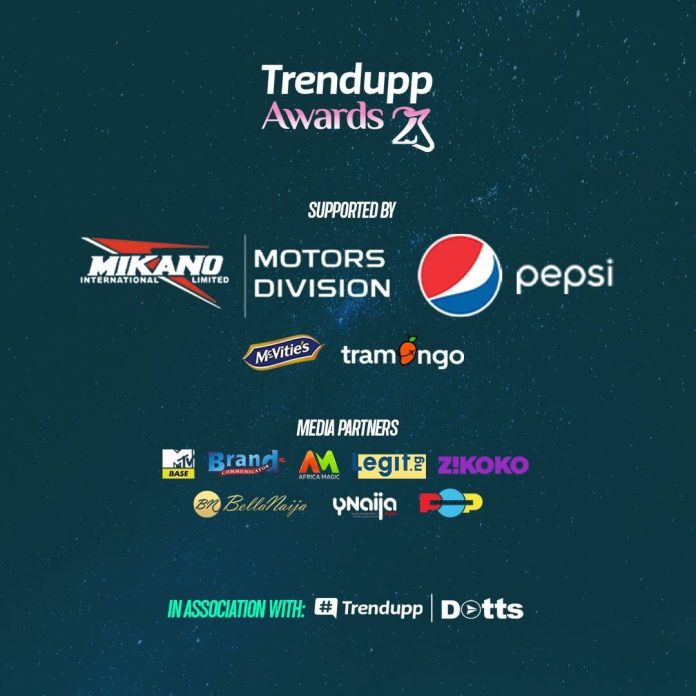
Trendupp Awards is an initiative of Trendupp Africa, a platform where creatives receive support, and build direct relationships with their fans across Africa. Trendupp Awards is presented by Trendupp Africa in association with DottsMediaHouse and proudly supported by Mikano Motors, Pepsi Nigeria, McVitie’s Nigeria, Tramango, MTV Base, Africa Magic, PopCentral Television, BellaNaija, Zikoko, Brand Communicator, Legit.ng, and YNaija.
Trendupp Africa is a subsidiary of DottsMediaHouse – The media company for leading brands across Africa – known as a leading force in the influencer marketing space in Nigeria.
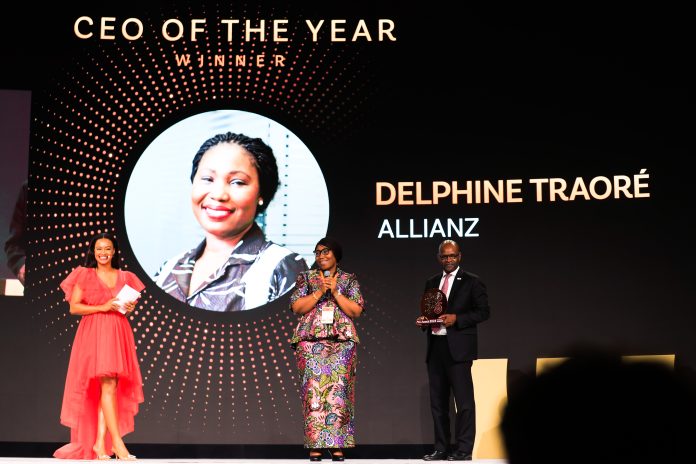
5/06/2023 - Abidjan, Côte d'Ivoire - Africa CEO Forum 2023 - Diner de gala | Remise des prix - CEO of the year : Delphine Traoré.
Delphine Traoré, Regional CEO of Allianz Africa, was recognized as CEO of the Year on June 5, 2023, in Abidjan, by the largest private sector meeting on the continent, the Africa CEO Forum.
In the presence of an assembly of almost 2,000 eminent personalities including Governments’ members, high-level actors from the private and public sectors as well as civil society from Africa and the world, Delphine’s merits are thus highlighted, not only as a recognition of her action, but also as a plea for the challenges facing the continent and which require for her continued commitment.
Indeed, in the insurance industry sector, Delphine is recognized for her commitment to improve the governance and successfully negotiated a major deal with Sanlam, making her group the largest non-banking financial services company in Africa.
On the social side, over the years, Delphine has never ceased to make a concrete commitment in advocating many social causes in Africa, whether for farmers’ prosperity, education of social entrepreneurs and girls, gender equality, inclusion, impact of climate change on the population…
The challenges are certainly numerous, but for Delphine, the opportunities are just as numerous!
“I would like to thank the Africa CEO forum and Jeune Afrique for this honor. I accept this award on behalf of our teams at Allianz, our partner Sanlam who together with us have been working tirelessly for long hours this past year to bring to life an insurance company that will transform the financial landscape in Africa! We have been supported by team of advisors and lawyers that are the best at their craft. This award is for all of us women. All we need is opportunity. We are seen we must just keep at it.”, stated Delphine Traoré.”, stated Delphine Traoré.
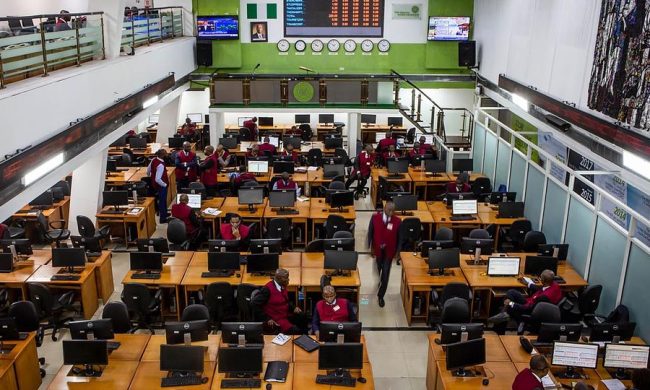
The Nigerian Stock Exchange (NGX) fell Wednesday after Airtel Africa shares fell. Shares of the telecoms giant fell as investors sold shares after recording gains the previous day.
Airtel Africa’s market valuation fell by more than N7.5 billion, with the local stock exchange slipping into the red at the close of trading, according to market data. The market performance indicator fell slightly to -0.02% and the year-to-date return fell to 9.32%, according to brokerage reports.
As expected from the weaker performance, the market index, or all-stocks index, fell 13.29 basis points, down a modest -0.02% to close at 56,025.56. However, Atlass Portfolios Limited informed investors that market activity has increased today with total trading volume and trading value up +23.30% and +12.24% respectively.
About 397.62 million units (worth £6.53719 billion) were settled in 5,613 transactions, according to equity market analysts.
NPFMCRFBK was the most traded stock on a volume basis, accounting for 25.36% of total volume, followed by GTCO (10.83%), JAPAULGOLD (7.01%), FIDELITYBK (6.12%) and ACCESSCORP (5.79%). Top 5 in volume table.
AirTerrafri was the most traded stock by value, accounting for 41.47% of the total trading volume on the stock exchange. HONYFLOUR topped the list of today’s gainers with gains of 9.87% each. Food manufacturers were followed by ETERNA (9.87%), FTNCOCOA (+9.86%), CORNERST (+9.78%), WAPIC (+9.52%) and 26 others. 12 stocks fell, with UBN being the biggest loser, down -8.86% to close at ₦7.20.
Flour Mills fell 4.20%, NGX Group fell 3.11%, Prestige fell 2.44% and Courtville fell 2.08%. The market width finished positive with 31 winners and 12 losers.
Three of the five major market sectors fell, according to the local stock exchange, and the performance of the market sector ended lower. The banking sector (-0.25%), industrials (-0.02%) and consumer goods (-0.01%) followed, while the insurance and oil & gas sectors were +3.61% and +0 respectively. Up
The market capitalization lost £7.24 billion on the sale, down slightly -0.02% from £30.513 trillion the day before, to close at £30.506 trillion.
Week 49 Pool Fixtures 2023 | Live Scores Pool Fixtures and Results
Week 49 Pool Result 2023
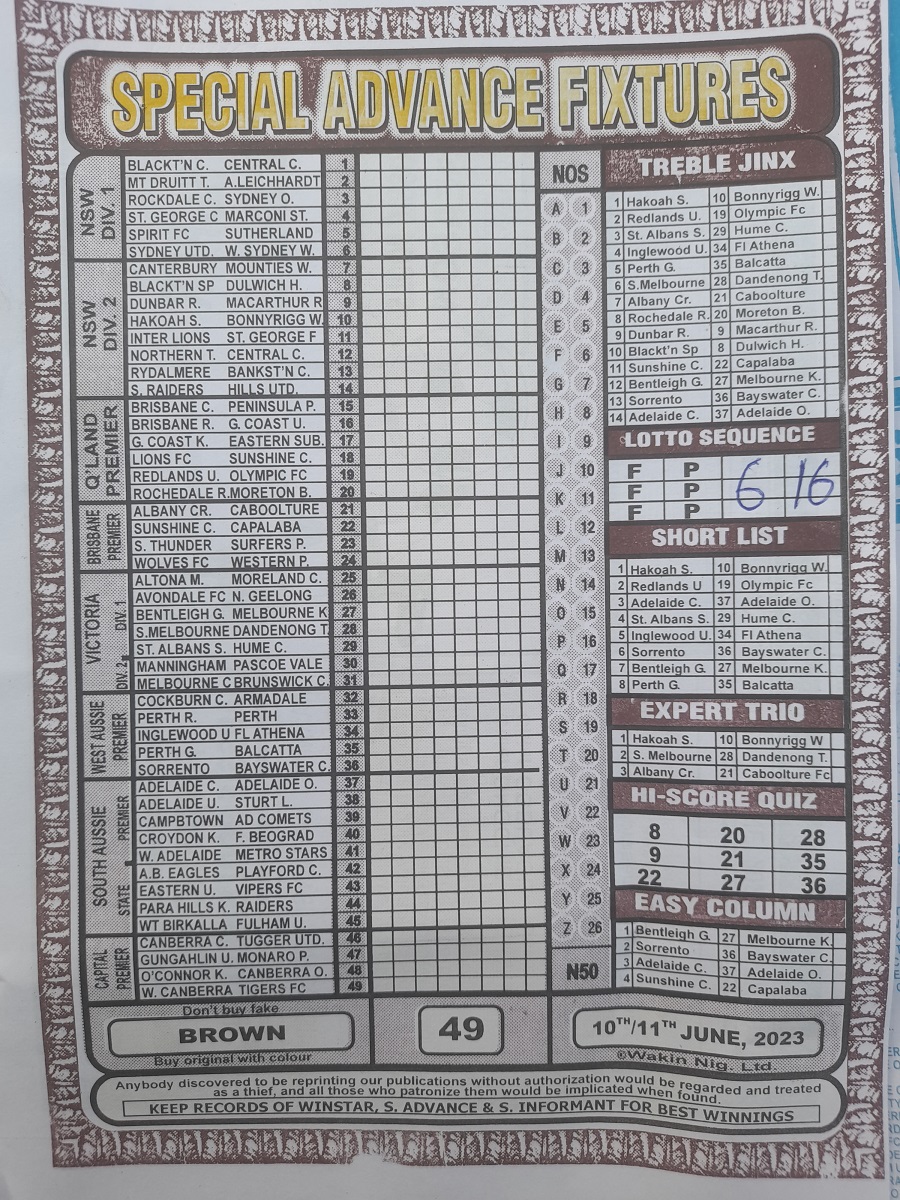
Now you can find Week 49 Pool Fixtures 2023: pool result, pool fixtures, uk pool fixture, pool fixtures for this week, this week pool fixtures, football pools results and fixtures, pool fixtures this week, coupon fixtures, aussie pool fixtures, uk pool fixtures, advance pool fixtures, special advance fixtures, live score fixtures, pool panel results, pool result today, pool results, pool fixture of Week 49 from FortuneSoccer.com
Week 49 RSK Pool Papers 2023: Soccer, Bob Morton, Capital Intl, Winstar, BigWin
Rsk Papers Week 49 2023
Week 49 rsk papers 2023: Welcome to Fortune Soccer here we provide you with RSK papers (Bob Morton, Capital International, Soccer ‘X’ Research) and papers from other publishers such as Dream International Research, Fortune ‘X’ Matrix, WinStar, Bigwin Soccer, Special Advance Fixtures, Right On Fixtures, Weekly Pools Telegraph, Pools Telegraph, Temple of Draws, Soccer Standard, and Dream International Fixtures.
The negative sentiment dominated the stock market of the Nigerian Exchange Limited (NGX) on Wednesday, June 7, 2023, as market indicator dropped by 0.03 per cent amid investors profit-taking on Airtel Africa Plc and 11 others undermined market performance.
The NGX All Share Index (ASI) declined by 14.33 basis points or 0.03 per cent to close at 56,024.52 basis points from 56,038.85 basis points.
Also, market capitalisation lost N7 billion to close at N30.506 trillion from N30.154trillion the market opened for trading yesterday.
The decline was impacted by losses recorded in medium and large capitalised stocks, amongst which are; Airtel Africa, Flour Mills of Nigeria, Nigerian Exchange Group, Union Bank of Nigeria (UBN) and Lafarge Africa.
However, market breadth closed positive, as 32 stocks gained relative to 12 losers. Eterna and Honeywell Flour Mills recorded the highest price gain of 9.87 per cent each to close at N12.25 and N3.45 respectively, while FTN Cocoa processors followed with a gain of 9.86 per cent to close at 78 kobo, per share.
Cornerstone Insurance went up by 9.78 per cent to close at N1.01, while Wapic Insurance appreciated by 9.52 per cent to close at 46 kobo, per share. On the other hand, Union Bank led the losers’ chart by 8.86 per cent, to close at N7.20, per share. Flour Mills followed with a decline of 4.20 per cent to close at N33.10, while Nigerian Exchange Group declined by 3.11 per cent to close at N28.00, per share.
Prestige Assurance depreciated by 2.44 per cent to close at 40 kobo, while Courteville Business Solutions declined by 2.08 per cent to close at 47 kobo, per share.
The total volume traded increased by 23.30 per cent to 397.625 million units, valued at N6.537 billion, and exchanged in 5,613 deals. Transactions in the shares of NPF Microfinance Bank topped the activity chart with 100.762 million shares valued at N181.373 million.
Guaranty Trust Holding Company (GTCO) followed with 43.031 million shares worth N1.197 billion, while Japaul Gold & Ventures traded 27.838 million shares valued at N11.541 million.
Fidelity Bank traded 24.297 million shares valued at N140.898 million, while Access Holdings sold 23.021 million shares worth N293.044 million.
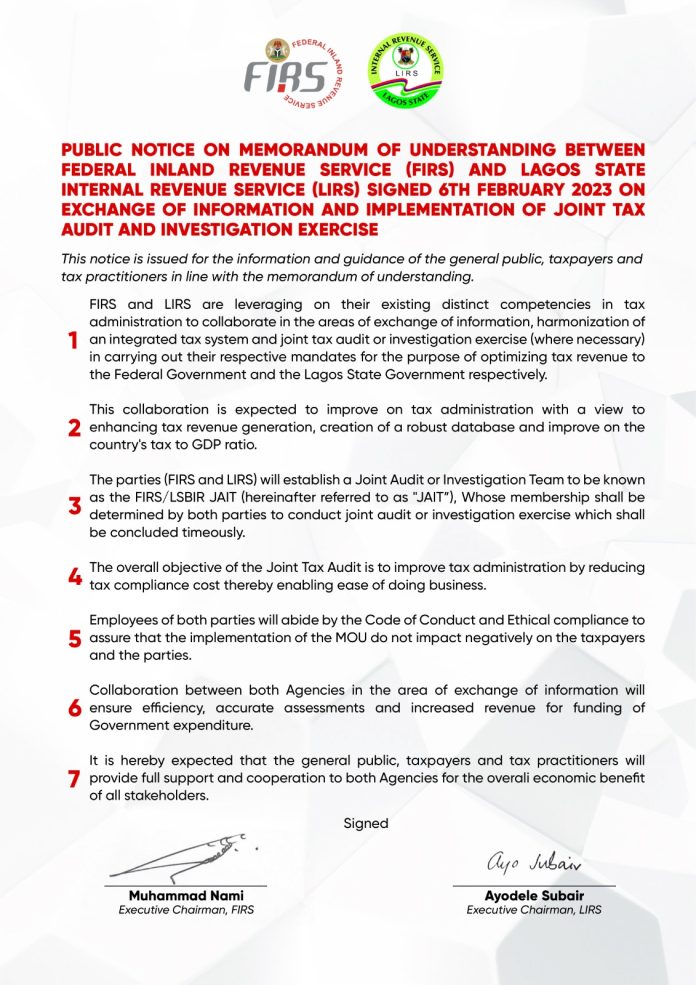
The Lagos Internal Revenue Service (LIRS) and the Federal Inland Revenue Service (FIRS) have issued a public notice on the Memorandum of Understanding (MoU) signed by both agencies to establish a Joint FIRS and LIRS Audit and Investigation Team aimed at encouraging the exchange of information between both agencies.
In the communique signed by Ayodele Subair, Executive Chairman, LIRS, and Muhammad Nami, Executive Chairman, FIRS on Wednesday, the general public, taxpayers and tax practitioners are charged to provide full support and cooperation to both Agencies for the overall economic benefit of all stakeholders.
According to the MoU, the overall objective of the Joint Tax Audit would be to improve tax administration by reducing tax compliance cost thereby enabling ease of doing business in the country.
Speaking on the MoU, Mr Ayodele Subair, Executive Chairman, LIRS, said while the importance of the agreement was to foster greater collaboration between the two agencies, “There is no reason to debate the above as it has been established that tax compliance and good governance are expected to co-exist as the undividable social contract that binds citizens and governments anywhere in the world.
“Therefore, citizens and governments are expected to fulfil their end of the bargain in achieving a balance.”
According to the FIRS Executive Chairman, Muhammad Nami, ‘’the cooperation would enable the two authorities to work as a team in sharing relevant information that would assist both parties in their tax administration and enforcement roles as it would also provide capacity building between both tax authorities.
“We will carry out a joint audit and investigation as a team, we will also conduct an automatic exchange of information for gathering data for the purpose of tax administration. With that information, we would be able to carry out tax administration seamlessly,” he submitted.
The communique says while the notice was issued for the information and guidance of the general public, taxpayers and tax practitioners in line with the memorandum of understanding, the collaboration between both Agencies in the area of exchange of information will ensure efficiency, accurate assessments and increased revenue for funding of Government expenditure,
FIRS and LIRS, the communique says further, are leveraging on their existing distinct competencies in tax administration to collaborate in the areas of exchange of information, harmonization of an integrated tax system and joint tax audit or investigation exercise (where necessary) in carrying out their respective mandates for the purpose of optimizing tax revenue to the Federal Government and the Lagos State Government respectively.
The collaboration is expected to improve tax administration with a view to enhancing tax revenue generation, creation of a robust database and improve on the country’s tax-to-GDP ratio.
The parties (FIRS and LIRS) are expected to establish a Joint Audit or Investigation Team to be known as the FIRS/LSBIR JAIT (hereinafter referred to as “JAIT”), whose membership shall be determined by both parties to conduct a joint audit or investigation exercise which shall be concluded timeously.
The communique assured the public that employees of both parties will abide by the Code of Conduct and Ethical compliance to assure that the implementation of the MOU does not impact negatively on the taxpayers and the parties.
According to the data at the FMDQ Security Exchange where forex is traded officially, the dollar to naira exchange rate stood at (undisclosed).
This would mean that the Nigerian currency either gained or lose in value against the United States dollar, as the foreign exchange (forex) trading closed at N461.78 per $1 on Tuesday, June 6.
How much is the dollarto naira at the black market today?
Going by sources at the Bureau De Change (BDC) in Lagos, the dollar to naira last traded between ₦750 and ₦780 with an average of ₦761.67 in the black market in the state.
It is, however, pertinent to note that the Central Bank of Nigeria (CBN) does not recognise the parallel market (black market), as it has directed individuals who want to engage in forex to approach their respective banks.
In the dynamic world of STEM education and innovation, one remarkable initiative, InterswitchSPAK National Science Competition, continues to ignite the passion for Science, Technology, Engineering, and Mathematics (STEM) among secondary school students in Nigeria and beyond.
From its inception, InterswitchSPAK, an initiative of Interswitch Group, has grown to become a beacon of inspiration for young African minds, nurturing their talent and encouraging them to explore the wonders of STEM as the key to delivering the Africa of their dreams. Following the completion of a successful first edition in Nigeria in 2018, the initiative was introduced to schools in Kenya the following year.
This year’s edition – InterswitchSPAK 5.0 marks a significant milestone in the timeline of this laudable initiative which has played a crucial role in encouraging young students to pursue STEM careers, providing a platform for them to showcase their talent and compete for exciting prizes, including university scholarships.
The success of past winners is a testament to the profound impact of the InterswitchSPAK competition. From the University of Lagos to Texas A&M University and Howard University, both in the USA, winners of the competition continue to shine like bright stars across the globe, spurred on by their passion and drive, and by the support they have received from Interswitch.
InterswitchSPAK 5.0 promises to be even more impactful with an expanded prize pool. The competition is open to all senior secondary school students between the ages of 14 and 17, currently enrolled in public and private schools in Nigeria. Contestants will go through various qualifying rounds, including online assessments, leading up to the grand finale where the finalists will compete for the ultimate prize.
The winner of InterswitchSPAK 5.0 will receive the grand prize of N7.5 million in scholarships for a five-year period, a laptop, and monthly stipends. The second-place winner will be awarded N4 million in scholarships for three years, a laptop, and monthly stipends.
In addition, the third-place winner will receive N1 million in scholarships for one year, along with monthly stipends and a laptop. The top three winners will also be entitled to mentoring and internship opportunities at Interswitch, as well as other exciting prizes.
Interswitch Group continues to showcase its unwavering dedication to promoting STEM education in Nigeria and across Africa. By celebrating five years of excellence in advancing STEM, Interswitch Group exemplifies its vision of an Africa empowered by young innovators.
As the remarkable journey continues, Interswitch eagerly anticipates the success stories that will unfold from this year’s competition. The impact these young innovators will have on the future of Nigeria and beyond is immeasurable, and Interswitch Group is proud to be a part of their journeys.
Registration for the competition is on until the 16th of June. For registration details, click here.
Nigeria, currently ranked 50th worldwide for online threats, South Africa at 82nd, and Kenya at 35th, have increasingly become focal points for cyber threats, as per the latest data from the Kaspersky Security Network (KSN).
Kaspersky presented on the reality of cyber threats in Africa at the recent inaugural GITEX Africa conference, held in Morocco.
Dr Amin Hasbini, Head of the Global Research & Analysis Team (GReAT) for META at Kaspersky, expanded on several cyberthreat trends, cautioning business and technology leaders about two primary forms of cyberattacks – criminal and advanced.
“Criminal attacks are mainly driven by the pursuit of financial profit, whereas advanced attacks indicate how cyber threat actors continually adapt their tactics and tools to breach security measures.
“A significant portion of the attacks witnessed across Africa are shaped by the rapidly changing geopolitical landscape. However, a growing concern is that cybercriminals are learning from successful advanced attacks to refine their craft,” said Dr Hasbini.
In the first quarter of 2023, Kaspersky reported that backdoor and spyware attacks were the most common threat types in South Africa, amassing to 106,000 attack attempts. Similar attacks attempts were observed in Nigeria, totalling 46,000, while the same type of attacks peaked at 143,000 in Kenya. However, in Kenya, exploits emerged as the most dominant form of attack with 177,000 incidents blocked.
Kaspersky also highlighted the growing surge of zombie machines – a connected device that becomes part of a botnet. Examples include legacy, old and forgotten devices, IoT devices, network equipment, printers, cameras, even coffee machines. In the year to date, 1.6 million zombie machines have been detected in South Africa and 300,000 in Kenya.
Dr Hasbini’s presentation flagged several ransomware groups setting their sights on African targets. “Threats to critical infrastructure, financial institutions, government entities, and service providers have predominated the cyber threat landscape over the past year. We have witnessed different threat actors target various businesses across industries.”
In response to these increasingly sophisticated cyber threats, businesses are advised to adopt a multi-layered defensive strategy. This is where extended detection and response (XDR) solutions become essential – they analyse data not only from endpoints, but also from other sources.
XDR introduces another layer of protection as attacks on infrastructure can occur through any entry point. XDR also adds analytical and automation functions for the detection and elimination of current and potential threats. Furthermore, continuous security awareness training for employees and real-time access to intelligence on the latest attack methods should supplement any cybersecurity strategy.
Dr Hasbini added; “Businesses should consider leveraging advanced technologies such as threat feeds, security information and event management systems, endpoint detection and response solutions, and tools with digital forensics and incident response features.
“It is vital to understand that cyber security measures are an ongoing endeavour – and that there is no universal solution to secure a corporate network or data.”
Apple has announced the release of its new VR device, the Vision Pro, which will only be available in the United States momentarily and is expected to cost $3,499 (N1.617 million).
The device which was unveiled by CEO Tim Cook, is being marketed as a revolutionary product that will change the way we view technology. The Vision Pro will focus on gaming, video streaming, and conferencing, and has been in development by Apple for years.
Here are 5 insane new features that are contained in this product:
Mac Integration: Put on the headset and control your mac in a full 3D world, absolute game changer for anyone in creative fields. Just open your Mac and put on the headset.
Natural Controls: You can literally control the headset with your eyes . Hand and voice controls are also available.
Augmented Reality (AR): When you put the headset on you enter a new digital world that transforms your surroundings into a super computer. AI integrations will change how humanity works completely.
Spatial Cinema: Enjoy insane movie & sports experiences like you’re sitting in your own private IMAX movie theatre.
The First 3-D Camera: Full 3-D camera and replay capabilities have the power to transform how we interact with our memories and content.
This argument is for the people. There is now a near-unanimous rejection of the petrol subsidy regime in Nigeria. This is now the popular position. I fear that with the deification of this position, some valid arguments in favour of petrol subsidy within Nigeria’s unique socio-economic context are being denied oxygen, with grave, even existential, threat to the people.
To surrender the argument to a government uninterested in ending its imperial status— with all its attendant costs— and an egotistic liberal economic elite buoyed by affirmations within its intellectual bubble, and determined to test the furthest free market theories on the already pulverized masses, is a position I cannot accept.
There has been a growing socio-economic inattentional blindness among Nigeria’s ruling and liberal economic intellectual elite regarding the petrol subsidy issue. They have almost entirely embraced the Bretton Woods position on the petrol subsidy expenditure which isolates it as a drain on national resources, costing the country multiple other development opportunities. This position is flawed, I reckon. In Nigeria, isolating fuel subsidy as a purely wasteful consumption spend is an error. Within the context of Nigeria’s energy crisis, inflation surge, purchasing power squeeze, and general cost of production challenges, petrol subsidy cannot be so rightly isolated.
Caution and contemplation are key in this debate. Scholarly tentativeness and intellectual humility are paramount. One ideological strand in economics cannot be gospel. It cannot be unchallengeable. It cannot be treated as an absolute truth. Our pro-subsidy removal economists (who also champion free float of the currency and other free market reforms) must be realistic enough to recognize that economics is not an exact science. An economic proposal, more often than not, cannot solely determine its own destiny; it depends on some other variables.
It is only this realization that will allow for expanded thinking and pragmatic, as against ideological, propositions. I reckon that what has become the subsidy conundrum has a hybrid solution, not an entirely free market solution, given the peculiarities of Context Nigeria.
The fuel subsidy regime does not exist in isolation. In Nigeria, it is simplistic, even inaccurate, to suggest that petrol subsidy is merely subsidizing consumption (not that it is entirely indefensible to argue for subsidy on consumption); it is subsidizing production as well. The Nigerian subsidy story is different. The Nigerian context strips some of the general oft-repeated theoretical principles against subsidy, like “don’t subsidize consumption”, “it is the rich that are being subsidized” and “government needs the money to drive development” of their force of truth; I will explain.
“In Nigeria, petrol subsidy is a purchasing power argument. It is a production argument. It is a local economy energizer argument. It is not merely a consumption argument”.
In Nigeria, petrol subsidy is a purchasing power argument. It is a production argument. It is a local economy energizer argument. It is not merely a consumption argument.
Regarding production and energizing of local economies, petrol subsidy within the context of Nigeria’s energy crisis provides useful insights. According to the World Bank, 85 million Nigerians (43% of the population) do not have access to grid electricity, representing the largest energy access deficit globally.
To survive the grid energy exclusion, individuals, households and businesses resort to reliance on generators. According to the National Bureau of Statistics (NBS), generators powered by petrol, diesel and gas provide 48.6 percent of the electricity consumed by power users across the country. Of this figure, petrol-powered generators account for the bulk of the share, at 22.6 percent.
Overall, an estimated 60 million people use generators to provide electricity for their homes and businesses. According to the International Renewable Energy Agency’s (IRENA), 84% of urban households use backup power supply systems such as fossil diesel/ gasoline generators, while 86% of the companies in Nigeria own or share a generator, making Nigeria the highest importer of Premium Motor Spirit (PMS) and diesel generators in Africa as of 2022.
“Nigerian households and businesses spend an estimated $22 billion annually to fuel generators powering their homes and business”.
The June 2022 report by Stears and Sterling, titled, “Nigeria’s State of Power: Electrifying the Nation’s Economy,” provides some useful insights. It reveals that:
“Over 40 per cent of Nigerian households own generators, and bear the associated costs. First, the cost of purchasing generators – an estimated $500m between 2015 and 2019, higher than the proposed capital expenditure in Nigeria’s 2022 budget.
“There is also the cost of powering these generators. Sources and estimates vary widely, but the African Development Bank estimated that Nigerians spend $14bn fuelling petrol or diesel powered generators.
“While PMS (Premium Motor Spirit) or petrol prices have been kept artificially low for the consumers through subsidies, variations in AGO (Automotive Gas Oil) or diesel prices can have a severe impact on households and businesses as Nigerians are currently experiencing.”
There is telling data from the report on how the largely stable price of petrol due to the subsidy regime helps small businesses survive. “These prices make the small petrol generators more attractive to households and MSMEs (micro, small and medium enterprises)”, the report stated.
“It is estimated that…In countries with low electricity reliability, the proportion of SMEs using a generator is higher, reaching 86 per cent in Nigeria.”
It is estimated that around 33 percent of SMEs in developing countries use a generator. In countries with low electricity reliability, the proportion of SMEs using a generator is higher, reaching 86 per cent in Nigeria.
I have taken pains to show how inextricably linked access to electricity is to petrol subsidy because this point is hardly stated by anti-subsidy advocates. Only recently, the NNPC boss, Mele Kyari, in defending the removal of subsidy, said the country was mostly subsidizing the rich. He, like others, uses car-ownership status as one key measure of ‘the rich’. I’ve always found this argument puzzling. The number of small commercial vehicles relying on petrol belongs to the rich too? Millions of Nigerians relying on petrol-powered commercial vehicles because of the absence of public transportation are enjoying some subsidy luxury?
It is also curious that the argument about lack of capacity for local refining of petrol being largely responsible for the cost of subsidies is now being abandoned. The NNPC boss said the coming of Dangote refinery and eventual return of Nigeria’s refineries would not impact price of petrol significantly. So, what is being said is that the people will now be at the mercy of the markets, essentially having to deal with another heavy cost burden in the foreseeable future, within an already killing cost of living crisis.
This is the new normal. An era of price hikes. The argument on how competition and market forces would swing price eventually to the consumer is a curious one too. Swing it to what range? If what has happened with the deregulated diesel and kerosene prices are anything to go by, the petrol price band will for the foreseeable future remain a menacing threat to the people’s standard of living.
The reliance of SMEs, especially, on petrol (as with owners and passengers of petrol-powered commercial vehicles) and petrol-powered generators is a counter to the argument that we are merely subsidizing consumption. SMEs within the formal and informal economies rely greatly on petrol. Removing the subsidy has just triggered an unprecedented price disruption with grave implications for these businesses and their consumers.
I have heard the argument about the unsustainability of petrol subsidy, given Nigeria’s revenue and debt crises. That’s a government argument, a convenient one. That’s not the fault of the people. If the government were serious about waste, prudence and efficiency, then a holistic reform proposal should be advanced. It must include, reining in the size of government, blocking leakages, cutting waste, fighting corruption, and ending subsidies for the actual rich.
“..the total waivers granted by the Nigerian government surpassed its total revenue by 71.3 per cent”
Speaking of subsidies for the actual rich, data from the nation’s Medium Term Expenditure Framework and Fiscal Strategy Paper (MTEF/FSP) 2023-2025 show that Nigerian government granted waivers, incentives and exemptions worth N2.296 trillion in 2021 to different beneficiaries through the Nigeria Customs Service (NCS) while Customs’ total revenue collection in 2021 was only N1.34 trillion. This implies that the total waivers granted by the Nigerian government surpassed its total revenue by 71.3 per cent.
The Federal Government’s introduction of import Duty Exemption Certificate (IDEC) through the Ministry of Finance exempting critical players from payment of import duties and other statutory Customs charges has been alleged to have cost the country a whopping N16 trillion in fraudulent manipulation of the system. Some companies, individuals and other entities were alleged to have abused the system and shortchanged the Federal Government of revenue by hiding under the waiver policy to evade duty on imported goods that are dutiable.
“Senate Committee on Finance had frowned at the N6 trillion tax and import duty waivers proposed by the Nigerian government in the 2023 budget, while pushing for wastages and leakages in the nation’s public sector to be blocked”.
It helps to remember that the Senate Committee on Finance had frowned at the N6 trillion tax and import duty waivers proposed by the Nigerian government in the 2023 budget, while pushing for wastages and leakages in the nation’s public sector to be blocked.
I have seen calls for interventions to cushion the impact of the subsidy removal on the people. Things like provision of public transportation and minimum wage increase have been proposed. I believe these proposals underestimate the multiplier force of petrol subsidy in Nigeria. With its removal, the price of virtually every commodity has gone up significantly.
Yemi Kale, former NBS boss, estimates that the removal will take inflation to 30 percent. This is at a time the people have been battling high prices of commodities. How can limited provision of public transportation or marginal increase in minimum wage mostly for federal workers stem this system-wide disruption? There are structural issues, like electricity deficit and other cost of production issues, which put these interventions in their proper context— a dangling reed in a deserted island.
And if increase in minimum wage triggers further inflation, what value of the increase would be left? Won’t this just amount to a circular price movement— akin to taking us on a deluded journey to escape a cost of living crisis and arriving at the same point of departure?
“how can the government which has failed to manage a subsidy regime that has inherent capacity for inclusive reach, design and manage a benefits system entirely dependent on its managerial capacity and integrity?”
Some have argued that the savings from the subsidy would be channelled to proper development priorities. This is the argument of the government as well. They seem to be arguing that the subsidy spend is a waste, a drain on national resources. While I can relate with the corruption part of the subsidy regime, I vehemently reject the dismissal of petrol subsidy as a waste. They appear to be saying that unless we subject public expenditure to some government programme that plans the disbursement of funds and decides winners and losers, the spend is of inferior value.
I reject this. This stems from unreasonable faith in the capacity of government; how can the government which has failed to manage a subsidy regime that has inherent capacity for inclusive reach, design and manage a benefits system entirely dependent on its managerial capacity and integrity?
“I believe petrol subsidy is the most direct, inclusive, impactful and far-reaching government benefits distribution system within the Nigerian context”
Contrary to this position, I believe petrol subsidy is the most direct, inclusive, impactful and far-reaching government benefits distribution system within the Nigerian context. We have seen failed attempts at palliative distribution. The social welfare system of the Buhari administration continues to suffer credibility issues as many believe it has been neither widespread, verifiable, or inclusive.
Some have even pointed to how many hard infrastructure projects could have been executed with the monies used for subsidy payments. It is as if they are saying hard infrastructure takes precedence over human development. This is a flawed argument. There is a reason why HDI is deemed an essential measure of a country’s development. Both can, and should, be prioritized.
“In the long run, we’re all dead”.
Finally, to the economists who ask the longsuffering Nigerian masses to exercise further patience, to have faith that the government’s reforms would yield lasting fruits, that the free market would resolve the issues in their favour in the long run, may I kindly remind them of John Maynard Keynes’ famous quote that “In the long run, we’re all dead”.
In fact, I reproduce it in full:
“But this long run is a misleading guide to current affairs. In the long run we are all dead. Economists set themselves too easy, too useless a task, if in tempestuous seasons they can only tell us, that when the storm is long past, the ocean is flat again.”
This article is written by By Chinedu Chidi
Chinedu Chidi, public commentator, writes from Abuja, Nigeria and can be reached via chiobe24.cc@gmail.com