Overnight rates which was 0.98 on Monday, February 1, leaped to 3.4167 at the close of business on Tuesday, February 2.
However,naira remained static at N199.1 to the dollar at the interbank market since the beginning of 2016.
Last week, overnight lending rates had surged from one per cent on Monday to 9.2917 per cent by Wednesday before dropping to 1.0467 per cent by the close of business on Thursday.
Loner tenured lending rates had remained relatively stable.
The Nigerian Liquefied Natural Gas, NLNG, Limited has offered N60 billion to partially fund the Bonny-Bodo Road, a road infrastructure project of the government.
The Managing Director of NLNG, Babs Omotowa, who explained that that the project will help improve the infrastructure in the Niger Delta when completed, added that the company’s N60 billion offer represents 50 per cent of the total project cost for the road.
Omotowa, who addressed the Senate Committee on Niger Delta Affairs at a hearing in Abuja, Omotowa stated that the NLNG’s offer to provide 50 per cent of the funding for the road will be activated provided the partnership is accepted and matched by the federal government.
He noted that the road in question cuts through Ogoni, Okrika, Eleme and Andoni into Bonny, adding that the lives of thousands of Nigerians living in these communities will be improved when it is completed.
To this end, he then called on the government and relevant agencies, including the Niger Delta Development Commission (NDDC) which is in disagreement with it over the legality of a three per cent development levy, to partner with it in the road project.
The senate committee had invited the NLNG to clarify its reported refusal to remit to the NDDC, a three per cent development levy as contained in the NDDC Act, but Omotowa explained that the company’s position on its exemption from payment of the levy was based on an existing law- the NLNG Act of 2004, which granted such exemption to it.
He noted that the matter under reference was also the subject of a legal action filed against NLNG by the NDDC in 2005 in which the High Court, the Appeal Court and the Supreme Court had all ruled in favour of NLNG.
He said, “We have offered to the government that the road between Bodo to Bonny which has being outstanding since the 1970s, that we are willing to offer 50 per cent of the cost of the project to the government and that contribution is N60 billion and we think that these are the kind of projects that the NDDC can work with us,” Omotowa said.
Banks operating in free trade zones in the country will be exempted from stamp duties on all its documents, withholding tax deductions on interest payable on deposits, dividends and royalties as well as corporate and capital gains taxes.
According to the Guidelines for Banking Operations in the Free Trade Zones in Nigeria just released by the Central Bank of Nigeria, banks operating in the zones will also enjoy the benefit of being exempted from import duties on furniture, office equipment and other facilities necessary for its operations as well as Value Added Tax.
The banks will also enjoy freedom to move funds in and out of the zone on all eligible transactions as well as “any other incentives as may be approved by the authority, from time to time” according to the guideline.
The CBN also set a minimum paid up capital of $10 million (about N2 billion) for any bank which want to operate in the free trade zone having paid a $20,000 license fee and received approval from the apex bank.
The free trade zone banks are however prohibited from sourcing foreign exchange from the official foreign exchange market of the country, insurance underwriting or opening an account for a customer in contravention of the Know-Your-Customer (KYC) principles.
The Federal Government plans to save N12 billion annually from the discounts it would receive from the large purchase of overhead items for Ministries Departments and Agencies (MDAs).
Head of MDAs, Patience Oniha, who addressed reporters on the activities of the newly created Efficiency Unit of government in Abuja on Tuesday, February 2, said by making electronic payments for overhead items instead of cash payments, government wants to enhance audit trails and be more transparent in its transactions.”
She said: “Ongoing reforms in the Federal Ministry of Finance is the overhaul of the internal controls within the MDAs. MDAs have auditors who are supposed to validate these items before payment is made to contractors.
“There have been significant weaknesses, so that is being overhauled entirely to make sure that what we are gaining from one side we don’t lose it on the other side. So those that will implement this have to be empowered so that they don’t lose sight. Infringements on procurement will not go free,” she added.
The Central Bank of Nigeria, CBN, on Tuesday, February 2, told commercial banks to fund their naira accounts to be able to participate in a currency intervention on the interbank market as it plans to pump foreign exchange in to the market.
Traders citing a message from the apex bank told Reuters that the CBN sold between $100 million and $150 million at its intervention last Thursday, but did not mention how much it will be selling on Thursday.
Although the value of the naira has remained static at N199.1 to the dollar at the interbank market since the beginning of the year, overnight rates which was 0.98 on Monday jumped to 3.4167 at the close of business yesterday.
Last week, overnight lending rates had risen from one per cent on Monday to 9.2917 per cent by Wednesday before dropping to 1.0467 per cent by the close of business on Thursday. Loner tenured lending rates had remained relatively stable.
The National Pension Commission, PenCom,has recovered over N10 billion unremitted pension contributions in principal and interest penalty.
The Commission would soon kick off pension audit of the books of over 200,000 existing employers in the country to determine those who failed to remit the mandatory 18 per cent pension contributions of workers to their Retirement Savings Account held by their respective Pension Fund Administrators (PFAs) the Nation learnt
Section 3 subsection (1) of the Pension Reform Act (PRA) 2014 states that there is an established law for any employer in the Federal Republic of Nigeria, to have a Contributory Pension Scheme (CPS) for payment of retirement benefits of employees to whom the scheme applies under the Act.
Section 4 subsection (1) states that the contribution for any employee shall be a minimum of 10 per cent by the employer and a minimum of eight per cent by the employee.
Section 11 subsection (1) states that every employee shall maintain a Retirement Savings Account (RSA) in his name with any PFA of his choice.
Subsection (3) states that the employer shall deduct at source the monthly contribution of the employee; and not later than seven working days from the day the employee is paid his salary; remit an amount comprising the employee’s contribution and the employer’s contribution to the Pension Fund Custodian specified by the PFA of the employee.
PenCom Head, Compliance and Enforcement, Alhaji Umar in an interview, said the commission decided to set up the pension audit system to complement its ongoing processes of ensuring compliance by employers in the country.
According yo him, the processes include engaging employers through warning letters, imposing two per cent monetary penalty on unremitted contributions, naming and shaming of erring employers and seeking litigation against them.
The removal of subsidy on household kerosene, has ignited fears that marketers will sell the scarce commodity as high as N250 per litre in some locations in the country, despite the open market price of N83/L stipulated by the government.
Some of the marketers and dealers who spoke to Sweetcrude disclosed that prior to the new price announced by the Federal Government, they sold the product between N100 and N150/Litre, but with the new price, they will sell at even higher prices.
Most of the filling stations visited in Abuja, the Federal Capital, claimed they have not yet purchased new stock since the announcement, while those that had the product were selling at N120/L.
For instance, Forte Oil in Central Area District, Area 3, said the last time they had the product was three months ago, Total in Area 11 and Area 3, said theirs was last sold two months ago, while all the private stations visited in the same areas did not have the product also.
Commenting on the price hike, ActionAid Nigeria, an anti-poverty agency, argued that this will further worsen the poverty situation in the country.
According to the Country Director, ActionAid, Ojobo Atuluku, the Federal Government’s decision to remove subsidy on kerosene signifies a continuation of a worrying trend of regressive policies that are emanating in recent times.
Atuluku noted that the product is mostly used by the poor who have no other means of preparing their meals and lighting up their homes in the face of unreliable electricity.
Executive Chairman of the agency, Tunde Fowler, made this known on Tuesday, February 2, at the opening of the Federal Inland Revenue Service 2016 Corporate Strategy Retreat, with the theme: “Optimizing non-oil tax revenue collection through compliance and enforcement,” in Abuja.
Fowler also announced that the FIRS had registered about 361,451 new corporate taxpayers within the last three months while targeting another 500,000 new corporate taxpayers by end of the first quarter of 2016.
He attributed the feat to the nationwide taxpayer registration, Value Added Tax (VAT) and Withholding Tax Monitoring (WTM) being undertaken by FIRS, alongside tax enlightenment and publicity campaigns, anchored by the FIRS Federal Engagement and Enlightenment Tax Teams, FEETT.
In addition to the above feat, he said the agency was leveraging heavily on technological tools to aid compliance by taxpayers and to enable the agency monitor and capture all taxable transactions as they occur.
The executive chairman, however, explained that the N4,957 trillion target for 2016 would be largely dependent on non-oil collection and in particular VAT, which will account for N2 trillion and CIT expected to account for Nl.877 trillion.
He said:“We have proposed a revenue target of N4.957 trillion for 2016. This target is largely dependent on non-oil collection and in particular, VAT and CIT.”
The minister of state for petroleum resources, Ibe Kachikwu, has revealed that the federal government would end crude swap in March.
According to the Minister, the nation would save $1 billion from the Direct-Sale–Direct-Purchase (DSDP) arrangement which will replace the crude-for-refined products exchange arrangement popularly referred to as crude swap.
Kachikwu also disclosed that the price modulation policy had rid the federal government of the burden of subsidy on imported petroleum products in January 2016.
The NNPC GMD made these disclosures on Tuesday, February 2, when he appeared before the House of Representatives Ad-Hoc Committee set up to investigate the Corporation’s offshore processing and crude swap arrangement for the period between 2010 to date at the National Assembly.
He explained that the DSDP was adopted to replace the Crude Oil Swap initiative and the Offshore Processing Arrangement so as to introduce and entrench transparency in the crude oil for product transaction by the Corporation in line with global best practices.
Under the old order, crude oil was exchanged for petroleum products through third party traders at a pre-determined yield pattern.
But Kachikwu, in a statement issued yesterday by the NNPC spokesman, Ohi Alegbe, noted that the DSDP option eliminates all the cost elements of middlemen and gives the NNPC the latitude to take control of sale and purchase of the crude oil transaction with its partners, adding that the initiative would save $1 billion for the federal government.
Minister of Power, Works and Housing, Babatunde Raji Fashola, has expressed confidence that power generation would leap with additional 2000 megawatts (MW) by the last quarter of 2016 following the various plans undertaken by the government in the sector.
Fashola spoke during the Ministry’s budget defence before the Senate Committee on Power and Mines noting that a lot has changed in the management of the sector in recent times.
Government has privatized power generation which has steered towards the full privatization of the sector with transmission aspect being managed by Manitoba International of Canada, he explained.
Assistant Director (Press), Power Ministry, Etore E. Thomas, in a statement quoted Fashola as saying that the 2016 budget focuses more on transmission, completion of ongoing projects, refurbishing power plants and tackling gas supply issues.
The Minister of State for Petroleum/Group Managing Director of the Nigerian National Petroleum Corporation, NNPC, Dr. Ibe. Kachikwu, on Tuesday, February 2, said the Federal Government did not pay any subsidy on petroleum products in January 2016.
This is coming as the federal government completely halts payment of subsidy on household kerosene.
Kachikw also stated that the country would save $1 billion (N200 billion) from the newly introduced Direct-Sale-Direct-Purchase, DSDP, arrangement in Nigeria’s crude oil for products transaction which is to commence next month.
He stated these when he appeared before the House of Representatives’ Ad-Hoc Committee set up to investigate the NNPC’s offshore processing and crude swap arrangement for the period from 2010 to date.
He explained that the DSDP was adopted to replace the Crude Oil Swap initiative and the Offshore Processing Arrangement so as to introduce and entrench transparency in the crude oil for product transaction by the corporation in line with global best practices.
No fewer than 30,000 bureaux de change (BDC) workers would be sacked within the first quarter of this year, out of about 200,000 workers are engaged in the sector.
The President, Association of Bureau De Change Operators of Nigeria (ABCON), Alhaji Aminu Gwadabe, who made this known yesterday, said the planned downsizing followed the continued loss of business by operators after the Central Bank of Nigeria’s (CBN) stoppage of weekly dollar sales to body.
The ABCON boss listed those to be affected as directors, auditors, operations managers and compliance officers, as well as chief executives.
The CBN Governor, Godwin Emefiele had announced a new foreign exchange policy which included the stoppage of weekly dollar sales to BDCs. He ordered the apex bank to henceforth discontinue sales of foreign exchange to BDCs.
“Operators in this segment of the market would now need to source their foreign exchange from autonomous sources. They must however, note that the CBN would deploy more resources to monitoring these sources to ensure that no operator is in violation of our anti-money laundering laws,” Emefiele said.
But Gwadabe said: “As law abiding citizens and partners in progress with the CBN, we respect the decision of the apex bank as the regulator of the banking industry and foreign exchange market where we operate. While we are not totally surprised by the decision, we, however, believe there are better ways of addressing the challenges in the foreign exchange market.”
He further said, BDC’s are not the problem of Nigeria as said by the CBN, but rather are solutions to the deep rooted problems of the economy, saying that the new CBN law will increase the devaluation of Naira.
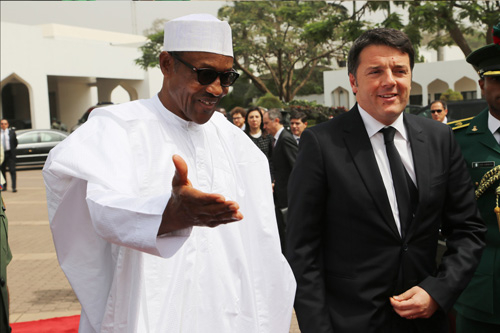
The Nigerian and Italian government on Monday in Abuja signed an agreement on intelligence sharing, capacity building and provision of logistics that will enhance the operations of the Nigeria Police.
The signing of agreement, witnessed by President Muhammadu Buhari and the Italian Prime Minister, Mr. Matteo Renzi, in the State House was part of bilateral meeting between the two countries which covered issues on energy, security, agriculture, immigration, human and drug trafficking, infrastructure and education.
The agreement on enhancing cooperation between the Nigerian and Italian Police was signed by the Inspector General of Police, Solomon Arase and the Italian National Police Chief, Alessandro Pansa.
Speaking at the bilateral meeting, President Buhari said he was impressed with the relationship between Nigeria and Italy over the years, especially in the areas of security, construction, oil and gas and the exploration of solid minerals.
‘‘I am impressed by the resilience and commitment of the Italian business to Nigeria’s development shown by the Italian construction companies and companies in the oil sector.
‘‘I am happy to hear that an Italian oil company, Eni ltd, is investing 4 billion U S dollars in the coming three years in the economy spite of the downward spiral of oil prices,’’ the President said.
In his remarks, the Italian Prime Minister said his country will support Nigeria in the ongoing fight against corruption, terrorism and also encourage Italian companies to invest more in sectors that will enable growth and create jobs for Nigerians like power, agriculture and solid minerals.
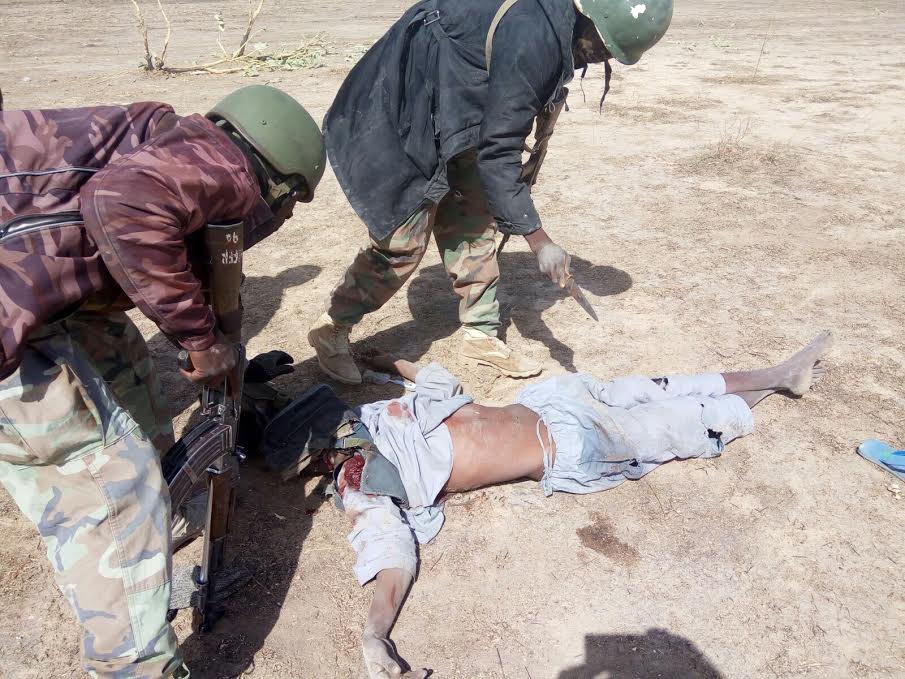
Troops on Monday carried out an offensive and rescue operation around Mafa, Dikwa and Kala area of Borno State.
The areas were regularly terrorised by members of the Boko Haram sect.
The intervention of the military saw over 500 persons, mainly women and children being rescued.
The raid also led to the killing of about 50 Boko Haram fighters, while some weapons were equally recovered.
On Tuesday, the Nigerian Civil Aviation Authority (NCAA) said that it received a total of 7,328 complaints from both domestic and international air passengers in 2015.
This is contained in a statement issued by the NCAA’s Consumers Protection Department.
The statement said 7,281 complaints were received from passengers flying international routes while 47 were received from passengers on domestic routes.
According to the statement, Turkish Airlines recorded the highest number of complaints with 1,960 cases, while Air France recorded 1,113 complaints.
This was followed by British Airways and Etihad which recorded 988 and 677 complaints respectively.
It stated that 4,376 of such cases were successfully resolved with compensation paid by airlines to the affected passengers during the period under review.
Speaking on the statement, the General Manager, Public Relations, NCAA, Mr Sam Adurogboye, said the regulatory agency was committed toward the protection of the rights of passengers.
Adurogboye explained that complaints such as short landing (delay in arrival of passenger’s luggage), was a normal occurrence in civil aviation globally, and if such cases occured, passengers should report to the airlines counter at the airport and also demand compensation as the law demands but should repirt to the NCAA if their demands were not met rather than take laws into their hands.
Adurogboye, therefore, advised passengers to desist from taking the law into their hands, adding that it was a very wrong approach to redressing their complaints.
The acquisition of Visafone by MTN has been approved by the Nigerian Communications Commission in order to save Nigeria’s Code Division Multiple Access (CDMA) networks.
NCC’s Executive Vice Chairman, Professor Umar Danbatta said this in Abuja. According to him, the NCC plans to sustain its revival effort on moribund CDMA networks to secure the investments in the sector.
He added that about 2.5 million jobs have been created by the telecoms sector over the years. He estimates that the sector contributed 9.5% to the GDP in 2014.
Former Minister of Education, Oby Ezekwesili on Monday charged President Muhammadu Buhari to always tell Nigerians the truth when it comes to insurgency so as to stop creating doubts in the minds of the citizenry.
Ezekwesili who is the leader of the BringBackOurGirls, BBOG, movement made the call at the group’s usual sit-out in Abuja.
Ezekwesili said, “The government cannot afford to go to the old ways where lies were fed to the people. Let there be truthfulness. Government should not create a trust deficit syndrome because it will be difficult to mend. Everything that the government is doing concerning the war, they should tell the truth. We will get used to it and join in the solution.”
Stating that BBOG will continue to demand for the return of the kidnapped Chibok girls, Ezekwesili beckoned on the President to fulfill the promise he made to the parents of the kidnapped girls.
Lagos state Governor, Gov. Akinwunmi Ambode has ordered sand dredgers operating in waterways in the state to stop their operations and vacate the sites immediately.
Mr Ade Akinsanya, the Commissioner for Waterfront and Infrastructure, relayed the governor’s order at a closed door meeting he held on Monday with the dredgers from Ebute-Ilaje in Alausa, Ikeja.
“He also ordered the dredgers in Ebute-Ilaje to evacuate their dredging equipment from the environment within 72 hours.
“The idea is to ensure adequate security of lives and property in the state.
“Dredgers in the state need to renew their operational permit annually, but majority of them have not renewed their permit for many years.
“The state government and the National Inland Waterways Authority are the licensing authorities to give directive on such operation on the waterways’’.
Commenting, Mr Kazeem Adesola, the Chairman of Ebute-Ilaje Dredgers Association, appealed to the governor to reconsider the decision.
Adesola said that there were lots of challenges involved in the relocation of the dredging equipment. “We are ready to obey the state government’s directive, but we will face a lot of constraints moving our equipment away from the place.
“In fact, 200 men will find it difficult to carry one of the dredging machines and we have over 100 operating machines. “Each of those machines costs N550, 000 and they are seven feet in height,’’ he said.
The order followed an uproar between two communities in Bariga area of the state, Folarin and Ebute-Ilaje over dredging sites. With the development, the government said it was out to check the activities of hoodlums in the area.
FCMB Group Plc (FCMB) has recorded an increase revenue of N109.3 billion for the nine-months ended September 2015, an increase of two per cent from N106.7 billion for the same period in 2014. The bank also recorded a profit before tax (PBT) of N2.6 billion for the period, as against N16.8 billion for the nine-months of 2014.
FCMB’s net interest income for the period ended September 2014 stood at N48.7 billion, as against N49.1 billion for the same period prior year. Operating expenses was up three per cent Year-on-Year (YoY) to N50.5 billion, for the nine-months ended September 2015, compared to N48.9 billion for the same period the previous year- a slower growth rate than inflation rate, underscoring FCMB’s successful cost saving initiatives.
Total assets was up 12 per cent YoY to N1.17 trillion as at September 2015 compared to N1.04 trillion as at September 2014, but flat Year-to-Date. First City Monument Bank Limited, the commercial and retail banking subsidiary of FCMB Group Plc, also increases loans and advances to its customers to N568.0 billion as at September 2015, as against N565.0 billion the previous year.
According to the managing director of FCMB Group Plc, Mr Peter Obaseki said, “The group’s nine months’ profit before tax, dropped YoY to N2.6 billion, with the significant earnings drop largely coming from our commercial banking activities. This was caused by a specific impairment of N5.4 billion on a contracted receivable with a reputable and creditworthy going concern, that we are hopeful of recovering and additional impairments of N6 billion on our loan book.
Irrespective of a weak macroeconomic environment, the priority in the coming months will be on cost efficiency – especially cost of risk – capital preservation, loan and receivable recoveries and sustaining the momentum in our retail banking activities.”
The Vice President, Yemi Osinbajo stated that Nieria has all it needs to develop and sustain a solid economy, saying that the dwindling oil prices will not affect the country. He promised to facilitate pre-investment approvals for would be investors to the country.
According to Prof. Osinbajo, the President has already given the mandate to ensure that a conducive environment is created for business investments in the country, and he added that work has already started with government looking at the different aspects involved.
He revealed that the entire power value chain would be well compensated in order to produce the needed results.
He also restated the commitment of the Buhari administration to creating jobs through businesses and direct action of the government to engage the youths. He said the 500,000 teaching positions for unemployed graduates is also included in the 2016 budget to help engae the youths in paid voluntary occupations in their communities.
However, the Federal Government will also create opportunity for about 370,000 youths who are not graduates to receive vocational training and acquire skills, while one million artisans and market women would receive soft loans through the Bank of Industry as already proposed in the proposed 2016 budget.