






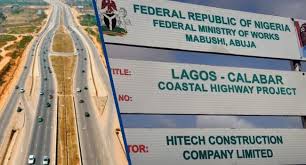
The euphoria that marked the commissioning of the first phase of the Lagos-Calabar Coastal Highway is beginning to wane, as the newly inaugurated 30-kilometre stretch remains inaccessible to motorists more than a week after its launch.
On Saturday, May 31, 2025, President Bola Ahmed Tinubu, flanked by political dignitaries, industry leaders, and stakeholders, officially commissioned Section 1, Phase 1 of the ambitious project at an elaborate ceremony. The highway, which stretches from Ahmadu Bello Way to Eleko Village, was hailed as a cornerstone of Tinubu’s infrastructure agenda and a symbol of national integration and economic advancement.
However, despite the high-profile inauguration, the road remains closed to general traffic. A construction worker at the site, who spoke on condition of anonymity, confirmed that ongoing works—particularly around the Dangote Refinery axis and near Eko Ekate—have necessitated the closure for safety reasons.
“Some parts, especially where a bridge is under construction, are not yet completed. The road is technically motorable, but it’s dangerous to open it while workers are still on site. Some drivers speed carelessly even near construction zones,” the worker said.
He added that on Sunday, June 9, the road was temporarily opened between 9 a.m. and 1 p.m., primarily for dispatch riders, who were observed using the route for deliveries.
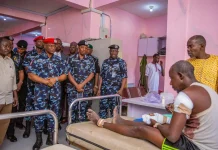
The situation has sparked public confusion and criticism. During the inauguration of the Lekki Deep Seaport Access Road last week, soldiers were reportedly deployed to prevent motorists from accessing the newly commissioned highway, fueling speculation and reigniting concerns about the project’s transparency.
“Why commission a road that isn’t ready for use?” the anonymous worker questioned. “Why the rush? Maybe someone just wanted to shine. It would have made more sense to wait until everything was complete.”
Despite the delay, the worker assured that the road would be fully opened before the end of June. He attributed the pace of work to the use of concrete pavement, which he said enables faster and more durable construction compared to asphalt. “We’re even replacing the initial asphalt layer with concrete. Once opened, people will enjoy it. Travel time from Victoria Island to Abraham Adesanya is now under 30 minutes, compared to nearly two hours via the old route,” he noted.
The Lagos-Calabar Coastal Highway is a 750-kilometre project traversing nine states—Lagos, Ogun, Ondo, Delta, Bayelsa, Rivers, Akwa Ibom, Cross River, and potentially Edo—designed as a six-lane carriageway across a 60-metre corridor. Its strategic intent is to enhance regional integration and unlock economic opportunities across the coastal corridor.
Yet, from inception, the highway has been mired in controversy. Critics have raised concerns over the staggering N15 trillion project cost, alleged bypassing of environmental and social impact assessments (ESIA), absence of transparent bidding processes, and the government’s disregard for ongoing litigation.
Minister of Works David Umahi confirmed last year that at least six lawsuits had been filed against the project but insisted they would not delay execution. Just days ago, a faction of the Yoruba socio-political group, Afenifere, called on the National Assembly to initiate impeachment proceedings against President Tinubu, citing a conflict of interest.
Oba Oladipo Olaitan, the group’s leader, accused Tinubu of impropriety for publicly acknowledging his partnership with Gilbert Chagoury, owner of Hitech Construction Company—the firm handling the project. “There is a clear conflict of interest when the President openly refers to the contractor as a partner,” Olaitan argued.
At the commissioning, President Tinubu praised Hitech and described the project as “a symbol of courage and commitment.”
Still, federal authorities remain optimistic. In March, Minister Umahi projected that Phase 1 of the highway would be completed by January 2026. “This is an exceptionally well-designed project,” he said, noting that the road’s concrete pavement exceeds the specified thickness of 275mm, reaching 280mm in some sections.
While the government pushes forward with its ambitious agenda, questions around process, timing, and accountability continue to cast shadows over one of Nigeria’s most consequential infrastructure undertakings in recent history.