










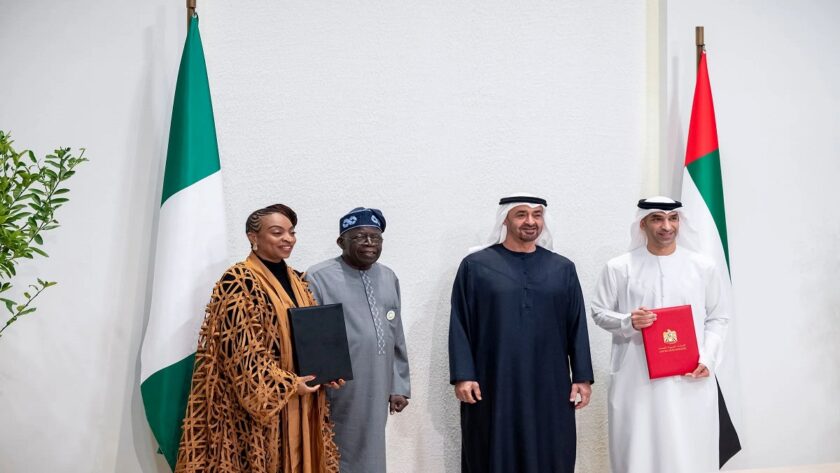
Nigeria has taken a major step toward expanding its global trade footprint following the signing of a Comprehensive Economic Partnership Agreement (CEPA) with the United Arab Emirates, a deal that removes tariffs on thousands of goods traded between both countries.
The agreement, signed in January 2026 during the Abu Dhabi Sustainability Week, is expected to significantly deepen economic ties between Africa’s largest economy and one of the Middle East’s most influential commercial hubs.
Speaking to journalists in Abuja, Rep. Sam Onuigbo, a member of the Governing Board of the North East Development Commission, described the CEPA as a defining moment in Nigeria’s international trade strategy. According to him, the agreement reached in Abu Dhabi represents a structural shift in how Nigeria positions itself within global supply chains.
Under the terms of the deal, the UAE will eliminate tariffs on 7,315 Nigerian products. Of this number, 2,805 items—accounting for 38.3 percent—will enjoy immediate duty-free access into the Emirati market, while tariffs on the remaining products will be phased out over a three- to five-year period. The coverage spans a wide range of agricultural produce and industrial goods.
In a reciprocal arrangement, Nigeria has also removed tariffs on 6,243 products imported from the UAE, creating what stakeholders describe as a balanced framework designed to encourage bilateral trade, investment flows, and industrial collaboration.
Onuigbo, who previously represented the Ikwuano/Umuahia North and South Federal Constituency in the House of Representatives and chaired the Committee on Climate Change during the 8th Assembly, noted that the agreement opens new mobility and business opportunities for Nigerian entrepreneurs.
According to him, verified Nigerian business owners will now find it easier to establish offices in the UAE, operate for up to three months, and return home, a development expected to improve skills transfer, trade facilitation, and international exposure for Nigerian firms.
He praised President Bola Tinubu for driving the agreement, noting that it aligns with the administration’s broader economic reform agenda aimed at repositioning Nigeria as a competitive investment destination, expanding employment opportunities, and improving overall economic confidence.
Onuigbo also highlighted Nigeria’s renewed emphasis on climate and energy policy during the Abu Dhabi meetings, pointing to the unveiling of Nigeria’s carbon market framework as another major milestone.
With a population approaching 250 million, Nigeria continues to grapple with energy supply constraints that have historically slowed industrial growth. He said the government’s recent policy actions—including the Energy Transition Plan, the Climate Change Act, and the Electricity Act signed shortly after President Tinubu assumed office in 2023—underscore the urgency of addressing power deficits as a foundation for sustainable industrialisation.
He added that Nigeria’s active participation at the Abu Dhabi summit strengthens international collaboration on climate action while unlocking economic opportunities that could help drive growth in 2026 and beyond.










 with the United Arab Emirates, a deal that removes tariffs on thousands of goods traded between both countries.)