









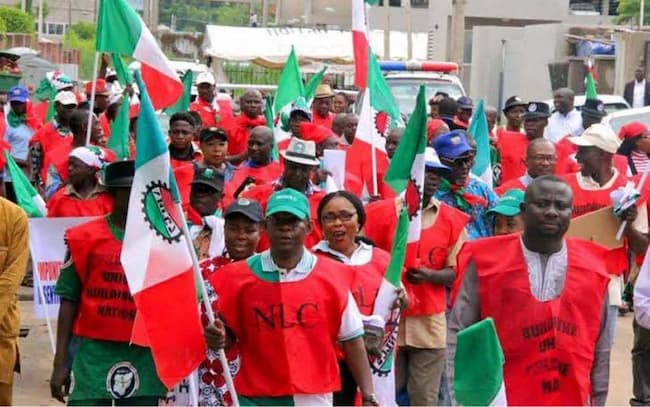
Nigeria Labour Congress (NLC) and federal civil servants have called on the Federal Government to urgently review Nigeria’s national minimum wage, insisting that the current ₦70,000 benchmark is no longer sufficient to sustain workers in the face of rising inflation and skyrocketing living costs.
The demand comes after several state governments, including Lagos, Rivers, and Imo, approved higher wages for their workers, setting new precedents that have reignited national debate.
President Bola Tinubu had signed the ₦70,000 minimum wage bill into law in July 2024, raising it from ₦30,000. However, union leaders argue that the adjustment has been overtaken by inflationary pressures.
In recent months, some states have moved ahead of the federal government. Imo State, under Governor Hope Uzodinma, raised the minimum wage to ₦104,000 in August 2025, while Lagos State currently pays ₦85,000 with a planned increment to ₦100,000 in 2025. Other states including Rivers, Bayelsa, Niger, Enugu, and Akwa Ibom have approved ₦80,000, while Ogun and Delta implemented ₦77,000.
Benson Upah, Acting General Secretary of the Nigeria Labour Congress (NLC), said the ₦70,000 wage has been eroded by inflation, leaving many workers struggling to meet basic needs. “₦70,000 is simply not sustainable under today’s economic realities,” he stressed, warning that labour may resort to industrial action if government fails to act.
Shehu Mohammed, President of the Association of Senior Civil Servants of Nigeria (ASCSN), commended states that have reviewed wages upward, saying their actions should serve as a signal to the federal government. He noted that labour initially proposed ₦250,000 as a living wage during negotiations, adding that current realities demand a higher review.
Workers interviewed expressed frustration at the harsh economy. They cited transportation costs, housing, food inflation, and electricity tariffs as major pressures making survival on ₦70,000 nearly impossible.
Many urged the government to consider not just wage increases but also policies to lower living costs through affordable housing, subsidized transport, and accessible healthcare.
Labour leaders emphasized that wage adjustments should be seen as a tool for economic growth rather than a burden, noting that increased disposable income would stimulate demand and support local businesses.




 and federal civil servants have called on the Federal Government to urgently review Nigeria’s national minimum..)