








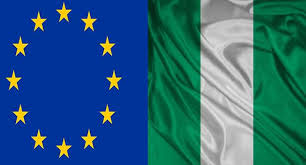
Nigeria and the European Union have entered into a landmark science and technology cooperation agreement, effectively reviving formal collaboration after more than two decades and laying the groundwork for expanded innovation and startup growth across Africa.
The agreement was executed in Abuja on Monday, with Ambassador Gautier Mignot, Head of the EU Delegation to Nigeria and ECOWAS, signing on behalf of the European Union. Nigeria’s Minister of Innovation, Science and Technology, Kingsley Udeh, signed for the Federal Government.
Speaking during the signing ceremony, Udeh described the pact as a defining moment for Nigeria’s scientific and technological trajectory, noting that it strategically positions the country as a continental hub for research, innovation and advanced technology development.
According to the minister, the agreement represents the first science-focused bilateral framework of its kind undertaken by the European Union in over 20 years, underscoring Nigeria’s rising profile within the global research ecosystem.
To prevent the framework from becoming dormant, Udeh disclosed that both parties have constituted a Joint EU-Nigeria Science and Technical Cooperation Committee. The committee will be responsible for ensuring implementation momentum, designing measurable programmes, and moving collaboration beyond declarative commitments into structured, results-driven execution.
He explained that the committee’s mandate goes beyond drafting conventional action plans and will instead focus on strategic coordination of direct and indirect scientific cooperation.
“The importance of this development is fully appreciated. It is not symbolic; it is operational,” the minister stated, adding that progress updates would be presented at the forthcoming ministerial engagement in Addis Ababa.
The agreement is expected to directly stimulate Nigeria’s already vibrant technology ecosystem, which has produced the majority of Africa’s unicorn startups—companies valued at over $1 billion. Government officials believe that structured international support under the EU framework will catalyse the emergence of additional high-value technology enterprises while strengthening research-commercialisation pipelines.
By integrating Nigerian innovation into broader European research platforms, policymakers aim to convert local ingenuity into tangible industrial output, job creation and macroeconomic growth.
Udeh further emphasised that the partnership aligns squarely with the Federal Government’s Renewed Hope Agenda, which prioritises science, innovation and technology as central pillars of national development and economic diversification.
Earlier, Mignot stated that although informal cooperation between Nigerian and European research institutions had continued over the years, the newly signed agreement provides a formal legal and political architecture to deepen and scale engagement.
He explained that institutionalising the relationship would increase visibility, unlock additional funding opportunities and accelerate joint research outcomes.
The EU envoy confirmed that the cooperation framework is anchored in Horizon Europe, widely regarded as the world’s largest science and innovation funding programme, with a financial envelope of nearly €100 billion.
He stressed that scientific research operates within a global ecosystem, and Nigeria’s research institutions and scholars should be integrated into large-scale collaborative initiatives under Horizon Europe to facilitate cross-border knowledge exchange.
According to him, the European Union recognises Nigeria as a significant centre of research excellence and technological innovation within Africa.
The agreement is structured to create pathways for joint research grants, academic exchange programmes, innovation financing mechanisms and institutional partnerships between universities and technology clusters across both regions.
With the pact now formalised, stakeholders expect measurable growth in collaborative patents, startup scaling initiatives, and industrial research output in the coming years.