










Key points
- Flood-related deaths drop from over 1,000 in 2024 to 241 in 2025.
- Number of affected persons declines significantly due to early warning systems and coordinated response.
- NEMA urges improved drainage management and community compliance ahead of 2026 flood season.
Main story
The National Emergency Management Agency (NEMA) has reported a significant reduction in flood-related casualties and displacement across Nigeria in 2025, attributing the improvement to proactive mitigation strategies and enhanced early warning systems.
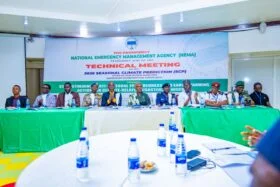
Assistant Director of Planning at NEMA, Dapo Akingboade, disclosed this in Abuja during an After-Action Review (AAR) of climate-related disasters in the country.
According to him, flood-related deaths dropped to 241 in 2025, compared to over 1,000 recorded in 2024. Similarly, the number of people affected declined from over five million to fewer than 500,000 within the same period.
He added that the number of displaced persons fell sharply from more than one million in 2024 to approximately 58,000 in 2025.
Akingboade also noted that 27 states and 128 local government areas were impacted by flooding in 2025, compared to 35 states affected in the previous year.
The issues
Despite the improvements, NEMA identified persistent challenges, including poor drainage systems, non-compliance by residents in high-risk areas and limited access to some communities during peak flooding.
The agency warned that these factors could undermine ongoing efforts if not addressed ahead of future flood seasons.
What’s being said
Akingboade attributed the improved outcomes to early dissemination of forecasts by the Nigerian Meteorological Agency (NiMet) and the translation of early warning messages into major local languages to reach grassroots communities.
“We were able to achieve this through collective responsibility and improved data coordination. Early release of the Seasonal Climate Prediction allowed us to conduct simulations and increase public awareness,” he said.
Also speaking, NiMet Assistant Chief Meteorologist, Abubakar Sadiq, said the agency achieved 74 per cent accuracy in rainfall predictions in 2025.
He explained that Nigeria is transitioning from a weak La Niña phase to neutral conditions in 2026, suggesting near-normal rainfall patterns across the country.
Sadiq added that collaboration between NiMet and the Nigeria Hydrological Services Agency (NIHSA) has improved flood and drought monitoring through the use of the Standardised Precipitation Index.
Earlier, NEMA Director of Planning, Research and Forecasting, Godwin Tepikor, said the review exercise was designed to draw lessons from past responses and strengthen future disaster management strategies.
What’s next
NEMA has called on state governments to operationalise local contingency plans and prioritise urban drainage management to mitigate flood risks in 2026.
The agency also emphasised the need for continued collaboration among stakeholders, including government institutions, security agencies and humanitarian organisations, to enhance national preparedness.
NiMet, on its part, is expected to improve forecasting accuracy through increased automation and data-driven modelling.
Bottom line
Improved forecasting, early warning systems and coordinated response efforts have significantly reduced flood-related casualties in Nigeria, but sustained investment in infrastructure and community compliance will be critical to maintaining progress in future flood seasons.








 has reported a significant reduction in flood-related casualties and ...)