





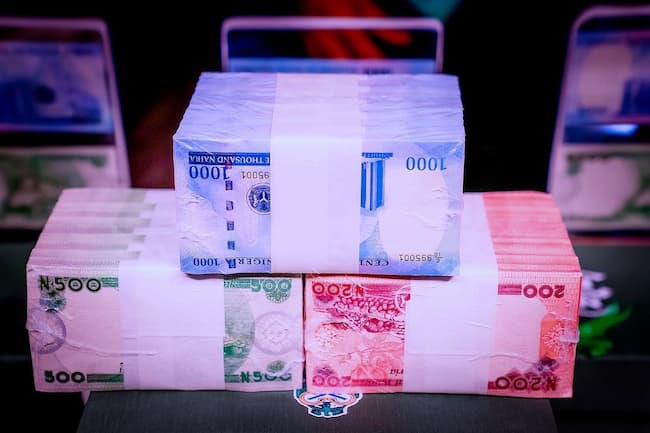
Nigeria’s foreign exchange market opened the week on a positive footing as the naira recorded gains across both the official and parallel segments, buoyed by improved dollar liquidity and a notable absence of aggressive foreign currency demand.
Market activity on Monday showed that dollar supply comfortably outweighed demand for foreign payments, easing pressure on the local currency. This dynamic played out across the Nigerian Foreign Exchange Market (NFEM) and the informal market, reinforcing broader confidence in the currency’s short-term outlook.
According to the latest data published by the Central Bank of Nigeria (CBN), the naira appreciated by 0.12 percent at the NFEM window to close at ₦1,421.46 per dollar. The appreciation was underpinned by fresh inflows from foreign portfolio investors, complemented by increased dollar supply from non-bank corporates operating within the official market.
Export-related inflows also contributed meaningfully to liquidity, with the apex bank maintaining close oversight of trading activities to ensure orderly market conditions. The movement in the spot exchange rate suggested that the foreign exchange market remained relatively calm, even as discussions about the naira’s valuation resurfaced among financial market participants.
Some currency traders and analysts continue to argue that the naira had been deeply undervalued in the previous year. Despite those concerns, the local currency closed last year with a cumulative appreciation of approximately 7.5 percent, marking its first full-year gain in over a decade.
The positive momentum extended to the parallel market, where the naira strengthened by 0.14 percent to trade around ₦1,464 per dollar. The improved pricing reflected stronger sentiment among dealers and reduced speculative pressure, mirroring developments in the regulated market.
Performance over the previous week had already signalled renewed resilience. The naira climbed to a midweek high of ₦1,418.26 per dollar at the NFEM before moderating slightly to ₦1,423.17 by the end of trading on Friday, translating to a week-on-week gain of 0.54 percent.
Looking ahead, analysts expect monetary authorities to prioritise stability rather than aggressive appreciation. In a market update, Coronation Merchant Bank’s research arm noted that the CBN is likely to focus on maintaining exchange rate stability through 2026, supported by disciplined policy implementation and prudent management of external reserves.
Meanwhile, developments in global commodity markets added another layer of complexity to investor sentiment. Crude oil prices moved higher after the United States halted certain supply routes to Cuba while signalling renewed scrutiny of Federal Reserve leadership, raising fresh questions around the policy rate trajectory heading into early 2026.
Brent crude climbed above $63 per barrel, while West Texas Intermediate traded above $59. Prices had already ended the previous week higher, supported by escalating geopolitical risks in key oil-producing regions.
Markets remained uneasy following political tensions in Venezuela, particularly after the reported capture of President Nicolás Maduro and announcements by the United States regarding tighter control of Venezuelan oil revenues. Speculation also grew over the potential release of crude volumes that had been stranded under sanctions, adding uncertainty to future supply dynamics.
At the same time, intensifying protests and civil unrest in Iran heightened fears of possible supply disruptions from one of the world’s major oil producers. These risks helped sustain oil’s upward momentum despite an already oversupplied global market.
By the end of the week, Brent crude settled at $62.99 per barrel, representing a weekly gain of approximately 3.62 percent. The benchmark is now tracking a year-to-date increase of about 3.52 percent, even as surplus supply continues to weigh on longer-term price expectations.
Market participants this week are expected to weigh abundant inventories and ongoing oversupply concerns against elevated geopolitical risk stemming from Venezuela and Iran. The interplay between these factors is likely to shape crude oil price movements in the days ahead.