






KEY POINTS:
- UN Secretary-General warns escalating Middle East conflict could destabilise the global economy and spiral beyond control.
- Humanitarian officials caution that disruptions to maritime routes may trigger food price hikes and global supply shocks.
- Fighting involving the United States, Israel and Iran intensifies, worsening displacement and humanitarian crises across the region.
MAIN STORY
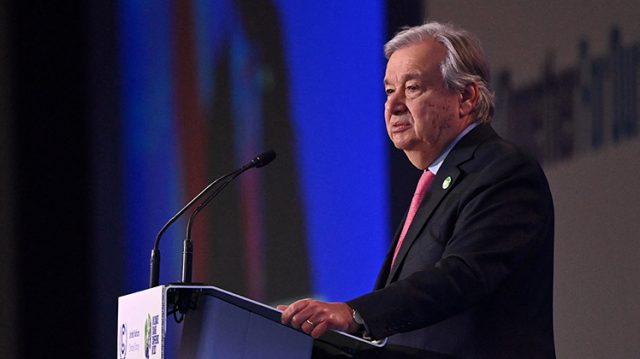
The Secretary-General of the United Nations, António Guterres, has warned that the escalating conflict in the Middle East poses a grave threat to the global economy and risks spiralling beyond control if hostilities continue.
In a statement released on Friday, Guterres said the ongoing military confrontation involving the United States, Israel and Iran had already inflicted severe suffering on civilians across the region.
He cautioned that the widening conflict, now entering its seventh day of sustained military strikes and counter-strikes, could generate far-reaching global consequences.
“All the unlawful attacks in the Middle East and beyond are causing tremendous suffering and harm to civilians throughout the region and pose a grave risk to the global economy, particularly to the most vulnerable people,” Guterres said.
“The situation could spiral beyond anyone’s control. It is time to stop the fighting and get to serious diplomatic negotiations. The stakes could not be higher.”
THE ISSUES
Senior UN humanitarian officials warn that the crisis could unleash cascading economic and humanitarian impacts worldwide.
Emergency Relief Coordinator Tom Fletcher told reporters at UN Headquarters in New York City that the world was entering “a moment of grave peril” as the conflict deepens.
He warned that vast financial resources were being channelled into military operations while humanitarian programmes in other crisis-affected regions remain critically underfunded.
Fletcher also cautioned that disruptions to major maritime routes could push up food prices, strain fragile health systems and complicate humanitarian operations across multiple regions.
“What we need is de-escalation and immediate cessation of hostilities, genuine dialogue and negotiations in line with the Charter of the United Nations,” he said.
Meanwhile, the United Nations High Commissioner for Refugees has declared the crisis a major humanitarian emergency requiring coordinated regional response.
The UN High Commissioner for Human Rights, Volker Türk, also warned that the conflict was expanding beyond the original parties and called for urgent international action to de-escalate tensions.
WHAT’S BEING SAID
The conflict is also threatening global trade and energy supplies.
According to Arsenio Dominguez, Secretary-General of the International Maritime Organization, maritime activity in the Strait of Hormuz — a key shipping route linking the Persian Gulf to global markets — has been severely disrupted.
The waterway carries roughly 20 per cent of the world’s oil supply.
Dominguez said the strait had effectively become unsafe for navigation after a tugboat assisting another vessel was struck on Friday morning, killing four seafarers.
He warned that nearly 3,000 vessels and about 20,000 seafarers are currently stranded in the region, raising concerns about global supply chains and energy markets.
Iran’s Permanent Representative to the UN, Amir Iravani, said Tehran did not seek further escalation but would defend its sovereignty.
“Iran does not seek war or escalation but Iran will never surrender its sovereignty,” he said, calling on the United Nations Security Council to take decisive action.
WHAT’S NEXT
Humanitarian conditions across the region continue to deteriorate.
In Lebanon, mass displacement is ongoing as civilians flee areas affected by airstrikes and evacuation orders.
In Gaza, UN officials say civilians remain exposed to continued bombardment and ground fighting, while humanitarian agencies struggle to deliver aid amid restricted border crossings.
UN spokesperson Stéphane Dujarric said the Kerem Shalom crossing remains open for limited humanitarian supplies, although other major crossings, including Rafah crossing, remain closed.
Medical evacuations, humanitarian staff rotations and civilian movements have largely been suspended.
Aid agencies are prioritising emergency healthcare, maternal services, trauma treatment and disease management amid dwindling fuel supplies.
BOTTOM LINE
As the Middle East conflict intensifies, the United Nations warns that the consequences may extend far beyond the region — threatening global energy supplies, humanitarian operations and the stability of the world economy — unless urgent diplomatic efforts halt the fighting.