






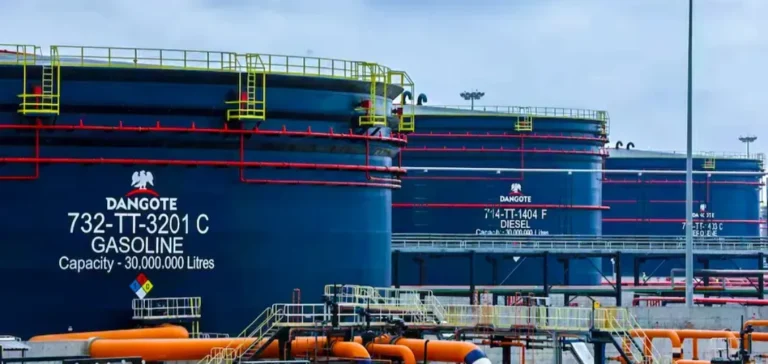
The Federal Government has reaffirmed its commitment to supporting the Dangote Refinery in achieving its target production capacity of 1.4 million barrels per day (mbpd).
Minister of State for Petroleum Resources (Oil), Heineken Lokpobiri, made this known during his opening remarks at the 19th Africa Downstream Energy Week in Lagos, themed “Energy Sustainability: Growth Beyond Boundaries and Competition.”
Lokpobiri described the refinery’s expansion as a defining moment for Africa’s energy independence and a validation of President Bola Tinubu’s reform-driven energy policies.
“The Dangote Refinery’s expansion to 1.4mbpd will not only transform Nigeria and West Africa but will impact the global energy landscape,” Lokpobiri said. “The Federal Government will support this vision all the way.”
He explained that the removal of fuel subsidy and liberalisation of the downstream petroleum sector were critical policy decisions that created a conducive environment for private investment.
“Without subsidy removal, the private sector would never have grown,” the minister noted. “Now we have a competitive market where prices are stable, availability has improved, and products are more accessible.”
Lokpobiri reiterated that energy transition must be approached with realism, adding that the global economy still depends heavily on hydrocarbons.
Quoting a recent United Nations report, he said the world needs an annual investment of $540 billion in oil and gas infrastructure to meet energy demand and ensure security.
“Africa, with a population of over 1.4 billion, cannot ignore oil and gas investments,” he stressed. “Expanding exploration and refining capacity is key to achieving energy security and economic stability.”
Also speaking, Adetunji Oyebanji, Chairman of the Advisory Board of OTL Africa Downstream Energy Week, emphasized the need for innovation, collaboration, and policy consistency to drive Africa’s energy transformation.
Oyebanji described the deregulation of Nigeria’s downstream petroleum sector as a turning point, adding that progress in logistics, digital trading, and storage efficiency reflects renewed investor confidence.
“Our ability to thrive depends not just on competition, but on cooperation,” he said. “The future of Africa’s energy lies in integration, where hydrocarbons, renewables, and innovation work together for sustainable growth.”




.)