







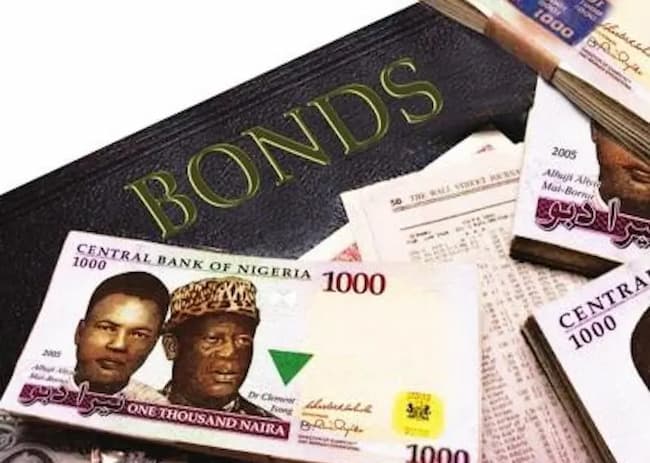
The Federal Government has signalled a sharper reliance on the domestic debt market, announcing plans to raise as much as ₦900bn from its January 2026 Federal Government of Nigeria (FGN) bond auction—double the ₦450bn targeted in January 2025—amid rising fiscal pressures and growing refinancing needs.
Offer documents released by the Debt Management Office (DMO) show that the January 2026 auction will comprise three reopened FGN bonds with a combined offer size of ₦900bn, representing a 100 per cent year-on-year increase in the size of the January issuance.
In contrast, the government adopted a more restrained borrowing posture in January 2025, offering ₦450bn across three maturities in the five-year, seven-year and 10-year segments. Specifically, it sought to raise ₦100bn from a five-year bond due April 2029 with a 19.30 per cent coupon, ₦150bn from a seven-year February 2031 bond carrying an 18.50 per cent coupon, and ₦200bn from a new 10-year January 2035 bond. The relatively modest offer reflected lower funding requirements at the time, despite elevated interest rates.
The January 2026 programme, however, underscores a stronger dependence on domestic borrowing. According to the DMO circular, the government plans to raise ₦300bn from a reopening of the 18.50 per cent FGN February 2031 bond, ₦400bn from a reopening of the 19.00 per cent FGN February 2034 bond, and ₦200bn from a reopening of the 22.60 per cent FGN January 2035 bond.
Beyond the larger headline figure, the composition of the offer points to a shift in borrowing strategy. Ten-year instruments account for ₦600bn—about two-thirds of the total auction—compared with ₦200bn in 10-year paper offered in January 2025. This tilt towards longer-dated securities suggests an effort to extend the government’s debt maturity profile and ease near-term refinancing risks.
Coupon rates on the 2026 bonds remain elevated, reflecting tight monetary conditions and investors’ demand for compensation against inflation and interest-rate uncertainty. Notably, the 22.60 per cent coupon on the January 2035 bond marks a significant increase from rates on comparable tenors a year earlier, highlighting the higher cost at which the government is now borrowing.
The DMO said the bonds would be issued at ₦1,000 per unit, with a minimum subscription of ₦50.001m. Interest will be paid semi-annually, with principal repaid in a single bullet payment at maturity. For reopened bonds, successful bidders will pay prices determined by the yield that clears the auction volume, in addition to accrued interest.
Despite the planned expansion of domestic borrowing, the Minister of Finance and Coordinating Minister of the Economy, Mr Wale Edun, said the Federal Government intends to reduce its dependence on debt by strengthening domestic resource mobilisation.
Speaking in an interview with Bloomberg Television on the sidelines of the World Economic Forum in Davos, Switzerland, on Tuesday, Edun said the focus was now on boosting revenue. “The issue now is to focus on revenue, focus on domestic resource mobilisation. We’re hoping to rely less on borrowing,” he said.
He added that while Nigeria could still access international capital markets if necessary, the government’s priority was to mobilise domestic resources, particularly through improved tax collection and broader fiscal reforms, as it seeks to strengthen fiscal sustainability amid mounting global economic pressures.