





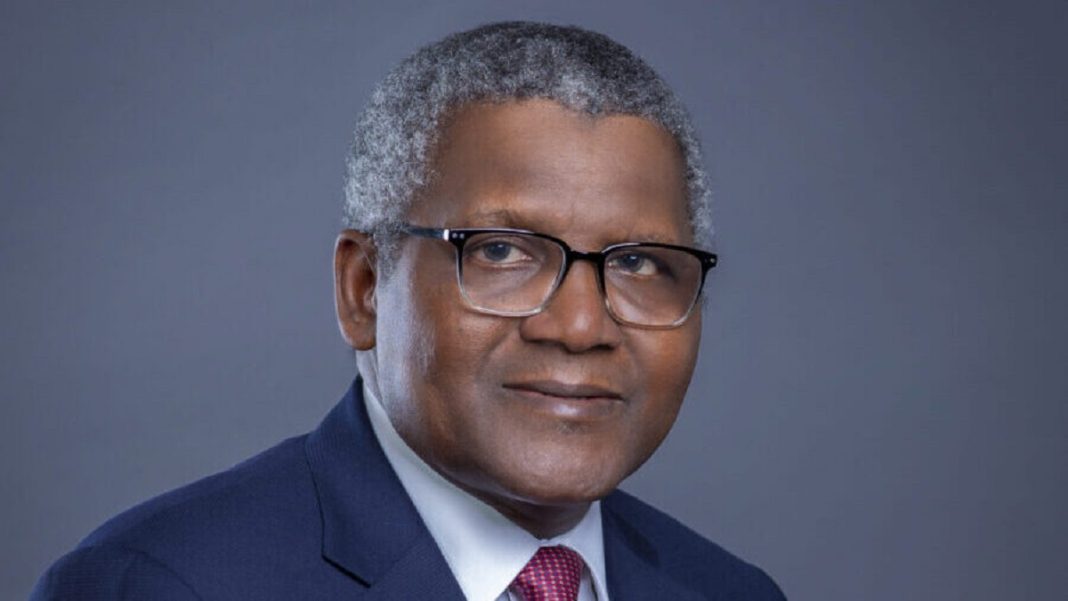
Tensions are rising in Nigeria’s oil sector as Africa’s richest man and President of the Dangote Group, Alhaji Aliko Dangote, has called on President Bola Tinubu to expand the ‘Nigeria First’ policy by banning the importation of refined petroleum products into the country. The proposal, however, has sparked immediate backlash from petroleum marketers and industry experts who warn it could trigger monopolistic practices and harm market competition.
Dangote made the appeal during the Global Commodity Insights Conference on West African Refined Fuel Markets, co-hosted by the Nigerian Midstream and Downstream Petroleum Regulatory Authority (NMDPRA) and S&P Global Insights. He argued that Nigeria’s continued dependence on imported fuel is crippling domestic refining efforts and discouraging investment.
“The Nigeria First policy announced by His Excellency, President Bola Tinubu, should apply to the petroleum product sector and all other sectors,” Dangote said. “We are now facing increased dumping of cheap, often toxic petroleum products, some of which are blended to substandard levels that would never be allowed in Europe or North America.”
Dangote claimed that heavily discounted fuel—some allegedly subsidised in Russia—was entering the Nigerian market at prices far below cost, undermining local refiners and distorting market stability. He warned that unless protected, Nigeria’s refining sector would be unable to survive.
“Due to price caps on Russian petroleum products, discounted fuel finds its way into Africa, severely undercutting our production. In Nigeria, this leads to fuel being sold as low as 60 cents—cheaper than Saudi Arabia,” he stated.
Despite denying that he was seeking a monopoly, Dangote said local investors needed protection similar to what producers in the U.S., Canada, and the EU receive.
“This is not about dominance or monopoly. Too many people with the means to invest in Nigeria prefer to sit on the sidelines and invest their wealth abroad while criticising local investors.”
To prove capacity, Dangote revealed that his $20 billion refinery has already exported over 1.35 billion litres of petrol in the last 50 days, effectively making Nigeria a net exporter of refined fuel.
“From early June to now, we have exported about 1 million tonnes of PMS. Nigeria is now a net exporter of refined products,” he said.
Marketers Push Back
The proposal, however, met strong opposition from independent petroleum marketers. National Publicity Secretary of the Independent Petroleum Marketers Association of Nigeria (IPMAN), Chinedu Ukadike, warned that banning fuel imports would stifle competition and trigger a monopoly in the downstream sector.
“We will depart from that request. If the government bans imports, it would spell doom. We will not be able to check inflation or monopoly since Dangote is the only refinery operating. Importation should continue even as we buy locally,” he argued.
Ukadike further countered Dangote’s claim that importation hurts local businesses.
“Importation won’t kill local refineries. Rather, it will challenge them to step up. We don’t support a ban at this point.”
President of the Petroleum Products Retail Outlet Owners Association of Nigeria (PETROAN), Billy Gillis-Harry, also rejected the idea.
“We are running a free economy. There’s no reason why any single company should dominate the entire downstream sector. Importation stabilises the market. Yes, some goods should be banned, but not refined petroleum products,” he said.
Expert Warns Against Monopolistic Risk
Energy law expert and professor at the University of Lagos, Professor Dayo Ayoade, also voiced strong opposition to the proposal, calling it economically and legally risky.
“We cannot have a legal ban on petroleum imports. That would give a monopoly to a private individual and pose a threat to energy security. International trade law does not favour outright bans, and we must tread carefully,” he cautioned.
He advised the government to focus instead on diversifying and liberalising the refining space.
“We need a broader product market base. Until then, banning imports is unwise. The market should determine price and supply naturally.”
Call for More Refineries
At the same event, Dangote urged regulators to revoke refinery licences from operators who have failed to build any infrastructure.
“You can’t obtain a licence and use it to decorate your house,” he said.
On this point, marketers agreed with the billionaire. IPMAN’s Ukadike said the country needs more operational refineries to meet local demand and scale up exports.
Meanwhile, Dangote is doubling down on expanding operations. He announced plans to ramp up refining capacity to 700,000 barrels per day by December 2025, up from the current 650,000 BPD.
In a related development, Dangote on Friday stepped down as Chairman of Dangote Cement to focus fully on managing the refinery, petrochemicals, and fertilizer business, as well as government relations.
The Dangote refinery is also set to commence a free fuel delivery scheme starting August 1. The initiative involves distributing petrol, diesel, and aviation fuel directly to filling stations and large consumers like telecom companies using 4,000 newly acquired CNG-powered trucks.