






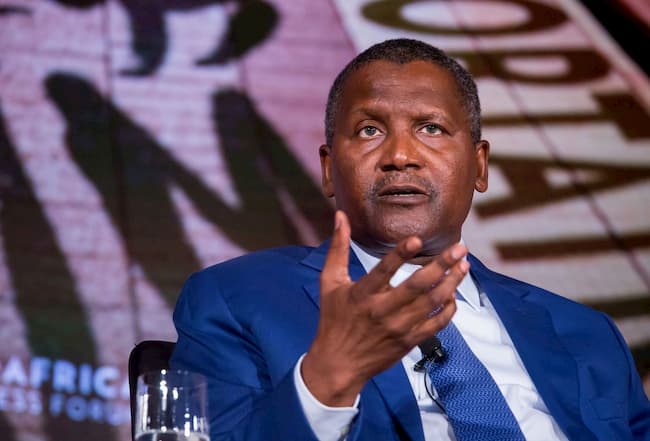
Africa’s richest man, Aliko Dangote, has revealed plans to expand the capacity of the Dangote Refinery from its current 650,000 barrels per day (bpd) to 1.4 million bpd, positioning it as the largest oil refining facility in the world.
In an interview with S&P Global, Dangote disclosed that the refinery aims to scale up production to 700,000 bpd by the end of this year, as part of broader efforts to enhance Africa’s energy independence and reduce reliance on imported fuel.
S&P Global reported that Dangote is pursuing Middle Eastern investment partnerships to support the expansion, which could make the Lagos-based refinery the world’s largest — surpassing India’s Jamnagar Refinery, currently at 1.36 million bpd.
The Dangote Refinery has already transformed Nigeria’s energy landscape, making the nation a net exporter of diesel and jet fuel, with large volumes of petrol now being produced locally.
Dangote acknowledged that building the refinery had been a “herculean task,” noting that duplicating such infrastructure elsewhere would be far more expensive. Engineers at the Lekki complex confirmed that the site was originally designed for expansion, with available space for an additional refining system.
Plans also include new projects in linear alkylbenzene and base oil production, alongside efforts to boost polypropylene capacity from 1 million metric tonnes to 1.5 million metric tonnes in the coming years.
Despite projections by the International Energy Agency (IEA) that the world will have excess refining capacity by 2030, Dangote remains firm on his vision to make Africa energy self-sufficient. He warned that without massive private sector investment, the continent risks deepening its dependence on imported petroleum products.
The refinery’s Vice President, Devakumar Edwin, confirmed that the facility’s residue fluid catalytic cracker (RFCC), which went offline in September after scheduled maintenance, resumed operations in early October and is expected to return to full capacity soon.
Dangote also announced plans to list 5–10% of the refinery’s shares on the Nigerian Stock Exchange within the next year as part of efforts to attract investors and diversify ownership. He noted that while the NNPC Limited currently holds a 7.2% stake, further discussions on additional equity participation would take place after the next growth phase.
“We want to demonstrate the refinery’s potential before expanding ownership,” Dangote stated, adding that the next maintenance shutdown will be carefully scheduled to avoid the year-end demand surge.






 to 1.4 million bpd, positioning it as the largest oil refining facility in the world.)