








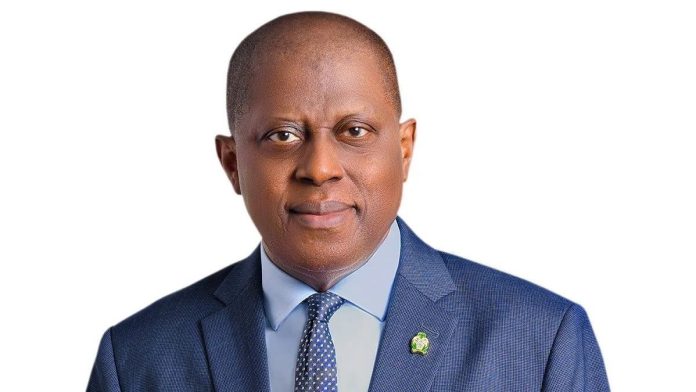
The Central Bank of Nigeria (CBN) has restated its commitment to achieving price and monetary stability through ongoing reforms and policy measures aimed at curbing inflation and supporting economic recovery.
Speaking at the CBN Fair held in Uyo, Akwa Ibom State, on Tuesday, the CBN Governor, Olayemi Cardoso, said several of the bank’s monetary interventions were beginning to yield positive results. He noted the gradual easing of inflationary pressures and improved stability in the foreign exchange market.
Cardoso, represented by the Acting Director of Corporate Communications, Hakama Ali, explained that the exchange rate unification policy had reduced market volatility and cleared over $7 billion in verified foreign exchange backlogs.
He also pointed out that the B-Match foreign exchange trading system had enhanced transparency and strengthened market confidence. Other initiatives, he said, include the ongoing recapitalisation of banks to boost financial system resilience, the introduction of the non-resident Bank Verification Number (BVN) to connect Nigerians abroad to domestic banking services, and the implementation of the Nigeria Payments System Vision 2028 to accelerate digital transformation and deepen financial inclusion.
According to him, the 75 per cent Cash Reserve Ratio (CRR) on non-Treasury Single Account (TSA) public sector deposits was also part of the bank’s strategy to enhance liquidity management and contain inflationary pressures.
“Some of our monetary policies have started yielding positive results. This can be seen in the steady ease of inflation and current stability in the foreign exchange market,” Cardoso said.
He also urged Nigerians to treat the naira with respect, cautioning against acts such as spraying, mutilating, or counterfeiting the national currency.
Earlier, the CBN Uyo Branch Controller, Njideka Nwabukwu, said the fair was aimed at sensitising the public to the bank’s policies and gathering feedback to improve service delivery.
She reaffirmed the CBN’s commitment to supporting Akwa Ibom State’s economic development through public enlightenment, financial literacy campaigns, and stakeholder engagement.
Meanwhile, the naira continued its upward trend last week, closing at ₦1,465/$ at the official market. The currency’s appreciation was attributed to weaker U.S. economic data that reduced dollar demand and stronger foreign exchange inflows that eased market pressure.
At the parallel market, the naira also appreciated by 3.8 per cent week-on-week to ₦1,460/$, narrowing the gap between the official and parallel market rates to ₦5.68/$1, compared to ₦34.34/$1 the previous week.
In a related development, data from the National Bureau of Statistics (NBS) showed that the Nigerian Railway Corporation generated ₦1.95 billion from passenger services in the first quarter of 2025.
According to the NBS Rail Transportation Data for Q1 2025, released on October 5, a total of 929,553 passengers travelled by rail during the period, marking a 37.65 per cent increase from 675,293 recorded in the same quarter of 2024.
The volume of goods and cargo transported also rose to 181,520 tons, up from 160,650 tons in Q1 2024. Revenue from goods and cargo amounted to ₦657.03 million, reflecting an 8.19 per cent increase from ₦607.32 million recorded a year earlier. Other receipts totalled ₦115.68 million, a 355.39 per cent rise from ₦25.40 million in Q1 2024.
The surge in rail transport activity and revenue has been linked to ongoing infrastructure investments, particularly the Lagos–Ibadan rail line, which has significantly boosted the sector’s performance since its launch in 2021.
The rail sector’s contribution to Nigeria’s Gross Domestic Product rose by 18.65 per cent in the first quarter of 2025, underscoring its growing role in the country’s economic growth.



 has restated its commitment to achieving price and monetary stability through ongoing reforms....)