









KEY POINTS
- The Manufacturers Association of Nigeria (MAN) will host its 2026 Manufacturers Energy Security and Energy Efficiency Summit on November 3 and 4 in Lagos
- MAN says energy accounts for about 40 per cent of manufacturing costs in Nigeria, compared with five to 10 per cent in some other African countries.
- The association wants electricity distributors held accountable for failing to meet promised supply hours under Band A and Band B tariffs.
- An Industrial Energy Cost Reduction and Adoption Programme will be launched by MAN during the summit
- The programme will promote rooftop solar, battery storage, gas-powered electricity and other options to reduce factory energy costs.
MAIN STORY
The Manufacturers Association of Nigeria (MAN) will host its 2026 Manufacturers Energy Security and Energy Efficiency Summit on November 3 and 4 in Lagos, bringing industrial chief executives, regulators, financiers and technology providers together to find ways of cutting factory energy costs.
The two-day summit, themed “Innovative Energy for Cost-Effective Smart Manufacturing with Structured Financing”, holds on November 3 and 4 at Legend Hotel Lagos Airport, Curio Collection by Hilton, Ikeja Free Zone, Lagos. It is organised by Manufacturers Power Development Company Ltd (MPDCL), a MAN subsidiary, in partnership with the German development agency GIZ and the Nigerian Energy Support Programme (NESP). Attendance is by invitation, for chief executives and other C-suite officers.
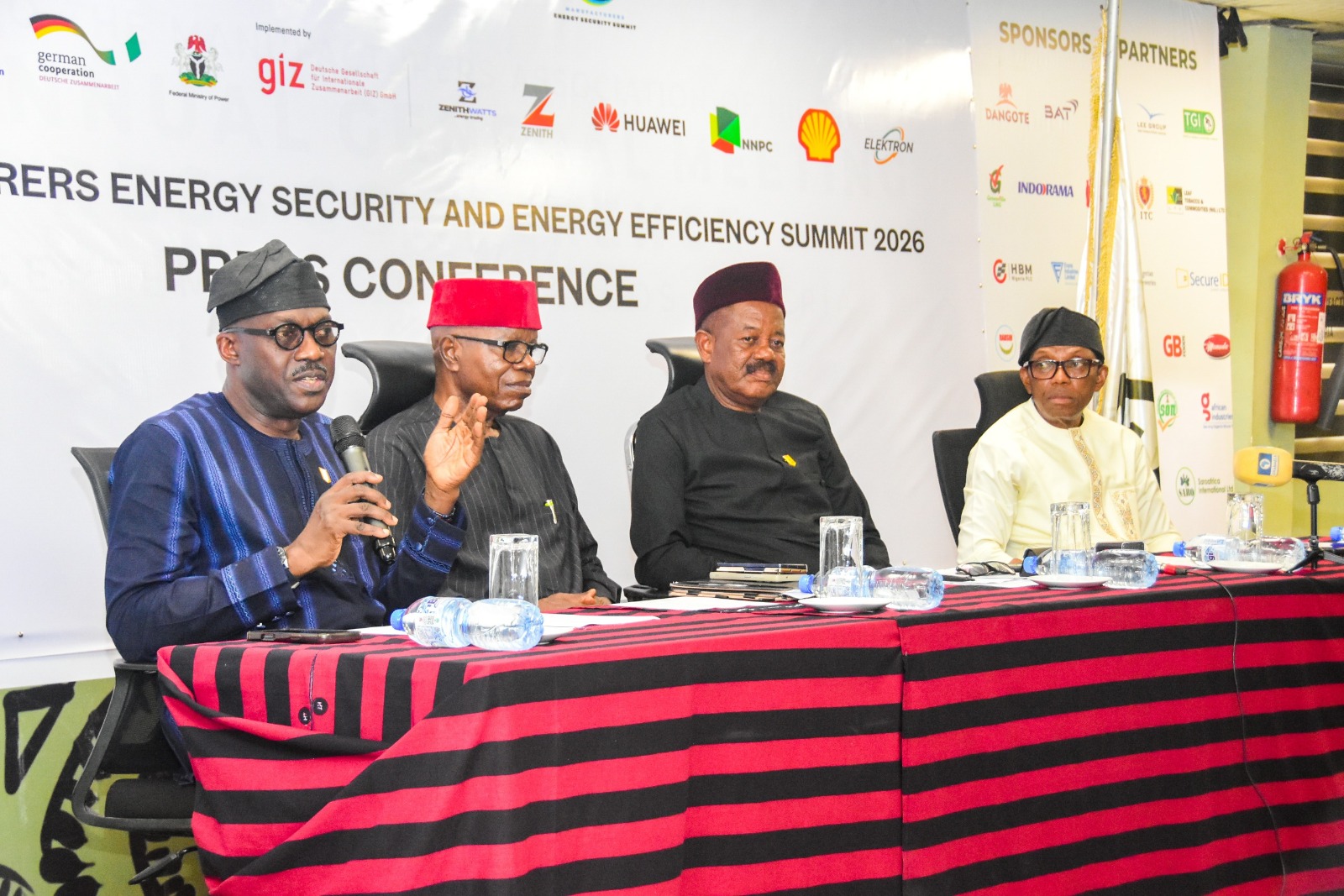
MAN announced the summit at a press conference at MAN House, Ikeja, on Monday, where manufacturers raised concerns about the cost of powering factories, the burden of switching energy sources and the effect of unreliable electricity on industrial competitiveness.
MAN President, Dr Ifeanyi Okoye, said electricity distribution companies must deliver the service promised under the Band A and Band B tariff classifications on guaranteed daily hours, e.g. at least 20 hours for Band A and 16 for Band B. He said some manufacturers classified under Band A were not receiving the promised hours of supply despite paying higher tariffs, and called on the government to hold distribution companies accountable and ensure adequate investment in the national grid.
MAN Director-General, Segun Ajayi-Kadir, said Nigeria’s manufacturing sector would struggle to compete with other African economies if energy kept taking a disproportionate share of production costs. He put energy at roughly 40 per cent of manufacturing costs in Nigeria, against between five and 10 per cent in some other African countries.
Chief John Aluya, Chairman of the Manufacturers Power Development Company Ltd (MPDCL), said distribution companies should be assessed on the electricity reaching customers’ premises rather than the supply delivered to substations. He cited faults along distribution lines and delays in repairing underground cables as factors affecting supply to industrial users.
The new programme is meant to speed up MAN’s campaign for decarbonisation and clean energy integration, starting with rooftop solar on factory roofs. It also covers battery energy storage systems, captive gas-to-power and green hydrogen, and will help manufacturers access carbon credits. Okoye said a case study already exists at Nkpor, Anambra State.
Oweh Mba Sam, Acting Managing Director of MPDCL, said the summit would focus on cutting industrial energy costs, tackling high gas prices and helping manufacturers adopt cost-effective technologies. He said it would bring together manufacturers, energy providers, financiers and technical experts to explore solutions, including solar power, battery storage and access to gas-powered equipment.
Mba Sam said manufacturers could use solar energy during daylight hours to reduce dependence on conventional electricity, while battery storage could sustain production when solar generation was unavailable. He added that organisers would engage oil and gas stakeholders on ways to make gas more affordable for industrial users.
The summit will also feature executive policy dialogues, technical masterclasses, an energy technology showcase, business-to-business matchmaking and structured financing sessions. Sessions will cover climate finance and carbon credits for industrial energy transitions, as well as state-level electricity markets, net-metering policies and decentralised power frameworks. An MPDCL-GIZ NESP award will go to a member of an Energy Efficiency Network.
On follow-up activities, Mba Sam said organisers intended to deepen their relationship with GIZ and expand a network encouraging manufacturers nationwide to adopt energy-efficient practices. Okoye said sustained engagement on energy management would help manufacturers control operating costs and improve profitability.
THE ISSUES
Energy costs affect how much manufacturers spend to produce goods and how much they must charge customers to remain in business. If a factory spends a large share of its operating budget on electricity and fuel, less money is available for equipment, workers, expansion and other business needs.
The comparison provided by MAN suggests that Nigerian manufacturers face a significant cost disadvantage in energy compared with manufacturers in some other African countries. However, the figures are estimates presented by the association, and the countries and manufacturing sectors covered by the comparison were not specified.
Unreliable electricity adds another burden. Manufacturers may have to pay for grid electricity while also operating generators or investing in alternative power systems. Where electricity supply falls below the hours promised under a tariff, businesses paying more for a higher service category may still need to spend additional money to keep production running.
The proposed programme could help manufacturers identify alternatives, but the cost of adopting them remains important. Solar panels, batteries and other equipment require upfront investment. Access to financing, the cost of maintenance and the ability of businesses to recover their investment through lower energy bills will influence how widely these options are adopted.
The programme’s impact will therefore depend not only on introducing new technologies but also on whether manufacturers can afford them, whether they deliver reliable power and whether improvements translate into lower production costs.
WHAT’S BEING SAID
- “electricity distribution companies must deliver the service promised under the Band A and Band B tariff classifications on guaranteed daily hours” – Dr Ifeanyi Okoye, MAN President, as reported in the source material.
- “Nigeria’s manufacturing sector would struggle to compete with other African economies if energy kept taking a disproportionate share of production costs.” – Segun Ajayi-Kadir, MAN Director-General,
- “distribution companies should be assessed on the electricity reaching customers’ premises rather than the supply delivered to substations.” – Chief John Aluya, MPDCL Chairman,
- “manufacturers could use solar energy during daylight hours to reduce dependence on conventional electricity, while battery storage could sustain production when solar generation was unavailable.” – Oweh Mba Sam, Acting Managing Director of MPDCL
WHAT’S NEXT
The immediate next step is the November 3 and 4 summit, where manufacturers, energy providers, financiers and technical experts are expected to discuss solutions to high energy costs and unreliable supply.
MAN also plans to deepen its relationship with GIZ and expand its Energy Efficiency Network to encourage wider adoption of energy-saving practices. The proposed programme’s progress will depend on the financing available to manufacturers, the practical results of the energy projects promoted and the extent to which businesses can reduce their total power costs.
BOTTOM LINE
MAN’s proposed programme aims to make energy more affordable and reliable for Nigerian manufacturers through alternative power sources, better financing and improved energy management. Its value will ultimately be measured by whether factories can cut their operating costs and produce goods more competitively.
Source: Information provided from MAN’s press conference on its 2026 Manufacturers Energy Security and Energy Efficiency Summit.




 will launch an Industrial Energy Cost Reduction and Adoption Programme ...)