








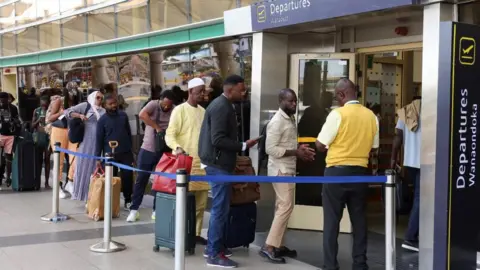
Operations at Jomo Kenyatta International Airport (JKIA) and other major Kenyan aerodromes have returned to normalcy following a high-stakes “return-to-work” agreement signed on Tuesday, February 17, 2026. The deal ended a grueling 48-hour industrial action by the Kenya Aviation Workers Union (KAWU) that had paralyzed East Africa’s busiest aviation hub, leaving thousands of passengers stranded and forcing dozens of flight cancellations.
Transport Cabinet Secretary Davis Chirchir led the emergency mediation, which brought together the Ministry of Labour, the Kenya Airports Authority (KAA), and the Kenya Civil Aviation Authority (KCAA) to break the deadlock.
The strike, which began at 6:00 a.m. on Monday, was triggered by long-standing grievances including stalled Collective Bargaining Agreements (CBA), poor working conditions, and the controversial use of temporary contracts for permanent roles.
During the two days of chaos, carriers like Kenya Airways and Jambojet reported departure delays of up to six hours, with some international flights diverted to neighboring countries. The sudden withdrawal of air traffic control services was the primary driver of the disruption, creating a significant backlog of passengers in terminals and on aircraft awaiting clearance.
Under the terms of the new settlement, the government has agreed to immediate concessions regarding staff representation. A key win for the union is the inclusion of KCAA employees in grades 4 and 5 within formal union representation, a demand that had been stalled for years.
For more complex issues like wage increases and contract conversions to permanent terms, the Ministry of Labour has established a structured conciliatory process that will begin immediately. Both parties have committed to a “roundtable dialogue” to prevent future disruptions while prioritizing national interests and tourism stability.
With the strike officially called off, KAA Acting CEO Dr. Mohamud Gedi confirmed that safety protocols remain uncompromised and that all airports are now clearing the backlog in a “structured and prioritized manner.”
Passengers are still encouraged to verify their flight statuses with their respective airlines as schedules may take up to 24 hours to fully stabilize. This resolution is seen as a critical step in restoring confidence in Kenya’s aviation sector, which remains a central pillar for regional trade and the country’s recovering tourism industry.












 and other major Kenyan aerodromes have returned to normalcy following a high-stakes "return-to-work" agreement signed on Tuesday, February 17, 2026. The deal ended a grueling 48-hour industrial action by the Kenya Aviation Workers Union (KAWU) that had paralyzed East Africa’s busiest aviation hub, leaving thousands of passengers stranded and forcing dozens of flight cancellations.)