










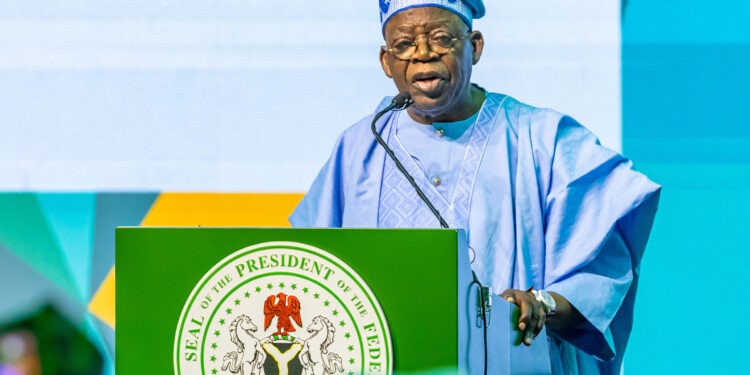
President Bola Tinubu has formally introduced Nigeria’s Industrial Policy 2025, directing all relevant Ministries, Departments and Agencies (MDAs) to prioritise swift and coordinated implementation of the new framework aimed at repositioning the country’s manufacturing and production landscape.
The policy was unveiled on Tuesday at the Bola Ahmed Tinubu International Conference Centre in Abuja. The event was presided over by Vice-President Kashim Shettima, who represented the President.

A Roadmap to Rebuild Nigeria’s Industrial Base
In his address, President Tinubu described the Industrial Policy 2025 as a comprehensive blueprint designed to overhaul Nigeria’s industrial architecture. He explained that the framework seeks to stimulate value creation across priority sectors, with an emphasis on boosting domestic production, strengthening competitiveness, and expanding employment opportunities.
According to the President, Nigeria’s industrial progress over the years has been constrained by structural weaknesses, including fragmented value chains, elevated production costs, persistent infrastructure deficits, regulatory inconsistency, and weak coordination between public institutions and private sector operators.
He stated that industrialisation requires deliberate execution rather than aspirational rhetoric, stressing that meaningful transformation depends on alignment across critical sectors such as energy, trade, infrastructure, finance, skills development, and innovation.
The President emphasised that collaboration between government institutions and private enterprises would be central to achieving the policy’s objectives.
Focus on Execution Over Documentation
Tinubu reiterated that his administration, upon assuming office in 2023, committed to redefining Nigeria’s industrial trajectory. He underscored that the success of the new policy would be judged by measurable outcomes rather than policy publications.
He said performance would be assessed by the number of operational factories, the scale of job creation for Nigerian youths, the volume of export-ready products shipped from Nigerian ports, and the degree of value retention within the domestic economy.
The Industrial Policy 2025 places strategic emphasis on sectors where Nigeria holds comparative and competitive advantages. It aims to deepen value chain development to ensure a gradual shift from exporting raw materials to manufacturing finished goods locally.
The framework also integrates micro, small, and medium enterprises (MSMEs) into mainstream industrial expansion, positioning them as critical drivers of inclusive growth.
In addition, the policy aligns infrastructure development and energy supply with industrial objectives, acknowledging that production efficiency depends on reliable power and logistics systems. It also prioritises skills acquisition, technology adoption, and innovation capacity to prepare Nigeria’s workforce for emerging industries.
Commendation for Policy Drivers
President Tinubu commended the Minister of State for Industry, Sen. John Enoh, for his leadership in steering the development of the policy. He noted that effective policy leadership requires discipline, coordination, and sustained follow-through.
The President also recognised the contributions of technical teams within the Ministry, as well as industry stakeholders, manufacturers, investors, and practitioners who participated in shaping the policy document.
Dangote Advocates Protection for Indigenous Industries
Speaking at the event, Chairman of Dangote Group, Aliko Dangote, expressed appreciation to the Federal Government for introducing what he described as a forward-looking industrial framework.
Dangote observed that Nigeria stands out in Africa as a country where private sector investment capacity exceeds that of government, highlighting the importance of aligning public policy with private capital.
He stated that local manufacturers have welcomed the new industrial direction under the Tinubu administration. Dangote further expressed optimism about currency stability, projecting that the naira could strengthen to ₦1,000 against the dollar within the year.
According to him, investor confidence in Nigeria has improved, driven by exchange rate reforms and broader macroeconomic adjustments. However, he cautioned that sustainable industrial growth requires deliberate protection of domestic industries.
He argued that without appropriate protective measures, local industries would struggle to compete, stressing that policy safeguards are essential to ensuring that Nigerian manufacturers can thrive.
Broader Economic Implications
The unveiling of Nigeria’s Industrial Policy 2025 signals a renewed commitment by the Federal Government to reposition manufacturing as a central pillar of economic diversification.
Analysts suggest that the success of the policy will depend largely on policy consistency, cross-ministerial coordination, infrastructure delivery, and sustained investor confidence.
If effectively executed, the framework could accelerate Nigeria’s transition from a resource-dependent economy to a production-driven industrial hub capable of competing regionally and globally.










 to prioritise swift and coordinated implementation of the new framework aimed at repositioning the country’s manufacturing and production landscape.)