








The Central Bank of Nigeria (CBN) has cautioned that persistent excess liquidity within the financial system, combined with expansionary election-cycle spending, poses a significant risk to Nigeria’s macroeconomic stability despite recent policy gains.
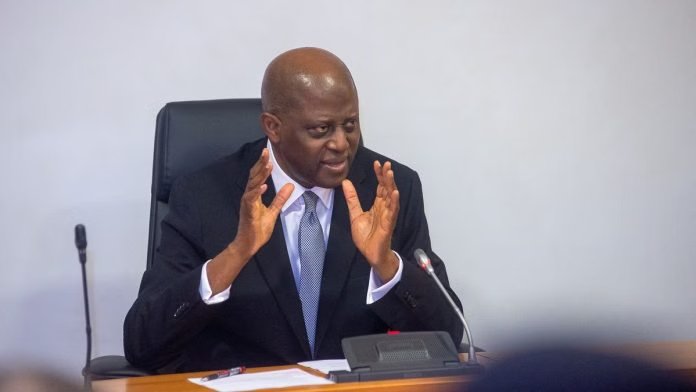
The warning was issued by CBN Governor Yemi Cardoso during the National Economic Council (NEC) conference held at the Presidential Villa on Tuesday, February 10, 2026. While improvements in exchange rate stability and tighter monetary conditions have begun to yield results, the apex bank stressed that Nigeria’s recovery remains fragile and vulnerable to policy reversals.
Liquidity Overhang Remains a Concern

According to the CBN, a substantial liquidity overhang continues to exert pressure on the financial system, heightening the risk of renewed inflation and currency volatility. The bank also warned that election periods historically inject large volumes of liquidity into the economy, often weakening monetary policy transmission and eroding reform gains.
As a result, safeguarding price stability will require disciplined liquidity management, stronger fiscal coordination, and sustained structural reforms, the bank said.
What the CBN Is Saying
Cardoso noted that Nigeria’s macroeconomic environment remains exposed to deep-rooted structural weaknesses that monetary tightening alone cannot resolve. He explained that while previous intervention measures helped stabilise markets, they also introduced long-term distortions that now complicate liquidity control.
“No central bank can sustainably deliver low and stable inflation on its own where structural drivers such as food supply shocks, high energy costs, and infrastructure deficits dominate price formation,” Cardoso said.
He disclosed that intervention programmes amounting to approximately ₦10.93 trillion provided temporary support to the economy but contributed to persistent structural imbalances. According to him, restoring macroeconomic stability requires a combination of liquidity discipline, fiscal alignment, and long-term reform implementation.
Structural Constraints on Monetary Policy
The CBN governor highlighted several factors limiting the effectiveness of monetary policy in Nigeria, including:
- Weak credit transmission mechanisms
- Shallow financial markets
- The large size of the informal economy
These structural issues, he said, reduce the speed and reach of policy adjustments, allowing inflationary pressures driven by supply-side constraints to dominate price formation.
He added that improved revenue mobilisation and more efficient public spending are essential to reinforce macroeconomic stability.
Role of Subnational Governments
Cardoso identified state governments as increasingly influential players in Nigeria’s macroeconomic framework. He noted that subnational governments now control roughly half of Federation Account revenues, giving them significant influence over liquidity conditions, inflation trends, and growth outcomes.
Higher revenues following recent reforms have expanded the macroeconomic impact of state-level fiscal decisions, while infrastructure investment at the subnational level could help ease structural inflation pressures. The CBN emphasised the need for sustainable borrowing frameworks and closer collaboration between state governments and the financial system to improve credit access, financial inclusion, and reform sustainability.
Why It Matters
The CBN’s warning underscores the delicate balance between stabilisation efforts and fiscal expansion during election cycles. With liquidity conditions still elevated, analysts say policy credibility will depend on coordinated fiscal restraint and disciplined monetary management.
- Excess liquidity raises inflation and exchange rate risks.
- Election-related spending can weaken monetary policy transmission.
- Structural cost pressures continue to limit the effectiveness of interest rate tools.
- Subnational fiscal behaviour now has system-wide implications.
What You Should Know
The CBN’s policy stance reflects a broader shift toward orthodox monetary management and stronger institutional coordination.
- Nigeria is transitioning toward an inflation-targeting framework.
- External reserves are increasingly supported by diaspora remittances and non-oil inflows.
- Banking sector recapitalisation is expected to strengthen long-term credit growth.
- Fiscal discipline and structural reforms remain central to durable price stability.
With reforms still unfolding, the apex bank maintains that Nigeria’s stability gains depend on disciplined liquidity control, coordinated fiscal policy, and sustained structural transformation.