






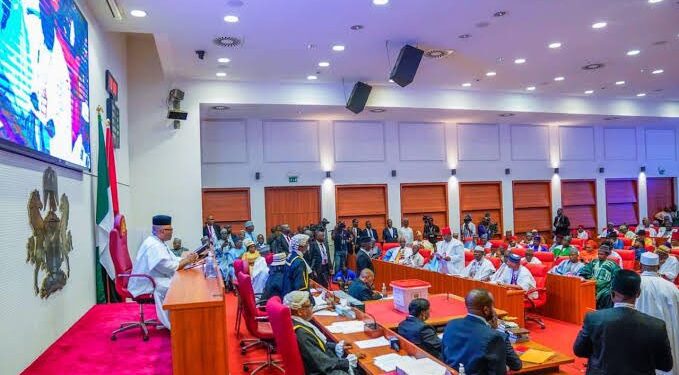
The House of Representatives has defended the delay in the passage of the Electoral Act Amendment Bill, attributing it to ongoing efforts to harmonise diverse views and produce a comprehensive reform framework that would strengthen Nigeria’s democratic process.
It also dismissed claims by Senator Ali Ndume that recently passed tax laws were falsified, describing the allegation as misleading and capable of undermining public confidence in the National Assembly. In a related development, the House Public Accounts Committee (PAC) has pledged to ensure the timely submission of outstanding audit reports by the Office of the Auditor-General for the Federation (OAuGF).

The clarification followed growing public concern over the delay in the final approval of the harmonised electoral reform bill, despite its passage by the House of Representatives. Speaking at the commissioning of road projects in Isaba and Oke-Ayedun, Ikole Local Government Area of Ekiti State, as well as a staff quarters at Odo-Oro High School, Odo Oro, the House spokesperson, Mr Akintunde Rotimi, urged Nigerians to exercise patience.
According to Rotimi, the delay was deliberate and aimed at ensuring that the final document reflects broad consensus and effectively addresses the weaknesses observed during the 2023 general elections.
“The Electoral Act Amendment Bill 2026 is designed to enhance transparency, credibility and efficiency in our electoral system,” he said. “Credible elections are the bedrock of democracy, and these reforms are intended to guarantee that Nigerians can vote freely and have confidence that their votes truly count.”
Rotimi, who represents Ikole/Oye Federal Constituency, also highlighted his legislative record, noting that he had sponsored more than 40 bills, many of which he described as progressive and landmark interventions.
Meanwhile, the Deputy Spokesperson of the House, Mr Philip Agbese, speaking to journalists in Abuja, rejected claims that the National Assembly tampered with provisions of the newly passed tax laws. He stressed that due legislative processes were strictly adhered to and that concerns raised had already been subjected to institutional review.
“It is wrong and misleading for anyone to suggest that the National Assembly altered, concealed or falsified provisions of the tax laws,” Agbese said. “Both chambers are committed to transparency, accountability and due process.”
He warned that such allegations could create unnecessary tension and erode public trust in the legislature, adding that the House had already constituted a committee to examine issues surrounding the tax legislation, rendering insinuations of a cover-up or legislative fraud unfounded.
“It is sheer mischief to suggest that the tax laws were falsified,” he added.
Agbese’s comments followed criticisms by Senator Ndume, who faulted Senate President Godswill Akpabio’s position that the new tax laws were free of inconsistencies.
Separately, the House Public Accounts Committee expressed concern over delays in the submission of audit reports, which it said had constrained its oversight responsibilities. Chairman of the committee, Mr Bamidele Salam, made the remarks at a retreat for committee members, staff and stakeholders held over the weekend in Ghana.
Salam disclosed that when the committee assumed office in 2023, it inherited a backlog of audit reports dating back to 2019, noting that reports for 2020, 2021 and 2022 had since been received.
“While this shows progress, it is still insufficient, considering that we are now in 2026,” he said. “We intend to convene a meeting with the Accountant-General, the Auditor-General, the Financial Reporting Council, and other stakeholders to agree on definite timelines for the submission of the 2023, 2024, and 2025 reports.”
He explained that the retreat provided an opportunity for reflection, performance review and agenda-setting for the committee in 2026, stressing that clear targets and performance indicators were essential to improving legislative productivity and accountability.