






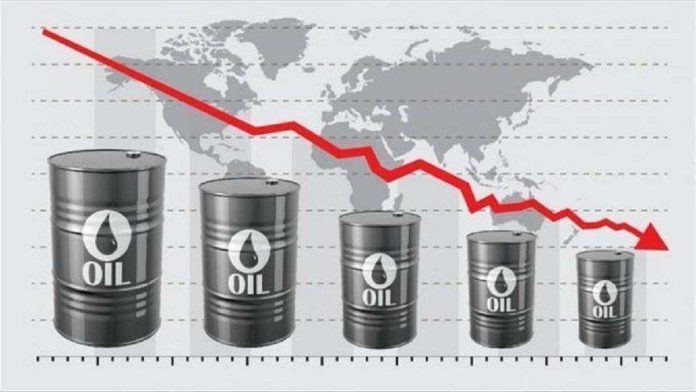
Global oil prices declined on Monday as fears of supply disruptions eased following reports that the United States had halted plans for potential military action against Iran.
Crude markets reacted to news that US President Donald Trump had abandoned proposed strikes on Iranian targets, significantly lowering geopolitical risk tied to Middle Eastern oil supply. The decision alleviated concerns that tensions could disrupt exports from one of the world’s most strategically sensitive energy regions.
Brent crude futures fell to $63.83 per barrel, down about 0.5% from last Friday’s close of $64.13. Meanwhile, US benchmark West Texas Intermediate (WTI) declined to $59.13 per barrel, compared with $59.44 at the end of last week.
According to Axios, the White House stepped back from the military option following a combination of diplomatic developments, operational challenges and resistance from key regional allies. A US official told the outlet that military action had been imminent, noting that forces were prepared to respond rapidly before plans were ultimately shelved.
Expectations of an impending operation had intensified after a high-level meeting earlier in the week, during which military options against Iranian infrastructure were reportedly narrowed. However, unresolved complications led to hesitation within the administration.
One of the key constraints cited was the redeployment of US military assets toward the Caribbean and Asia, leaving insufficient resources in the Middle East. Officials reportedly concluded that the region was not adequately prepared for a strike, limiting the feasibility of available options.
Diplomatic engagement also played a decisive role. A backchannel exchange between US envoy Steve Witkoff and Iranian Foreign Minister Abbas Araghchi reportedly contributed to de-escalation. In a message sent on Wednesday morning, Araghchi pledged to halt ongoing violence and suspend planned executions of protesters.
These developments significantly reduced market anxiety around potential supply disruptions from Iran, exerting downward pressure on crude prices.
Attention is also shifting toward developments in Venezuela’s oil sector. US markets were closed on Monday in observance of the Martin Luther King Jr. Day holiday, but investors continued to monitor Washington’s stance on Venezuelan energy assets.
US Energy Secretary Chris Wright said the administration is working to accelerate approval for an expanded production license for Chevron in Venezuela, according to reports. The move signals a potential recalibration of US policy toward Venezuelan oil output.
Fitch Ratings has cautioned that the geopolitical oil risk premium is likely to remain restrained, citing ample global supply that could offset uncertainty linked to Iran and Venezuela. The agency noted that any short-term disruptions from Iran would likely be absorbed by the market, while increases in Venezuelan production are expected to remain limited in the near term.