Nigeria’s currency recorded a broad-based recovery on Thursday as foreign exchange markets adjusted to expectations of stronger economic expansion driven by ongoing macroeconomic reforms and improving fundamentals.
Trading activity showed the naira touching an intraday low of ₦1,418 per dollar, reflecting a notable absence of heavy international payment pressures during the session. The local currency later climbed to an intraday high of ₦1,422 before settling stronger, according to the Central Bank of Nigeria’s daily foreign exchange update.
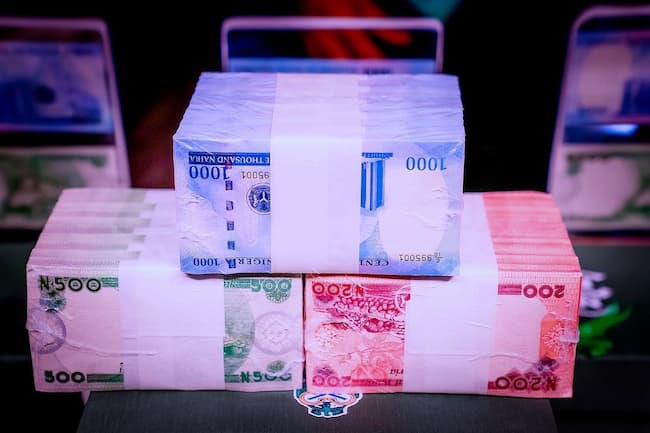
At the Nigerian Foreign Exchange Market (NFEM), the naira appreciated marginally at the official window, strengthening by 5 basis points, or ₦0.75, to close at ₦1,419.28 per dollar. Market participants attributed the movement to relatively improved dollar supply conditions, which helped contain demand pressures and kept the currency trading within a narrow range throughout the day.
Sentiment also improved across the informal market, where the naira advanced to ₦1,465 per dollar in the parallel segment. The synchronized gains across both regulated and unregulated FX markets underscored a cautiously optimistic outlook among currency users.
The renewed confidence follows fresh economic projections from the Central Bank of Nigeria and leading economists, who anticipate stronger gross domestic product growth and a moderation in inflation by 2026. These forecasts were discussed during a hybrid economic roundtable organised by the Chartered Institute of Bankers of Nigeria Centre for Financial Studies in collaboration with B. Adedipe Associates.
Speaking at the event, the CBN’s Deputy Governor for Economic Policy, Dr. Muhammad Abdullahi, disclosed that real GDP growth is projected to reach 4.49 percent in 2026, reflecting the cumulative impact of structural reforms and stabilising macroeconomic indicators.
International institutions have echoed similar optimism. The International Monetary Fund recently projected that Nigeria’s economy could expand by 4.2 percent in 2026, supported by improved oil output, enhanced security conditions, and sustained policy discipline.
Meanwhile, Nigeria’s external reserves rose by $42.88 million, lifting the total stock to $45.82 trillion. The increase was supported by inflows from multiple sources amid rising global crude oil prices earlier in the week.
Global markets, however, saw a reversal in oil prices on Thursday. Crude benchmarks fell sharply after U.S. President Donald Trump indicated that tensions surrounding protests in Iran were easing, reducing fears of potential military escalation and supply disruptions. Brent crude declined by more than 4.3 percent to around $63.60 per barrel, while U.S. West Texas Intermediate dropped by at least 4.5 percent to approximately $59.05.
Gold prices also retreated as stronger-than-expected U.S. dollar performance followed weaker weekly jobless claims data. President Trump’s more measured tone on Iran further reduced safe-haven demand for the precious metal. Spot gold eased by 11 basis points to $4,615.64 per ounce, while U.S. gold futures declined by 26 basis points to $4,623.76 per ounce.
Analysts expect cautious to mildly bearish trading conditions across commodity markets in the near term, with lingering geopolitical risks continuing to shape investor behaviour, while gold remains a fallback hedge against renewed uncertainty.