








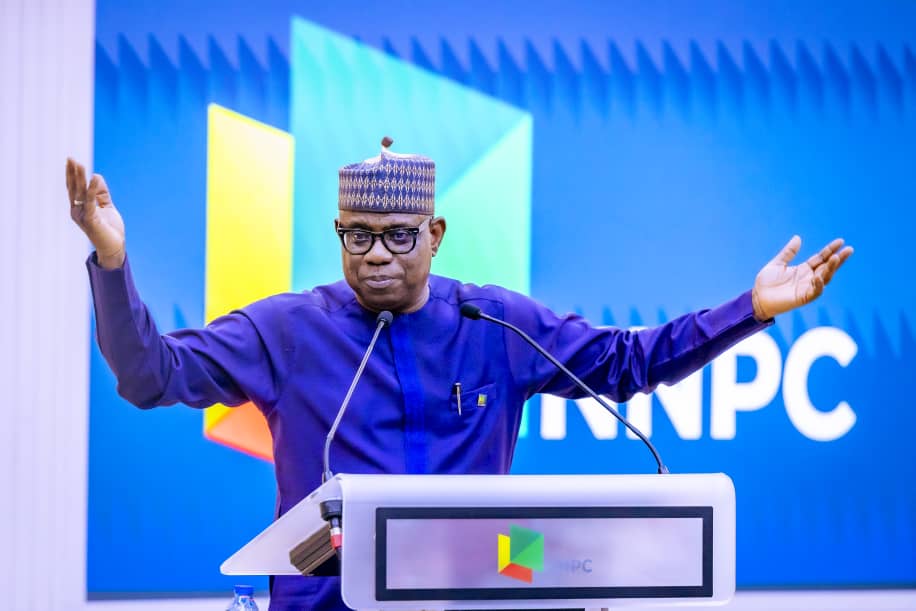
Nigeria’s ongoing fuel price rivalry will ultimately deliver relief to consumers, according to the Group Chief Executive Officer of the Nigerian National Petroleum Company Limited (NNPCL), Bayo Ojulari, who described the turbulence in the downstream sector as an inevitable phase of market transformation.
Ojulari said the sharp price movements currently being experienced are the direct result of Nigeria’s shift away from a fuel-import-dependent system toward domestic refining, a transition he believes will stabilise over time.
Speaking to journalists in Lagos after briefing President Bola Tinubu, the NNPCL chief said competition in a liberalised market naturally creates short-term friction but delivers long-term benefits.
“In any environment where there is genuine competition, the final winners are the buyers,” Ojulari said. “What we are seeing now is part of a major transition. There will be tension initially, but the market will find its balance.”
His comments come amid an aggressive price war in the downstream petroleum market that has seen pump prices tumble significantly within weeks. Petrol prices that exceeded N1,200 per litre in November 2024 fell to as low as N739 per litre at select retail stations by December 2025. The downward spiral has been driven by intensified competition between Dangote Refinery, NNPCL retail outlets, and independent marketers nationwide.
“At the end of this process, Nigerians at the grassroots level will be the real beneficiaries,” Ojulari stated.
NNPCL No Longer Sets Prices
Ojulari used the opportunity to clarify misconceptions about NNPCL’s role following the full implementation of the Petroleum Industry Act (PIA), stressing that the company no longer regulates prices or the petroleum market.
“The PIA fundamentally changed the structure of the industry,” he explained. “Before 2021, NNPC was responsible for both regulation and operations. That is no longer the case.”
Under the new framework, regulatory responsibilities are split between two agencies: the Nigerian Midstream and Downstream Petroleum Regulatory Authority (NMDPRA), which oversees midstream and downstream activities, and the Nigerian Upstream Petroleum Regulatory Commission (NUPRC), which handles upstream regulation.
“It is important Nigerians understand that post-PIA, NNPC is not a regulator. We are a commercial entity,” Ojulari said. He emphasised that NNPCL now operates strictly as a profit-driven company, competing with other players in a deregulated environment.
“We have been restructured to function as a commercial company. That means we must compete, raise financing independently, and operate profitably like any other business.”
Ojulari disclosed that NNPCL no longer receives direct allocations from the federation account, noting that the company now sources capital through commercial financing arrangements.
Dangote Refinery Changes Market Dynamics
Nigeria’s downstream sector has been reshaped since September 2024, when Dangote Refinery—Africa’s largest single-train refinery with a capacity of 650,000 barrels per day—commenced domestic petrol production.
Data from the National Bureau of Statistics shows that the average retail price of Premium Motor Spirit declined by N153 per litre between November 2024 and November 2025, falling from N1,214.17 to N1,061.35. Analysts attribute the reduction to improved supply conditions and heightened competition.
The competition escalated sharply in December 2025 after Dangote Refinery slashed its ex-depot price from N970 to N699 per litre, triggering immediate reactions across the market.
MRS filling stations, Dangote’s retail partner, began selling petrol at N739 per litre nationwide, while NNPCL retail outlets reduced prices from N875 to between N825 and N840 per litre, depending on location. Independent marketers followed suit, with some stations offering petrol for as low as N865 per litre.
Figures from Petroleumprice.ng indicate that Dangote Refinery adjusted its pricing more than 20 times in 2025 alone, underscoring the intensity of competition.
Marketers Under Pressure
The rapid price swings have created difficulties for marketers holding inventory purchased at higher prices, forcing them to choose between selling at a loss or losing customers.
The Marketers Association of Nigeria confirmed that price competition has become the dominant driver of customer loyalty. Its spokesperson, Chinedu Ukadike, said operators unwilling to adjust prices risk losing patronage while accumulating interest on bank loans used to finance stock purchases.
Ojulari described NNPCL as the “supplier of last resort,” noting that the company works closely with all major players, including Dangote Refinery, to ensure consistent product availability.
“Our priority is to increase production,” he said. “As production rises, refineries will have better access to feedstock, and downstream participants will have greater flexibility to compete effectively.” He acknowledged that the simultaneous operation of large-scale domestic refineries has disrupted existing market dynamics.
“When you introduce a refinery of Dangote’s scale into an environment where it did not exist before, and you combine that with the rehabilitation of NNPC refineries, the market will inevitably feel the impact,” he said.
“What matters is how we collectively navigate this phase.”
Ojulari described domestic refining as a strategic advantage for Nigeria, with the potential to supply West Africa and international markets.
“The reality is that having a major refinery within the country is a positive development. The challenge is ensuring that market forces stabilise in a way that allows all participants to operate sustainably.”
He added that NNPCL would defer competition-related oversight to the NMDPRA, noting that price discovery in a willing-buyer, willing-seller market is rarely smooth in its early stages.
From Import Dependence to Local Supply
Before Dangote Refinery’s entry, Nigeria relied almost entirely on imported petrol despite being Africa’s largest crude oil producer. NNPC dominated fuel imports and distribution under a subsidy-driven system.
President Tinubu’s removal of fuel subsidies in May 2023 triggered a surge in pump prices, which rose from about N195 per litre to over N1,030 per litre by October 2024, intensifying inflationary pressures already exceeding 30 per cent.
While the Federal Government attempted to revive the Port Harcourt refinery in November 2024, imports remained necessary until Dangote Refinery significantly ramped up production in late 2024 and early 2025.
Production Gains and Infrastructure Progress
Ojulari said he briefed President Tinubu on NNPCL’s production performance in 2025, revealing that crude oil output has increased from 1.5 million barrels per day last year to more than 1.7 million barrels per day.
“These improvements are the result of deep structural changes within the organisation,” he said. Gas production has also risen, climbing from 6.5 billion standard cubic feet per day to over 7 billion standard cubic feet daily.
NNPCL is targeting crude production of at least 1.8 million barrels per day in 2026, moving closer to the administration’s goal of reaching 2 million barrels per day by 2027 and attracting over $30bn in new investment by 2030. Ojulari also announced the completion of welding on the main line of the Ajaokuta-Kaduna-Kano (AKK) gas pipeline, including the long-delayed crossing of the River Niger.
“For years, crossing the River Niger was a major obstacle. Completing this main line means we can now proceed with connecting facilities along the route,” he said.
The 614-kilometre AKK pipeline is expected to deliver gas to northern Nigeria for power generation, fertiliser production, and industrial use when commissioned in early 2026.
“We believe we are now in a strong position to move fully into implementation,” Ojulari said.


, Bayo Ojulari, who described the turbulence in the downstream sector as an inevitable phase of market transformation.)