






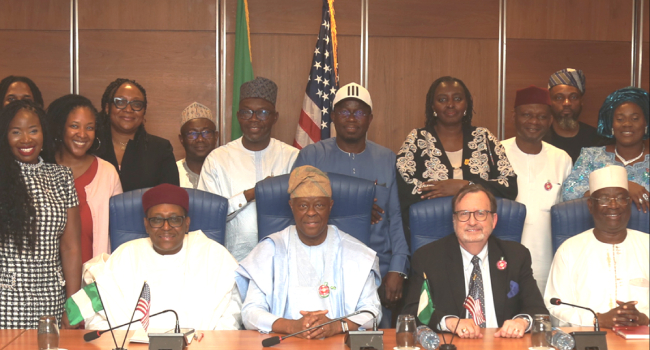
The Federal Government of Nigeria and the United States Government have signed a five-year, $5.1 billion Memorandum of Understanding (MoU) on bilateral health cooperation aimed at strengthening Nigeria’s health system and advancing the America First Global Health Strategy.
The agreement, signed on December 19, seeks to support resilient, self-reliant and sustainable health systems, while promoting accountability and shared responsibility between both countries.
Details of the partnership were disclosed in a statement titled “Strengthening U.S.-Nigerian Health Cooperation under the America First Global Health Strategy”, issued by the United States Mission in Nigeria on Sunday.
According to the statement, the United States plans to commit nearly $2.1 billion in health assistance over the five-year period, while the Government of Nigeria is expected to invest approximately $3.0 billion in new domestic health expenditures within the same timeframe.
The US Mission described the agreement as the largest co-investment made by any country under the America First Global Health Strategy, noting that it reflects Nigeria’s growing commitment to national ownership and financing of its health system.
Under the MoU, the United States will continue to support disease surveillance and outbreak response, laboratory systems, health commodities, frontline healthcare workers and health data systems. Nigeria continues to face major health challenges, including one of the world’s highest maternal and child mortality rates and an estimated 30 per cent of the global malaria burden.
The agreement is also expected to expand access to affordable preventive and curative services for HIV/AIDS, tuberculosis, malaria, polio, and maternal and child health, with the aim of improving health outcomes nationwide.
A key component of the MoU is its emphasis on Christian faith-based healthcare providers, which the US Mission described as critical to healthcare delivery in underserved communities. Nigeria has more than 900 faith-based clinics and hospitals, which collectively serve over 30 per cent of the country’s estimated 230 million population, particularly in areas with limited or no public health facilities.
The MoU earmarks about $200 million to strengthen these facilities, enhance workforce capacity and expand access to integrated services for HIV, TB, malaria, and maternal and child health. The statement noted that investments in faith-based health institutions are expected to complement public-sector services and reinforce Nigeria’s overall health infrastructure.
The US Mission added that the agreement was negotiated alongside reforms by the Nigerian government aimed at protecting Christian populations from extremist violence. It further noted that, as with all US foreign assistance, the US President and Secretary of State retain the authority to pause or terminate programmes that do not align with US national interests, stressing expectations for continued progress in addressing religiously motivated violence.
The agreement is the latest in a series of health cooperation MoUs signed across Africa this month, as the United States continues to pursue multi-year bilateral health agreements with partner countries.
Nigeria continues to grapple with a high burden of infectious diseases, including malaria, HIV/AIDS, tuberculosis, cholera and Lassa fever, alongside a rising incidence of non-communicable diseases such as cardiovascular conditions, diabetes and cancer. The challenges are compounded by weak health infrastructure, funding gaps, workforce shortages, poor sanitation, malnutrition and high out-of-pocket healthcare costs.
Meanwhile, the Federal Government says it is advancing health sector reforms to improve service delivery and outcomes. The Coordinating Minister of Health and Social Welfare, Prof. Muhammad Pate, recently acknowledged that funding constraints remain a major challenge but said the administration is scaling up investments in health infrastructure, human resources, vaccines and essential commodities as part of President Bola Tinubu’s Renewed Hope Agenda.