







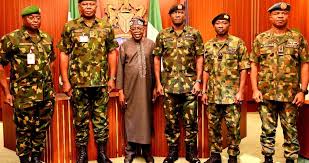
The Senate has confirmed Nigeria’s four new service chiefs following extensive screening sessions in Abuja, where each nominee presented comprehensive strategies aimed at building a smarter, self-reliant, and technology-driven military.
The confirmations came after President Bola Ahmed Tinubu, last week, forwarded the names of Lt-Gen Olufemi Oluyede (Chief of Defence Staff), Maj-Gen Waidi Shaibu (Chief of Army Staff), Rear Admiral Idi Abbas (Chief of Naval Staff), and Air Vice Marshal Sunday Aneke (Chief of Air Staff) to the Senate for approval.
During the screening, the nominees unveiled distinct yet complementary blueprints focused on local defence production, inter-service cooperation, troop welfare, and technological innovation as key drivers of national security reform.
Chief of Defence Staff, Lt-Gen Olufemi Oluyede, underscored the urgent need for Nigeria to invest in domestic military production, describing dependence on imported weapons as “unsustainable and economically draining.”
“No nation can claim true sovereignty without control over its defence production; we must develop the capacity to produce, equip, and defend the nation from within.” Oluyede stated. “
He also emphasised emerging threats such as cyber warfare, misinformation, and internal security lapses, stressing that the welfare of troops must reflect their sacrifices.
Chief of Army Staff, Maj-Gen Waidi Shaibu, pledged to modernise counter-terrorism and counter-insurgency operations through technology, intelligence gathering, and improved troop morale.
“The welfare of our soldiers is central to maintaining fighting power. We will prioritise living conditions, ensure prompt financial support, and expand access to quality healthcare and education.” He said.
Shaibu further committed to enhancing night-fighting capabilities, retraining special forces, and strengthening the Operation Safe Corridor (OPSC) programme for the rehabilitation of repentant insurgents, calling for a whole-of-society approach to sustainable peace.
Chief of Naval Staff, Rear Admiral Idi Abbas, ruled out the creation of a new Coast Guard, arguing that the Nigerian Navy’s constitutional mandate already covers coastal security and maritime defence.
“Resources should go into upgrading existing platforms and logistics, not creating parallel structures,” he said.
Abbas revealed plans to deploy drones, digital surveillance, and a new Special Operations Command in Makurdi to safeguard inland waterways and combat oil theft and piracy. He also stressed the importance of community engagement and coordination with civil and law enforcement agencies in maritime operations.
Air Power and Adaptive Warfare
Chief of Air Staff, Air Vice Marshal Sunday Aneke, emphasised the need for adaptability, intelligence, and innovation to stay ahead of contemporary threats.
“The enemy you are fighting went to school — he is as smart as you. Your greatest mistake is to think of him as ragtag,” he warned.
A seasoned pilot with over 4,300 flying hours and multiple advanced degrees, Aneke pledged to drive intelligence integration, cost efficiency, and joint operations among the armed forces.
“Security is not a solo effort,” he said. “The Air Force, Navy, and Army must operate as one cohesive unit.”
His agenda focuses on adaptive warfare, continuous training, and technological innovation to ensure the Nigerian Air Force remains agile and proactive against evolving security challenges.
Senate Commendation and Outlook
Senate President Godswill Akpabio commended the nominees for their professionalism, depth, and patriotism, describing their collective vision as one that reflects “a new generation of military leaders ready to defend Nigeria with intellect, innovation, and integrity.”
He noted that their shared priorities — self-reliance in defence production, technology-driven operations, troop welfare, and inter-agency synergy — align with President Tinubu’s broader national security reforms.
With their confirmation, the new service chiefs now face the task of transforming their ambitious visions into actionable strategies in a complex security environment marked by insurgency, cyber threats, oil theft, and resource constraints.
Their unified doctrine, however, signals a clear direction: to build a self-sufficient, well-equipped, and technologically superior Nigerian Armed Forces committed to protecting the nation with unity and innovation.