









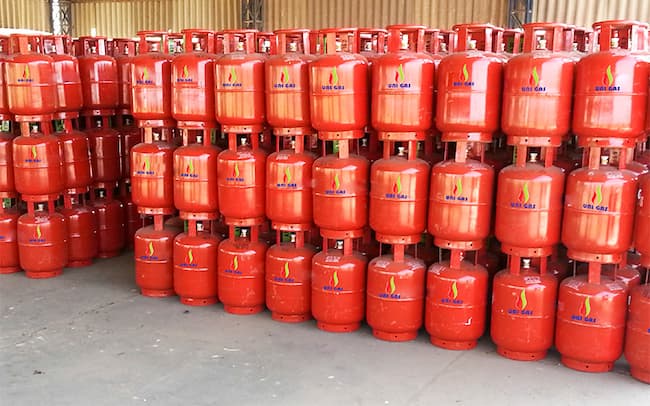
Ekperikpe Ekpo, the Minister of State for Petroleum Resources (Gas), has stepped in to address the ongoing shortage of liquefied petroleum gas, commonly referred to as cooking gas, vowing to take strong action against marketers involved in stockpiling or overcharging customers.
This comes amid grievances from retailers about the disparity between the rates provided by the Dangote refinery and the elevated amounts charged by intermediaries when selling to the broader market.
It’s worth noting that Aliko Dangote, the refinery’s head, had previously warned of potentially handling distribution directly if partners failed to help lower costs.
During a discussion with our reporter on Monday, Ayobami Olarinoye, who leads the Liquefied Petroleum Gas Retailers division of the Nigeria Union of Petroleum and Natural Gas Workers, revealed that the Dangote refinery offers LPG at N15.8 million for 20,000 metric tonnes to primary buyers and large distributors, who then pass it on to retailers at prices ranging from N18.4 million to N18.5 million for the same quantity.
Insiders at the Dangote refinery informed our reporter that “distributors collect the product from us at N715,000 per metric tonne, up to N790,000 per metric tonne.” They clarified that one metric tonne contains 1,000 kilograms.
“In terms of a metric tonne, that’s 1,000 kg. Distributors acquire LPG at N715 per kg directly from the plant.
We have no influence over end-user pricing. Based on the Petroleum Industry Act and guidelines from the Nigerian Midstream and Downstream Petroleum Regulatory Authority, price setting is a government function. Our control ends at the refinery gate. If they mark it up to N2,000 per kg after purchasing at N715 per kg, we’re powerless to intervene,” the insiders explained.
Recently, cooking gas costs have surged from around N1,000 per kilogram to as much as N2,000 per kg in certain areas. This spike coincided with the recent work stoppage by the Petroleum and Natural Gas Senior Staff Association of Nigeria amid tensions with the Dangote refinery.
Nearly two weeks following the end of the strike, cooking gas prices have remained elevated, with shortages persisting. In a statement released by his media aide, Louis Ibah, the minister voiced worries about the situation, calling for patience from the public and guaranteeing that conditions would stabilize by the following week.
He attributed the abrupt price jump to two key issues: the PENGASSAN labor action at the Dangote refinery and routine upkeep at the Nigeria LNG Train 4 plant.The minister elaborated that the PENGASSAN protest briefly stopped LPG shipments from Dangote, while the NLNG maintenance cut back on available gas supplies for local use.
These interruptions created a supply deficit, driving up prices due to mismatched demand and availability. Nevertheless, Ekpo highlighted progress, noting that activities at the Dangote refinery have restarted, with domestic LPG deliveries now in progress. He mentioned that the Bonny River Terminal, managed by Seplat Energy, has also begun shipments, and NLNG is ramping up to full capacity as repairs wrap up.
“These advancements should balance out domestic supplies by next week, paving the way for steady price drops,” the minister stated.
Ekpo emphasized that the LPG sector operates without price controls and encouraged all participants in the gas industry—marketers, distributors, and others—to act responsibly. He urged them to avoid stockpiling and to steer clear of profiteering at consumers’ expense.
“To enforce adherence, the minister has directed the Nigerian Midstream and Downstream Petroleum Regulatory Authority to ramp up oversight of LPG storage facilities nationwide, aiming to curb hoarding and other unethical behaviors that could aggravate the crisis,” the statement continued.
In his remarks, Olarinoye argued that hoarding wouldn’t occur if supplies were sufficient. “I maintain that the core issue is insufficient availability relative to consumer needs,” he asserted.
Although he supported any initiatives to boost LPG accessibility and affordability, he pointed out that retailers lack the means to hoard large volumes.
“What’s our storage limit to begin with? Regulations restrict the amount we can hold in one spot for safety reasons, which is why retailers often suffer first during supply disruptions in the chain. I’m speaking only for LPG retailers. Maybe authorities have intelligence indicating otherwise. From my perspective, the real problem is product scarcity,” he elaborated.
Additionally, the retailer recommended that the government investigate why key players have reduced purchases from NLNG since the Dangote refinery entered the scene.
“Authorities should explore why primary buyers and large firms aren’t sourcing from NLNG as before to support Dangote’s output. NLNG could offer competitive pricing, close to Dangote’s or with a minor gap that buyers can overlook. This might encourage more uptake,” he proposed.
Olarinoye called on the Federal Government to actively resolve the ongoing disputes between Dangote and labor groups to ensure reliable LPG production and supply.
“Over time, the government ought to push other approved private refineries to accelerate development, reducing dependence on one provider. Granting more licenses and overseeing construction starts is essential.
“The administration under Bola Tinubu must address the challenges plaguing the four idle state-owned refineries,” he recommended.
Previously, the Nigerian Association of Liquefied Petroleum Gas Marketers claimed that retailers were responsible for the recent cooking gas price escalation throughout the nation.
Oladapo Olatunbosun, NALPGAM’s National President, pointed fingers at gas retailers for the increases. On Channels Television, Olatunbosun linked the rises to brief supply interruptions and opportunistic practices by certain players. He maintained that no formal price adjustment had occurred for LPG, attributing the problem to profiteers capitalizing on gaps from the PENGASSAN action.
“As NALPGAM’s leader, I feel for Nigerians because this wasn’t our plan. Let me be clear: cooking gas prices haven’t officially risen. Some marketers are exploiting shortages and economic dynamics for fast gains, which we condemn as an organization,” Olatunbosun commented.
Yet, LPG retailers pushed back, labeling Olatunbosun’s statements as “unjust and ill-informed.” Our reporter remembers that LPG was available for as little as N950 per kg in some spots prior to the sharp increase after the PENGASSAN disruption.
As of Monday, reports from Nigerians indicate prices still hover at N2,000 in regions like Lagos and Ogun, with slight reductions in a few areas, though many retailers remain out of stock.
Worries persist that some households are reverting to traditional fuels like wood and coal for meal preparation. However, the gas minister assured that stability would return by next week.



, has stepped in to address the ongoing shortage of liquefied petroleum...)