








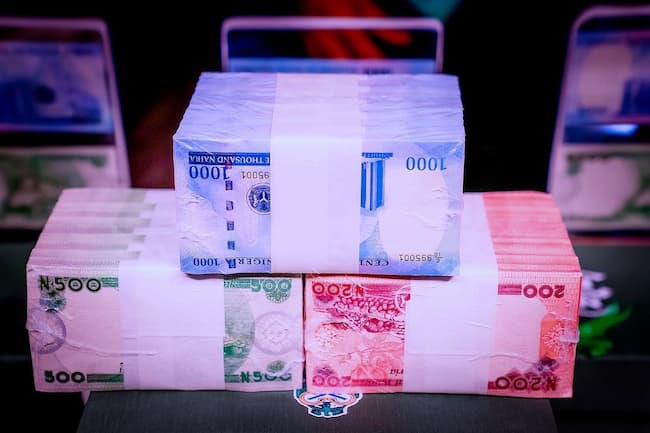
The Nigerian currency, the naira, extended its decline against the United States dollar at the official foreign exchange (FX) market midweek, following a $52 million intervention sale by the Central Bank of Nigeria (CBN).
The trading trend showed heightened demand for the greenback at the Investors’ and Exporters’ window, with CBN’s direct intervention helping to moderate volatility in the exchange rate. Analysts noted that participants in the official FX market remain largely dependent on dollar supply from the apex bank to meet eligible demand. However, limited inflows from exporters and the absence of open market operations to attract fresh foreign capital have left FX liquidity stretched.
According to the latest spot data from the CBN, the naira depreciated by 0.08 percent to close at ₦1,488.56 per U.S. dollar, signaling sustained pressure on the currency. In intraday trading, the exchange rate reached a high of ₦1,498 per dollar, weaker than the previous peak of ₦1,495. On the lower band, the naira touched ₦1,481 compared to ₦1,482.55 earlier, further highlighting the imbalance in dollar supply.
At the parallel market, the local currency also slipped, closing at an average of ₦1,518 per dollar, according to checks with traders.
In a research note, analysts at TrustBanc predicted that Nigeria’s foreign reserves could rise to $45 billion before the year ends, supported by crude oil inflows, diaspora remittances, and external borrowings. The firm disclosed that the nation’s reserves have already climbed to $42.14 billion, the highest level in six years, recovering from a low of $37.18 billion in July. This represents a 13 percent increase, boosting investor confidence in Nigeria’s debt cover and FX market stability.
However, the outlook for reserves will depend heavily on oil production levels, policy consistency, and steady foreign investment flows.
Meanwhile, in the global oil market, crude prices advanced as U.S. inventory data showed a surprise drawdown, alongside disruptions in exports from Iraq, Venezuela, and Russia. Brent crude futures rose by 94 cents, or 1.4 percent, to $68.57 per barrel, while West Texas Intermediate (WTI) crude gained 97 cents, or 1.5 percent, to settle at $64.38 per barrel.











 market midweek)